
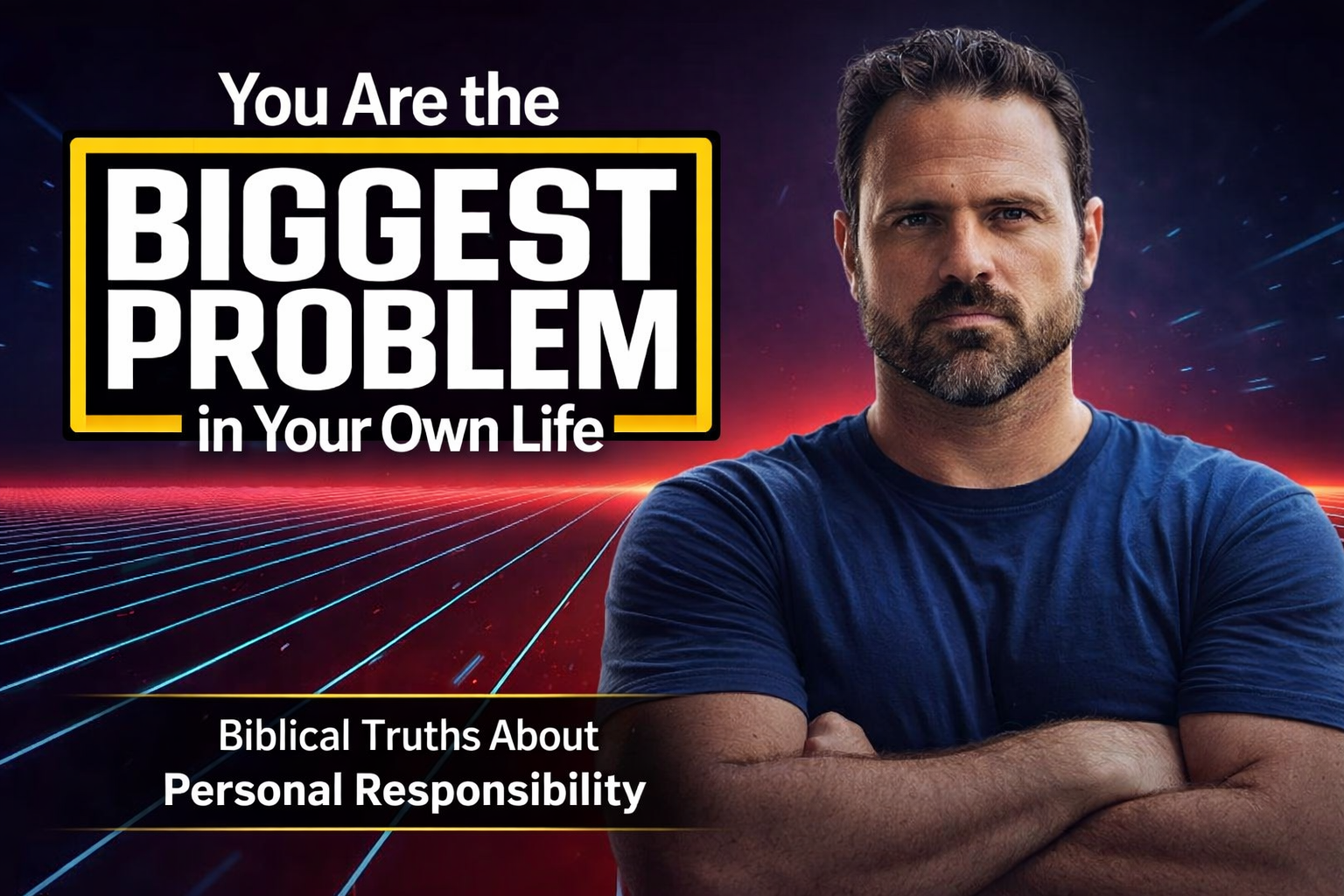
You Are the Biggest Problem
And That Is the Best News You Will Ever Hear
I am asked a version of this question almost every week.
What is the single biggest problem you help people overcome???
After decades of working as a psychologist, coaching business leaders, counseling marriages, and walking with men and women through both collapse and success, my answer has become remarkably consistent.
The biggest problem in a person’s life is always the person themselves.
Why you are your biggest problem? Good Question…
That is the answer I give to most people who ask me the first thing they can do to help themselves. It almost always begins with this realization. You are your own worst enemy when it comes to success, growth, healing, and forward momentum.
That sentence alone stops most people cold because it flies directly in the face of what we have been taught for years in school, in universities, and in modern culture.
We have been trained to blame others. Parents. Systems. Circumstances. Trauma. Authority. The economy. We are taught that if we can feel our pain deeply enough and hold onto it long enough, then someone else becomes responsible for fixing it, and somehow we are told this is supposed to make us happy. It still amazes me how deeply this idea has been embedded in people.
The problem is that this training causes us to get in our own way.
Over time, people become perpetual victims of their own lives. Blame becomes the default response. Blame feels justified. Blame feels explanatory. Blame provides a story that helps people make sense of their pain and confusion by insisting that their downfalls must be someone else’s fault.
After decades of working as a psychologist, coaching leaders, counseling marriages, and walking with men and women through both collapse and success, I can say this with clarity.
Blame is the wrong answer to getting ahead.
The right answer is far simpler, more confronting, and far more freeing.
It begins by asking yourself one honest question.
Now what?
No matter what happened to you.
No matter what you did to yourself.
No matter how unfair or painful or costly it was.
Now what are you going to do… NOW WHAT?
This mindset flies directly in the face of our cultural insistence that the person with the biggest, most unsolvable problem somehow wins moral authority. In real life, the person who wins is the one who takes responsibility and moves forward anyway.
That is why when people ask me what the biggest problem I help them overcome is, my answer never changes.
One hundred percent of the time, the biggest problem in a person’s life is the person themselves.
That truth irritates modern culture. It clashes with how many of us have been trained to think. Yet it remains one of the most freeing realizations a man or woman can ever face.
This truth exists to clarify responsibility.
It exists to restore agency.
It exists to reveal where real power actually lives.
Until a person understands this, progress remains fragile and dependent on circumstances that are always outside their control.
Why Human Beings Rarely Learn From Observation Alone
One of the most misunderstood aspects of human nature is the way people actually learn.
We like to believe that wisdom is primarily transferred through instruction, example, and warning, yet anyone who has spent time paying attention to human behavior knows that this is rarely how deep learning occurs. People watch others succeed and still take shortcuts. They watch others fail and still convince themselves they will be different. They listen to warnings and quietly assume that those warnings apply to someone else.
Growth usually comes through direct experience, particularly experiences that involve pain, loss, consequence, and responsibility. People learn when the cost becomes personal and unavoidable.
Carl Jung captured this dynamic when he wrote that until the unconscious is made conscious, it will direct a person’s life while being mistaken for fate. Scripture makes the same observation in different language, repeatedly pointing out that wisdom is formed through testing, endurance, and lived obedience rather than through passive observation.
This is not a flaw in human design. It is part of how responsibility is forged.
How Modern Culture Trains People to Externalize Blame
One of the most damaging developments of the modern educational and cultural environment is the way blame has been normalized, rewarded, and institutionalized.
From a young age, people are increasingly taught to interpret discomfort as injustice and difficulty as oppression. Parents become the explanation for adult dysfunction. Authority becomes the explanation for lack of discipline. Systems become the explanation for stalled progress. Language becomes the explanation for emotional fragility.
Over time, this produces a worldview in which the most socially protected position is the one with the greatest grievance.
Victimhood becomes identity.
The more unsolvable the problem appears, the more moral authority it seems to carry. The more permanent the wound, the more insulated a person becomes from responsibility.
The psychological cost of this worldview is enormous. When problems are framed as external and permanent, action feels pointless. When responsibility is removed, hope disappears. When hope disappears, meaning collapses.
A future imagined without agency always becomes bleak, regardless of how much comfort or affirmation is provided.
A Story From Real Clinical Work
Over the years, I have worked with many men whose lives looked stable from the outside yet felt profoundly stuck on the inside. One of those men was named Mark.
Mark was forty two years old and worked as a senior project manager for a commercial construction firm that specialized in large municipal projects. He was sharp, articulate, and well respected for his technical competence. He understood budgets, timelines, and systems, and he had built a reputation as someone who could keep complicated projects from going off the rails.
When Mark first came into my office, he was frustrated and tired in a way that went beyond simple burnout. He felt stalled professionally, disconnected in his marriage, and quietly resentful toward colleagues who he believed had advanced more quickly with less effort.
Mark had a story for why his life felt the way it did, and it was a story he had been refining for years. His parents’ divorce had created instability that he believed followed him into adulthood. A former supervisor had overlooked him for a promotion early in his career, which Mark experienced as a betrayal that set him back permanently. At home, he felt that his wife expected more emotional presence than he had energy to give after long workdays, which he interpreted as unfair pressure rather than as an invitation to lead differently.
None of these observations were fabricated. They were all partially true. What made them destructive was the way they functioned together to create a single, coherent narrative in which Mark was always reacting to forces acting upon him.
Over time, it became clear that Mark had learned to interpret difficulty as evidence that something external needed to change before he could fully engage his own capacity. When work became demanding, he retreated into frustration rather than stepping into challenge. When feedback felt uncomfortable, he categorized it as unfair rather than developmental. When his marriage required intentional leadership and presence, he framed the tension as exhaustion caused by others rather than as a responsibility he could grow into.
During one session, after listening to Mark explain yet another situation in which circumstances felt stacked against him, I asked him to slow down and consider a different frame.
I asked him what it might mean if every obstacle he resented was also evidence that he had survived something difficult without being destroyed by it.
That question landed differently than he expected.
For the first time, Mark began to see that his life was not defined by what had been done to him but by what he had already endured. His career had not crushed him. His marriage had not broken him. His past had not eliminated his future. He was still standing, still capable, still responsible.
What had truly limited Mark was not a lack of intelligence, opportunity, or resources. What had limited him was the story he told himself about blame and power.
As that story slowly changed, his behavior changed with it. He stopped waiting for fairness and started building competence. He took ownership of his preparation, his communication, and his discipline. He approached his marriage with intentionality rather than fatigue and began to lead rather than withdraw.
His external circumstances did not change first. His internal narrative changed first.
I have seen this pattern repeat itself for decades.
The story a person tells themselves about blame becomes the most powerful story of their life.
The Blame Story and the Illusion of Powerlessness
Stories shape behavior long before people realize they are living inside them.
When a person believes the world controls their outcomes, effort feels optional. When a person believes others determine their success, discipline feels unnecessary. When a person believes their past defines them, the future feels closed.
Albert Bandura’s work on self efficacy demonstrated repeatedly that belief in personal agency predicts success more reliably than talent, intelligence, or background. Scripture articulated this reality thousands of years earlier by pointing out that a person’s inner orientation shapes the entirety of their life.
Blame offers emotional relief while quietly removing power. Responsibility feels heavier at first, yet it is the only position from which growth can occur.
A Principle That Changes Everything
There is a principle I teach consistently because it reframes suffering in a way that restores strength.
A person cannot blame a circumstance, person, or event without also giving it credit.
Anything that attempted to destroy you and failed contributed to your endurance. Anything that attempted to stop you and failed strengthened your capacity. Anything that attempted to break you and failed revealed resilience that you may not yet fully understand.
You are still here.
That fact alone matters.
Scripture repeatedly frames suffering as a refining force rather than a disqualifying one, pointing out that endurance produces character and character produces hope.
Blame denies this process. Responsibility activates it.
Why Responsibility Creates an Unfair Advantage
When a person stops blaming the world and starts governing themselves, they gain an advantage that most people never experience.
While others wait for conditions to improve, they adapt. While others demand fairness, they develop strength. While others seek permission, they take responsibility.
Responsibility restores agency, agency restores dignity, and dignity restores hope.
This is not about self worship or pretending that pain did not happen. It is about placing power where it actually belongs.
Internal Resourcefulness Matters More Than External Resources
One of the most persistent myths people believe is that success depends primarily on external resources.
Money helps. Time helps. Connections help. Opportunity helps.
None of those things determine who rises when life becomes difficult.
History repeatedly shows that people rebuild from loss, trauma, and disadvantage when they develop internal resourcefulness, which includes discipline, adaptability, responsibility, and meaning.
Scripture reinforces this reality by emphasizing faithfulness with little, stewardship, and personal responsibility long before abundance ever arrives.
You Are the Problem and the Path Forward
God Is the Source
The message reaches maturity here.
You are the greatest obstacle you will ever face, and you are also a critical part of the solution.
Transformation does not come from self reliance alone. It comes from surrendered strength, alignment with truth, and responsibility before God.
When a person governs themselves under God, stability follows. When responsibility is accepted, clarity emerges. When the will is surrendered, strength multiplies.
The Freedom on the Other Side of Responsibility
Responsibility is often framed as heavy and restrictive, yet lived experience proves the opposite.
A person who understands their own shadow becomes harder to manipulate. A person who governs themselves becomes harder to control. A person who submits to God stands steadier in the world.
The greatest limitation most people face is not external conditions but internal stories.
When that story changes, everything else follows.
The place where the problem lives is also the place where growth begins.
And God is already present there.