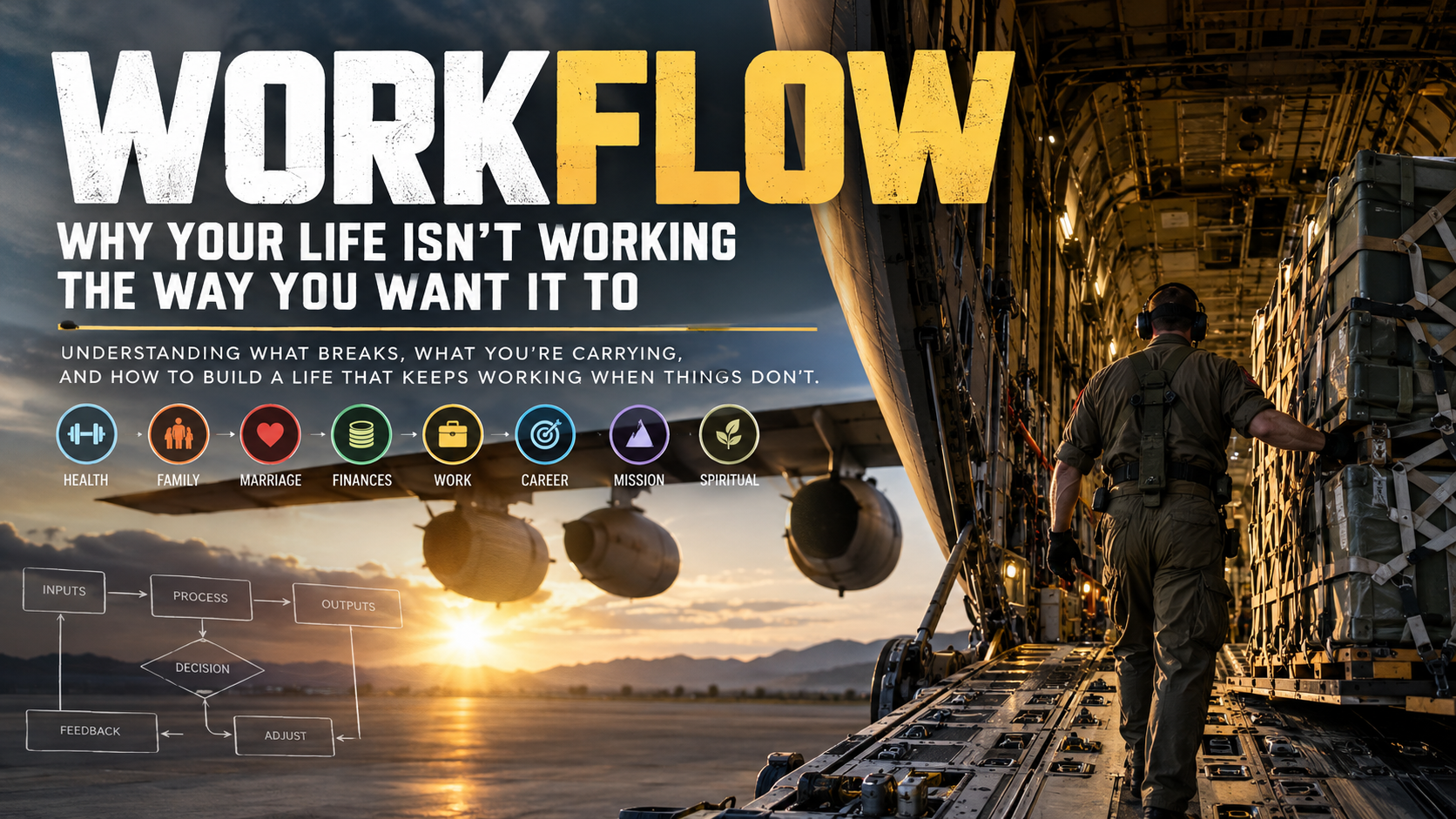
WORKFLOW: Why Your Life Isn’t Working the Way You Want It To
Understanding what breaks, what you’re carrying, and how to build a life that keeps working when things don’t.
By Dr. Keith M. Waggoner
Have you ever wondered why you can be incredibly successful in one area of your life and struggle so badly in another? You might be an outstanding businessman who can’t seem to get his health under control. You might be a wonderful father who struggles to connect with his wife. Or perhaps you’re someone who knows exactly what needs to be done, has the necessary resources, and still can’t seem to consistently follow through.
What’s wrong? Most people assume it’s a discipline problem. They tell themselves they need to work harder, get more motivated, or make a stronger commitment. Sometimes that’s true. But after decades of coaching people from virtually every walk of life, including professional athletes, military leaders, executives, entrepreneurs, and families, I’ve discovered something important.
Most people don’t have a goal problem. They have a WORKFLOW problem.
James Clear, author of Atomic Habits, makes a powerful observation:
“You do not rise to the level of your goals. You fall to the level of your systems.” — James Clear
I agree. But I want to take that idea further. What happens when the system itself breaks? What happens when you’re carrying more than your system can handle? What happens when the resources you depend on disappear, or when your own nervous system begins working against the very goals you’re trying to accomplish?
That’s where understanding WORKFLOW becomes essential.
Your Life Is an Operating System
Think about your computer or smartphone for a moment. Every application depends on a series of processes working together. Information comes in, something happens to that information, and an intended result is produced. That’s a workflow.
But have you ever updated an application or operating system only to discover that something that worked perfectly yesterday suddenly doesn’t work today? Perhaps a component became incompatible, a connection was lost, or one part of the system didn’t update correctly. The entire application may still look perfectly normal, but something important isn’t working.
Our lives operate in remarkably similar ways. We develop habits, beliefs, emotional responses, relationships, routines, and strategies that work together to produce the results we experience every day. And when something changes, whether it’s our age, health, marriage, career, finances, responsibilities, or environment, the old workflow may no longer produce the desired result.
Yet most people keep trying to run the same program! They assume that because something worked ten years ago, it should work today. Not necessarily. Sometimes you need to upgrade your skills, change your habits, strengthen your relationships, or redesign the entire process.
You cannot always get back to where you want to be using the same methods that got you where you are.
This is one of the reasons I believe personal development must involve more than motivation. It requires understanding how our lives actually function and identifying which parts of our operating systems need improvement.
WORK, LOAD, and FLOW: Three Things You Must Understand
I’ve been developing a coaching concept I call WORKFLOW Mastery. It begins with understanding three important distinctions.
WORK is what needs to be accomplished. What’s the mission? What are you actually trying to produce, and why does it matter?
LOAD is the weight you’re carrying. What are the demands on your time, energy, emotions, finances, relationships, and nervous system? More importantly, what is your actual capacity to carry those demands?
FLOW is how everything moves through your system. What sequence of decisions, resources, habits, relationships, and behaviors produces the intended result?
When these three things are properly aligned, life tends to work better. When they’re not, problems begin to develop. You can be working incredibly hard and still accomplish very little if your workload exceeds your capacity or your workflow is broken.
The late systems thinker Donella Meadows spent much of her career studying how complex systems behave. In her influential work Leverage Points: Places to Intervene in a System, she explained that changing a system’s goals, rules, or underlying mindset can sometimes be more powerful than merely adjusting its individual components.
That’s a profound insight for personal development. Sometimes the most important change isn’t doing more. It’s discovering which change will make everything else work better.
STRATEGIC EDGE PRINCIPLE
Working harder on a broken system usually produces more frustration, not better results. Find the failure before increasing the effort.
The Loadmaster: Learning to Carry What Matters
During my years working with military personnel, I became familiar with an important responsibility in military aviation: the loadmaster.
A loadmaster doesn’t simply throw cargo onto an aircraft and hope everything works out. He must understand the aircraft’s limitations, how the cargo is distributed, how much weight can safely be carried, and how to properly secure that load. The mission also determines what cargo must take priority.
Think about that for a moment. It isn’t enough to know how much weight the aircraft can carry. You also have to know where that weight belongs. A poorly balanced load can create serious problems even when the aircraft hasn’t exceeded its total weight limit.
Your life works the same way.
In Strategic Edge Coaching, I teach people to evaluate their lives through Eight Core Categories. These represent the major dimensions of life that require attention, investment, responsibility, and development. Each category has its own demands, resources, and capacities, but they all interact with one another.
A man may be carrying enormous responsibilities in his career while neglecting his marriage, health, spiritual life, or children. He may be incredibly productive professionally while becoming progressively less effective at living. He’s working hard, but the load is poorly distributed.
This is why I teach something called Yes Management. Every yes carries a cost. Every commitment occupies capacity. And every responsibility you accept must fit somewhere within the overall mission of your life.
The question isn’t simply, “Can I do this?” It’s also, “Should I carry this, what will it cost, and what am I going to have to put down to pick it up?”
There’s another important distinction here. Capacity isn’t necessarily the same as tolerance. You may possess the skills and abilities necessary to accomplish something but lack the current emotional, physical, or psychological tolerance to sustain it consistently. The good news is that many of these capacities can be developed through training, conditioning, experience, and appropriate support.
A good loadmaster understands that the mission matters more than any individual piece of cargo. So should you.
Stop Expecting a Ferrari to Pull a Trailer
One of the illustrations I frequently use when coaching couples involves a Ferrari and a pickup truck.
Imagine marrying a Ferrari of a woman and then spending the next twenty years trying to turn her into a heavy-duty pickup truck. You keep trying to install a trailer hitch, load her down with responsibilities, and make her pull things she was never particularly suited to carry. Then you become frustrated because she doesn’t perform like a pickup!
That’s ridiculous. And yet people do this to each other all the time.
Now, don’t misunderstand me. I’m not suggesting that people are permanently limited or incapable of growth. Quite the opposite. We should all be developing greater capacities throughout our lives. But people have different strengths, temperaments, experiences, competencies, and tolerances.
Your spouse may have tremendous emotional capacity in an area where you struggle. You may possess organizational, practical, or financial capacities that don’t come as naturally to your spouse. Neither of you is necessarily deficient. You’re different.
A great marriage requires understanding those differences and learning how to work together rather than constantly demanding that the other person become a copy of you.
I teach a concept called the Weight-Load Trust Bridge. Every relationship has a certain capacity to carry weight. Trust, competence, consistency, and experience help determine how much responsibility and vulnerability that relationship can sustain.
You cannot continually place more weight on a bridge than it has been developed to carry and then act surprised when something breaks. Sometimes the solution is to strengthen the bridge. Other times, you need to redistribute the load or recognize that you’ve been asking the wrong person to carry the wrong responsibility.
This isn’t just marriage advice. It’s leadership advice, parenting advice, and business advice. The more accurately we understand the capacities of the people around us, the more effectively we can build relationships that allow everyone to contribute their best.
STRATEGIC EDGE PRINCIPLE
Don’t judge a Ferrari by its towing capacity or a pickup truck by its performance on a racetrack. Understand what you’re working with, develop its strengths, and stop demanding that everything perform the same way.
Find What’s Breaking Your Supply Chain
Here’s another way to understand WORKFLOW. Think about the global supply chain.
A manufacturer may have an excellent product, skilled employees, outstanding facilities, and customers ready to purchase. But if one essential component becomes unavailable, the entire production process can stop. The problem isn’t that the employees suddenly became lazy. The supply chain broke.
The same thing happens in our personal lives.
Let’s say you want to get fit and lose thirty pounds. You know what to do. You’ve done it before. You understand exercise, nutrition, and the importance of consistency. But you’re not doing it. Why?
Perhaps your work schedule changed. Maybe your sleep has deteriorated. Perhaps you’re eating in response to stress, or your nervous system has developed a conditioned response that drives you toward food whenever you become anxious, exhausted, or emotionally uncomfortable. Maybe your problem is accountability, or perhaps your environment makes the wrong choices too convenient and the right choices too difficult.
I’ve coached people who wanted significant changes in their lives but were unwilling to make a meaningful investment in the process. Sometimes hiring a trainer, committing financially, or involving another person creates the accountability necessary to follow through. For other people, that isn’t enough because the real obstacle lies somewhere else.
Sometimes medical issues, injuries, medications, or other physiological factors may be affecting the process. Those possibilities deserve appropriate professional evaluation rather than being mistaken for character deficiencies.
The point is that we must diagnose the system rather than blindly prescribe the same solution to everyone.
The question isn’t merely, “Why aren’t you doing what you should?” The better question is, “What is breaking the workflow that would normally produce the result you want?”
Understanding why something isn’t working doesn’t remove your responsibility to do something about it. It gives you a better opportunity to take responsibility intelligently.
Build Redundancies: Don’t Depend on Everything Going Right
In engineering, aviation, technology, and logistics, redundancy can be the difference between a temporary inconvenience and a catastrophic failure.
Critical systems often have backup power, alternative communication methods, additional equipment, or multiple ways to accomplish the same objective. Why? Because intelligent people recognize that things break. Resources disappear, circumstances change, people become unavailable, and plans fail.
Yet many of us build our personal lives around a single point of failure.
Think about exercise again. If your entire fitness program depends on feeling motivated at 5:30 in the morning, you have a very fragile system. What happens when motivation disappears? Your workflow stops.
But what if you had several reasons to work out and several ways to make it happen? What if your exercise routine also gave you an opportunity to spend meaningful time with your son? What if you had a friend counting on you to show up? What if you hired a trainer who expected you to be there? What if exercise became part of your identity as a man who leads by example?
Now you’ve created a much stronger system because success no longer depends on one fragile source of motivation or one perfect set of circumstances.
This is where we need to distinguish between two kinds of redundancy. Operational redundancy gives you alternative ways to accomplish something when the original plan fails. Motivational redundancy gives you multiple meaningful reasons to keep pursuing the goal when one source of motivation weakens.
Both are important. A man with strong motivation but no backup plan may fail when circumstances change. A man with excellent backup plans but no compelling reason to act may never begin.
Value Stacking: Make One Action Serve Multiple Purposes
I teach a concept called Value Stacking. It means intentionally connecting an important behavior to several meaningful values rather than depending on a single reward or reason for doing it.
Instead of exercising only to lose weight, you’re exercising to improve your health, strengthen your relationship with your son, develop discipline, increase emotional resilience, and become a better steward of the life God has entrusted to you. One activity now serves several important purposes.
And here’s the beautiful part. When one source of motivation becomes weak, the others may help keep you moving.
Perhaps you don’t feel like exercising today, but your son is looking forward to spending time with you. So you show up. Maybe your son isn’t available tomorrow, but you’ve already committed to your trainer. You show up again. Perhaps you’re traveling and can’t access your usual gym, but you’ve developed a simple bodyweight routine that keeps your commitment alive.
Over time, something important begins to happen. Exercise becomes more than an activity you occasionally perform. It becomes part of the way you live and the kind of person you’re becoming.
James Clear addresses this in Atomic Habits through his work on identity-based habits. The behaviors we repeatedly practice can reinforce our understanding of who we are. I believe Value Stacking strengthens that process by connecting our actions to the relationships, responsibilities, and purposes that matter most.
And this applies far beyond fitness. A husband can stack values into a weekly date with his wife by connecting it to friendship, communication, intimacy, spiritual partnership, and the example he wants to set for his children. A business leader can stack values into mentoring a younger employee by connecting it to leadership development, succession planning, service, and the organization’s future.
The goal is to make important actions meaningful enough to sustain and practical enough to repeat.
STRATEGIC EDGE PRINCIPLE
Don’t build your commitments around a single reason to succeed. Stack meaningful values into your actions and create alternative ways to follow through when circumstances change.
Your Nervous System Is Part of the Workflow
This is where psychology becomes particularly important.
Many people approach personal development as though every decision is purely rational. It isn’t. Our nervous systems constantly process information, respond to perceived threats, regulate physiological states, and influence our behavior. Under stress, we may fall back into familiar patterns even when we consciously know those patterns are destructive.
Neuroscientist Andrew Huberman has discussed the role of the anterior midcingulate cortex in tenacity, effort, and persistence. Research suggests this brain region participates in networks involved in effortful behavior and responding to challenges. The broader lesson is that persistence isn’t merely an abstract personality trait. It involves physiological and neural processes that interact with our experiences, habits, and environment.
That doesn’t mean every struggle can be reduced to one brain region or that every problem is solved by simply pushing harder. It means we need to understand the relationship between our physiological state, learned responses, and the demands we’re attempting to meet.
This is why I teach the importance of identifying our Triggers, Traps, and Templates.
A trigger is something that activates a response. A trap is the destructive or unproductive pattern we fall into. A template is the learned response pattern that helps explain why we keep responding that way.
For example, a businessman receives criticism from his wife. His nervous system interprets that criticism as an attack, and he becomes defensive, raises his voice, withdraws, or attempts to regain control. Now the marriage is experiencing conflict.
But what actually broke? Was it communication, emotional regulation, an old conditioned response, or a belief about what criticism means?
The answer matters because you cannot reliably correct a problem you haven’t accurately identified.
This is also why we need to examine another sequence I teach: Story, Statement, and Strategy. What story am I telling myself about what just happened? What statement am I making about myself, the other person, or the situation? And what strategy am I using in response?
A man who tells himself, “My wife doesn’t respect me,” may begin making statements and decisions consistent with that interpretation. But what if his story is inaccurate? What if she’s simply exhausted, overwhelmed, or trying unsuccessfully to communicate an unmet need?
When we learn to examine the story, regulate our physiological responses, and deliberately choose a better strategy, we create opportunities to develop healthier behavioral patterns.
We don’t simply want to manage symptoms. We want to identify and correct the operating patterns producing them.
The Readiness Formula: Are You Actually Prepared to Succeed?
Another essential component of WORKFLOW Mastery is something I call the Readiness Formula.
Before pursuing a mission, whether in business, relationships, physical fitness, or personal development, we need to evaluate six important areas.
Mission Assessment: What exactly am I trying to accomplish? Why does it matter? What does success look like?
Self-Assessment: What are my actual strengths, weaknesses, competencies, limitations, and capacities? Am I being truthful about myself?
Threat Assessment: What could interfere with the mission? What obstacles, temptations, competing priorities, or external circumstances could cause failure?
Awareness Assessment: What am I paying attention to? What am I overlooking? What patterns am I failing to recognize?
Preparedness Assessment: Do I have the resources, training, relationships, systems, and backup plans necessary to succeed?
Willingness Assessment: Am I truly willing to do what the mission requires, including making sacrifices, accepting discomfort, and changing my behavior?
These assessments expose a distinction that many people overlook. A person can be completely willing but inadequately prepared. Another person can have every resource necessary to succeed and still be unwilling to do the work. Someone else may possess tremendous ability but be carrying so much responsibility that there is no remaining capacity for another commitment.
If we misdiagnose the problem, we’ll probably prescribe the wrong solution. That’s one of the reasons generic motivational advice so often fails. Telling an overwhelmed man to try harder may make his situation worse. Giving an unwilling man more resources may accomplish nothing. And telling an unprepared person to simply believe in himself won’t magically produce the competencies he’s missing.
Effective coaching begins by discovering what the person actually needs.
Adaptability: The Difference Between Breaking and Bending
For years, I’ve taught the importance of AQ, or Adaptability Quotient.
Life changes. The market changes. Our bodies change. Our children grow up. Relationships evolve. Technology advances. Opportunities appear and disappear. The question isn’t whether change will occur. The question is whether you’ve developed the capacity to respond effectively.
A rigid person keeps trying to force the old workflow to function in a new environment. An adaptable person examines the mission, evaluates what has changed, and makes the necessary adjustments.
This doesn’t mean abandoning your principles. Quite the opposite. Your principles should remain strong enough to guide you while your strategies remain flexible enough to adapt.
I think of the Apostle Paul’s words in Philippians 4:11-12, where he describes learning to be content in different circumstances, whether experiencing abundance or need. Paul’s circumstances changed, but his deeper source of strength and purpose remained intact.
There’s an important lesson there. Better doesn’t always mean more. Sometimes making your life better means carrying less, saying no, simplifying your commitments, or removing something that has been draining your capacity for years.
A person with a high degree of adaptability isn’t necessarily someone who can carry unlimited weight. It’s someone who recognizes changing conditions, adjusts intelligently, and remains committed to what matters most.
Become a Broker of Certainty
One of the most important responsibilities of a leader, husband, father, or business owner is becoming what I call a Broker of Certainty.
This doesn’t mean pretending you can control everything. You can’t. It means becoming someone who can be trusted to assess reality, make sound decisions, communicate clearly, and follow through on commitments.
A Broker of Certainty doesn’t require everything to go perfectly before functioning effectively. He understands the mission, knows his capacities, recognizes threats, builds contingencies, and responds intelligently when something breaks. Rather than immediately collapsing into blame, panic, or helplessness, he begins identifying what needs to change.
This is also where CANI, Constant And Never-ending Improvement, becomes so valuable. I learned that powerful acronym through Tony Robbins and have incorporated it into much of my coaching over the years.
But CANI requires the right mindset. There are two very different questions people ask themselves. One is, “How can I make my life better?” The other is, “How can I get away with what I’m doing?”
Those questions produce very different lives.
One person is continually inspecting, adjusting, learning, and improving. The other is continually negotiating with his responsibilities and looking for the minimum amount of effort necessary to avoid consequences.
The first mindset builds mastery. The second eventually breaks the system.
The great management thinker Peter Drucker emphasized the importance of effectiveness rather than merely being busy. His work reminds us that activity and accomplishment are not necessarily the same thing. We can fill our days with work while neglecting the responsibilities that would make the greatest difference in our lives.
WORKFLOW Mastery brings these ideas together. It asks us to examine not only whether we’re working hard, but whether we’re working on the right things, carrying the right responsibilities, and developing systems capable of producing the results that matter.
Conduct a WORKFLOW Inspection of Your Life
I want to challenge you to do something practical with what you’ve just read. Choose one area of your life where you aren’t getting the results you want. It might be your marriage, fitness, business, finances, parenting, spiritual development, or emotional health. Don’t try to fix everything simultaneously. Choose one meaningful objective and begin investigating the system responsible for producing it.
First, identify the mission. What specific result are you trying to produce, and why does it matter? Be honest about whether the objective reflects your values or merely something you think you should want.
Next, examine your workload and capacity. What responsibilities, demands, and pressures are you currently carrying? Are you overloaded, poorly balanced, or expecting yourself or someone else to carry more than the current system can sustain?
Then map the workflow. What actions, habits, resources, and relationships must work together to produce the desired result? Where does the process repeatedly break? Is something missing, unavailable, inconsistent, overloaded, or improperly connected?
Pay particular attention to what happens inside you when the system breaks. What stories do you tell yourself? What statements do you make? What triggers, traps, and conditioned response patterns appear? Are you responding to the actual situation or reacting to an interpretation you’ve developed over time?
Finally, examine your readiness and build your redundancies. What resources, relationships, accountability systems, alternative strategies, and meaningful values could strengthen the process? What would you do if your original plan became unavailable tomorrow?
Once you’ve identified the most important weakness, make one deliberate improvement and measure what happens. Don’t confuse understanding the problem with solving it. Knowledge becomes valuable when it changes behavior.
This is where CANI becomes a way of life. We inspect, adjust, test, learn, and improve. Then we repeat the process.
THE WORKFLOW MASTERY QUESTION
“What is missing, overloaded, misaligned, or incorrectly conditioned in my current workflow, and what change would most improve my ability to produce the result I want?”
Build a Life That Keeps Working When Things Don’t
I believe God has entrusted each of us with responsibilities, opportunities, relationships, talents, and a limited amount of time. We are called to be good stewards of those gifts, but good stewardship requires more than good intentions. It requires wisdom, discernment, discipline, adaptability, and an honest understanding of our limitations.
It also requires recognizing that the systems we’ve developed throughout our lives may not always be adequate for the responsibilities we’re called to carry next. Sometimes we need to work harder. Sometimes we need to work differently. Sometimes we need to strengthen a relationship, develop a competency, increase our capacity, or learn to regulate a response that has been undermining us for years.
And sometimes the wisest thing we can do is put something down.
The next time you find yourself frustrated because something in your life isn’t working, resist the temptation to immediately blame yourself, blame someone else, or simply promise to try harder. Instead, conduct a WORKFLOW Inspection. Find what’s broken, identify what’s missing, evaluate your capacity, strengthen the weak connections, build redundancies, and stack meaningful values into the actions that matter most.
Then take responsibility for making the necessary changes.
Because the goal isn’t simply to create a life that works when everything goes according to plan. The goal is to develop the character, competence, capacity, and systems necessary to keep moving forward when things don’t.
Don’t just build a life that works. Build a life that keeps working when things don’t.
That’s how we get better. That’s how we develop mastery. And that’s how we Live Life ALIVE!
Recommended Reading, Listening, and Watching
If you’d like to explore the psychology, neuroscience, and systems thinking behind these ideas, I recommend the following resources.
Books
- Atomic Habits, James Clear. An excellent introduction to habit formation, identity-based behavior, and why systems are often more important than goals.
- Thinking in Systems: A Primer, Donella H. Meadows. One of the most useful books for understanding how interconnected systems function, why they break, and how to identify meaningful points of intervention.
- The 7 Habits of Highly Effective People, Stephen R. Covey. Particularly valuable for understanding personal responsibility, priorities, interdependence, and living according to principles rather than circumstances.
- The Effective Executive, Peter F. Drucker. A classic examination of priorities, decision-making, and the difference between being busy and being effective.
- Awaken the Giant Within, Tony Robbins. Explores the influence of beliefs, decisions, emotional patterns, and conditioning on personal achievement.
- Man’s Search for Meaning, Viktor E. Frankl. A profound examination of meaning, responsibility, and the human capacity to choose one’s attitude and actions under extraordinarily difficult circumstances.
Podcasts and Listening
- Huberman Lab: “How to Increase Your Willpower & Tenacity.” Andrew Huberman explores the neuroscience of persistence, including the anterior midcingulate cortex, effort, and the relationship between physiological state and willpower.
- The Tony Robbins Podcast. Look for episodes addressing behavioral change, emotional conditioning, personal standards, and the role of identity in sustained performance.
- The Knowledge Project with Shane Parrish. Particularly useful for exploring mental models, decision-making, systems thinking, and leadership.
Videos and Additional Resources
- Donella Meadows, “Leverage Points: Places to Intervene in a System.” A foundational essay on identifying where changes can have the greatest impact within complex systems.
- The Donella Meadows Project, “In a World of Systems.” An illustrated introduction to understanding interconnected systems and their sometimes surprising behavior.
- James Clear’s articles on systems, goals, and identity-based habits. Practical material for translating desired outcomes into repeatable daily behaviors.
Dr. Keith M. Waggoner is a psychologist, strategic coach, minister, and founder of Strategic Edge Coaching and Undisputed Mastery. He works with business leaders, professional athletes, military personnel, and individuals committed to developing greater mastery in every important area of life.