
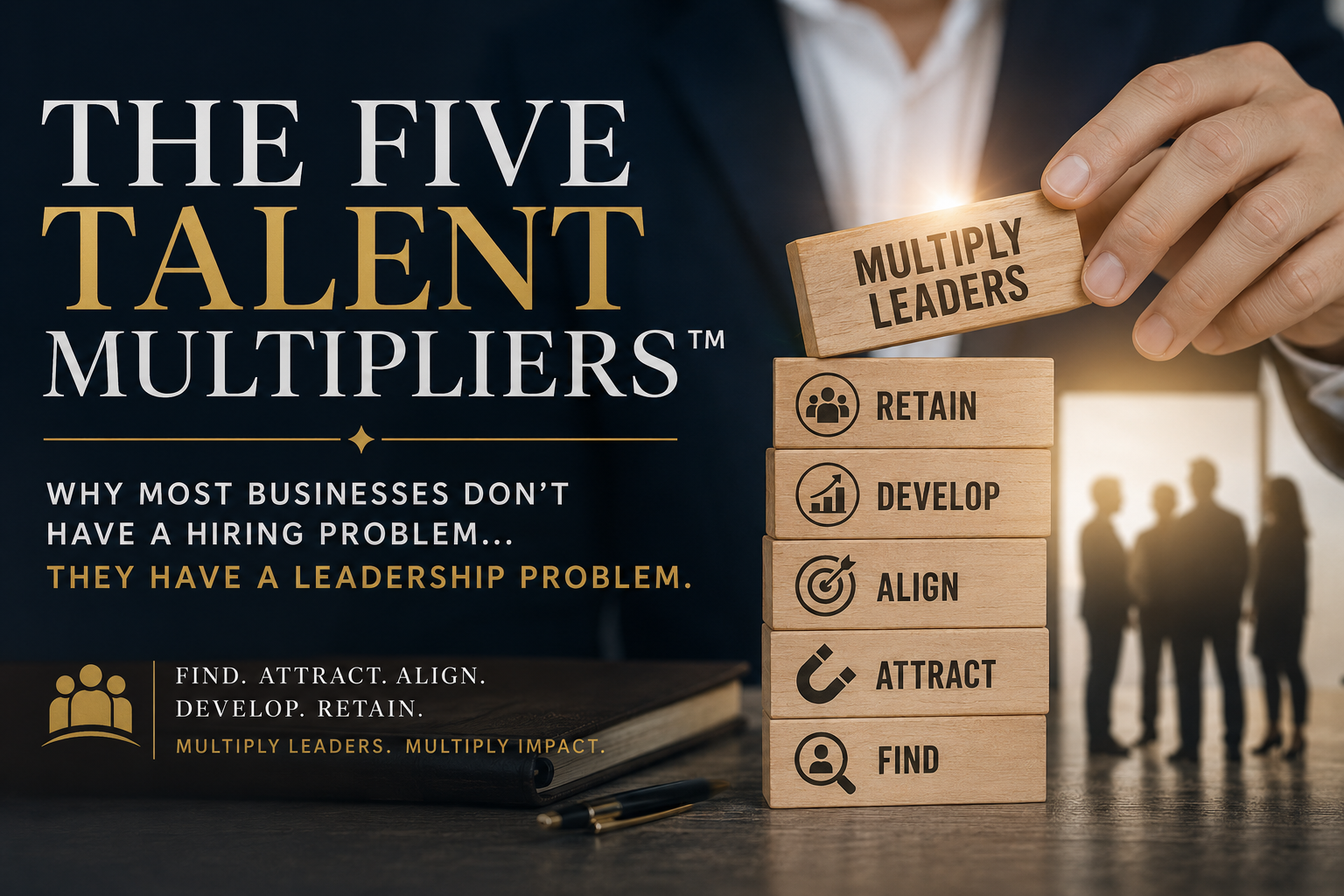
The Five Talent Multipliers™
Why Most Businesses Don’t Have a Hiring Problem… They Have a Leadership Problem.
By Dr. Keith M. Waggoner
A few years ago, I sat across the table from the CEO of a successful company that had every reason to be thriving. Revenue was growing. Demand for their services had never been higher. Their products were excellent. Yet the owner looked exhausted. He leaned back in his chair, folded his arms, and sighed. “Keith,” he said, “I don’t know what else to do. We just can’t find good people anymore.”
I’ve heard some version of that statement hundreds of times over the years. Business owners blame the younger generation. They blame the labor market. They blame social media. They blame government policies. They blame work ethic. Sometimes they even blame God. After coaching entrepreneurs, executives, physicians, military leaders, and organizations across the country for more than three decades, however, I’ve come to a different conclusion. Most companies don’t actually have a people problem. They have a leadership system problem.
That distinction changes everything. If your problem is simply that “good people don’t exist anymore,” then you’re essentially powerless. You’re left hoping better applicants magically appear or that the economy somehow shifts in your favor. But if the problem lies within your leadership system, then you have something you can improve. As your leadership improves, the quality of people your organization attracts, develops, and retains improves with it.
That realization fundamentally changed the way I coach businesses. For years, I watched organizations spend enormous amounts of money trying to improve employee engagement. They increased salaries, expanded benefit packages, introduced bonuses, created appreciation lunches, sponsored team-building events, and experimented with flexible work schedules. Some of those initiatives produced temporary improvements. None of them consistently solved the deeper problem because employee engagement is not a program. It is the natural byproduct of exceptional leadership.
Eventually I began noticing a remarkable pattern. The healthiest organizations, regardless of industry or size, were doing five things exceptionally well. Whenever one of those five areas weakened, growth slowed. Morale began slipping. Turnover increased. The owner became increasingly overwhelmed because every significant decision and every major problem eventually found its way back to his desk. The business became dependent upon the leader instead of being multiplied through the leader.
Those observations eventually became one of the foundational frameworks I teach inside my Business Results Coaching program. I call it The Five Talent Multipliers™.
I chose that name carefully. Notice I didn’t call them hiring principles, recruiting strategies, or employee engagement techniques. Those labels are far too narrow. This framework is not about hiring. It is about multiplication.
Hiring simply adds people to your payroll.
Leadership multiplies the value of the people already on your payroll.
That is one of the most important distinctions a business owner can ever understand.
Many organizations believe their objective is filling open positions as quickly as possible. Healthy organizations understand that their true objective is developing people who continually increase in value, responsibility, wisdom, influence, and leadership capacity. When you consistently multiply people, you naturally improve productivity, innovation, culture, customer experience, and profitability. Your business doesn’t merely become larger. It becomes healthier.
I believe this principle reflects one of God’s earliest mandates for mankind. In the opening chapters of Genesis, Adam wasn’t simply instructed to maintain the Garden of Eden. He was commanded to cultivate it, bring order from chaos, exercise wise dominion, and be fruitful and multiply. From the very beginning, biblical leadership has never been about preserving what already exists. It has always been about faithful stewardship that produces multiplication.
The Apostle Paul reinforced this same principle when he wrote to his young protégé Timothy: “And the things you have heard me say in the presence of many witnesses entrust to reliable people who will also be qualified to teach others” (2 Timothy 2:2). Hidden within that single verse are four generations of intentional leadership multiplication: Paul invested in Timothy, Timothy invested in reliable people, and those reliable people invested in others. Healthy organizations have always grown this way. They don’t depend upon one gifted leader. They intentionally develop leaders who create more leaders.
That is precisely what The Five Talent Multipliers™ are designed to accomplish.
This isn’t simply a hiring system.
It’s a leadership multiplication system.
Because exceptional organizations are rarely built by finding extraordinary people. More often, they are built by ordinary people who are developed by extraordinary leaders.
And it all begins with the first multiplier.
Finding the right people.
The First Two Talent Multipliers™
Find and Attract
Every healthy organization is built one person at a time.
That statement sounds almost too simple to be profound, yet most business owners violate it every day. They spend thousands of dollars refining their products, improving their marketing, upgrading their technology, and streamlining operations, but they devote surprisingly little intentional thought to the process of building the team that ultimately determines whether those improvements succeed or fail.
Businesses rarely outgrow the quality of their people. More accurately, they rarely outgrow the quality of the leaders responsible for finding those people in the first place.
The first two Talent Multipliers™ establish the foundation upon which everything else is built. If you consistently find the wrong people, no amount of training will compensate for poor selection. Likewise, if you know exactly who you’re looking for but fail to attract them, your organization will continually settle for whoever happens to apply instead of the people who are truly capable of advancing your mission.
Finding and attracting exceptional talent are two entirely different leadership competencies.
Unfortunately, many organizations treat them as though they are the same.
Talent Multiplier #1: Find the Right People
One of the first questions I ask a new executive coaching client sounds deceptively simple.
“What are you looking for?”
The answer I usually receive is something like this:
“We need someone who’s motivated.”
“We need someone who has experience.”
“We need someone who’s a hard worker.”
Those aren’t hiring standards.
Those are vague hopes.
Imagine asking a master builder to construct your dream home without providing blueprints. You tell him you want something “nice,” “comfortable,” and “high quality,” but you never specify the layout, dimensions, materials, or architectural style. The builder would have no objective way to determine whether he had succeeded because excellence was never clearly defined.
Many organizations recruit in exactly the same way.
Before you can identify the right person, you must first define what “right” actually means.
That process goes far beyond writing a job description. It requires leaders to identify the specific competencies, character traits, values, communication styles, emotional maturity, problem-solving abilities, and cultural attributes that distinguish exceptional performers from average ones.
I’ve watched business owners reject candidates with impressive résumés because they lacked humility, coachability, or emotional intelligence. I’ve also watched individuals with relatively little experience become extraordinary employees because they possessed integrity, curiosity, resilience, and a genuine desire to grow.
Skills can often be taught.
Character rarely can.
That’s why I encourage leaders to hire for values and potential while developing competencies through coaching, mentorship, and intentional leadership.
One of the greatest mistakes organizations make is hiring out of urgency rather than conviction. A key employee resigns unexpectedly. The workload begins piling up. Customers need immediate attention. Pressure mounts, and suddenly the hiring process becomes an exercise in relief instead of discernment.
Desperation almost always lowers standards.
When standards fall, the wrong people enter the organization.
Once the wrong people enter the organization, every other Talent Multiplier™ becomes exponentially more difficult.
The quality of your future organization is determined long before the interview ever begins.
It begins with the standards you establish.
Talent Multiplier #2: Attract the Right People
Finding exceptional people is only half the challenge.
The best people don’t simply want a job.
They want a future.
High performers almost always have options. They can choose where to invest their time, their gifts, and a significant portion of their lives. If your organization cannot answer the question, “Why should someone build their future here?” then someone else’s organization will.
This is where many leaders unknowingly sabotage themselves.
They assume compensation is their greatest recruiting advantage.
Compensation certainly matters. People deserve to be paid fairly, and organizations that consistently underpay their people should not expect exceptional loyalty. But after decades of coaching leaders across multiple industries, I’ve become convinced that compensation alone has never created lasting commitment.
People are searching for something much deeper.
They want meaningful work.
They want leaders they trust.
They want opportunities to grow.
They want clarity.
They want purpose.
They want to know that their contributions matter and that their future will be better because they chose to join your team.
In other words, they are evaluating your organization long before you begin evaluating them.
Healthy companies understand this reality. They intentionally cultivate a culture that talented people naturally want to join. They celebrate excellence, develop leaders from within, communicate a compelling mission, and create an environment where people believe they can become the very best version of themselves.
When organizations fail to attract exceptional people, they often blame the labor market.
I encourage leaders to ask a different question.
“What would make an extraordinary person excited to become part of our story?”
That single question shifts the focus away from external circumstances and back toward leadership responsibility, where meaningful change can actually occur.
Simon Sinek famously challenged leaders to begin with why. I believe that principle applies just as powerfully to recruiting. Long before people buy into your products, they buy into your purpose. Long before they commit to your organization, they commit to the leader who embodies that purpose with authenticity and conviction.
Exceptional people are rarely attracted by perks alone.
They are attracted by meaningful missions led by trustworthy leaders.
That is why the first two Talent Multipliers™ must always work together.
Finding identifies who belongs on your team.
Attracting gives those people a compelling reason to choose it.
Without both, sustainable growth remains painfully difficult.
Coaching Reflection
As you evaluate your own organization, ask yourself two honest questions.
First, have you clearly defined what an exceptional employee looks like, or are you hiring based on instinct and urgency?
Second, if your ideal candidate had three outstanding job offers sitting on their desk today, what would cause them to choose yours?
The answers to those two questions reveal far more about the health of your organization than any résumé ever will.
The Next Three Talent Multipliers™
Align, Develop, and Retain
Many leaders make a costly assumption after hiring someone.
They assume the difficult work is finished.
In reality, the work has only just begun.
I’ve seen organizations recruit incredibly talented people only to lose them within a year. Not because the employee lacked ability, but because the organization lacked intentional leadership. The irony is painful. Business owners spend months searching for the perfect candidate, only to place that person into an environment where success is largely left to chance.
When that employee eventually leaves, leadership often concludes, “They just weren’t the right fit.”
Sometimes that’s true.
More often, however, the organization never created the conditions necessary for that person to flourish.
That’s why the final three Talent Multipliers™ are so critical. They answer an important question that most companies never seriously consider:
Once you’ve found exceptional people and convinced them to join your organization, what will you do to help them become exceptional leaders?
The answer determines whether your business merely hires talent or truly multiplies it.
Talent Multiplier #3: Align People for Success
One of the most frustrating experiences an employee can have is wanting to succeed but never knowing exactly what success looks like.
Every leader has encountered it.
A team member works hard, puts in long hours, and genuinely wants to contribute. Yet they continually miss expectations. Deadlines slip. Communication breaks down. Small frustrations gradually become larger ones until eventually someone concludes, “This just isn’t working.”
Was the employee incapable?
Perhaps.
But not always.
Very often the real problem was alignment.
Alignment occurs when the right person occupies the right role with clear expectations, measurable outcomes, appropriate authority, adequate resources, and a direct connection to the organization’s larger mission. When those elements work together, people gain confidence because they know precisely what winning looks like.
Without alignment, even gifted people begin second-guessing themselves. They spend unnecessary energy trying to interpret unclear expectations instead of applying their strengths to meaningful work. Confusion quietly erodes confidence, and confidence eventually gives way to frustration.
This is one reason I frequently remind coaching clients that clarity is one of the greatest gifts a leader can provide.
People cannot consistently hit targets they cannot clearly see.
Alignment also requires something many organizations overlook: placing people where their natural gifts can flourish. Too often we attempt to force employees into roles that match our immediate organizational needs rather than their greatest strengths. Eventually both the employee and the organization suffer.
A wise leader doesn’t simply ask, “Where do I need help?”
A wise leader asks, “Where can this person create the greatest value?”
Those are very different questions.
One manages positions.
The other develops people.
Talent Multiplier #4: Develop Your People
One of the clearest indicators of organizational health is whether the people inside the company are becoming more valuable every year.
Healthy organizations produce healthier leaders.
Unhealthy organizations produce stagnation.
Far too many companies believe development consists of sending employees to an occasional seminar or purchasing an online training program. Those tools certainly have value, but development is much deeper than information transfer. Development is the intentional process of expanding a person’s capacity to think, lead, solve problems, exercise wisdom, and assume greater responsibility.
In my coaching practice, I often remind leaders that organizations don’t outgrow the intelligence of the owner nearly as often as they outgrow the development of their leadership team. Growth creates complexity. Complexity demands stronger leaders. If leadership development remains stagnant while the organization continues expanding, eventually the business begins straining under its own success.
This is why coaching has become one of the greatest competitive advantages available to modern organizations. Coaching helps people think more clearly, solve problems more effectively, manage conflict with greater maturity, and lead others with increasing confidence. It accelerates growth that might otherwise take years to achieve.
Development also communicates something profoundly important.
It tells employees, “We believe your future matters.”
People who feel invested in usually invest back.
I’ve watched average performers become extraordinary contributors because someone finally believed enough in them to challenge them, coach them, and hold them accountable to a higher standard. Potential often remains dormant until someone provides both belief and structure.
Leadership is not simply the art of getting work accomplished.
Leadership is the art of increasing the capacity of the people entrusted to your care.
Talent Multiplier #5: Retain Your Best People
When I ask executives why talented employees leave, the first answer is almost always compensation.
Money certainly influences decisions.
It simply isn’t the whole story.
Over the years I’ve watched remarkable people voluntarily leave higher-paying positions to work for organizations that offered greater purpose, healthier leadership, stronger relationships, clearer direction, and more meaningful opportunities to grow. I’ve also watched highly compensated employees quietly disengage because they no longer felt valued, challenged, or connected to the mission.
Retention is often misunderstood because leaders treat it like an isolated objective.
It isn’t.
Retention is the cumulative result of everything that came before it.
People stay because they were thoughtfully selected.
They stay because they joined a meaningful mission.
They stay because they were positioned to succeed.
They stay because someone continued investing in their growth.
Retention is not built during an exit interview.
It is built every single day through consistent leadership.
That doesn’t mean every exceptional employee will remain forever. Healthy organizations still experience turnover. People’s lives change. Opportunities arise. Families relocate. Callings evolve.
Success is not measured by keeping everyone indefinitely.
Success is measured by creating an environment where exceptional people genuinely want to stay.
One of the greatest compliments an organization can receive is not simply low turnover.
It is hearing employees say, “I became a better leader because I worked here.”
That statement reflects something far more valuable than loyalty.
It reflects multiplication.
And multiplication has always been the true objective.
Leadership Is Stewardship
As I reflect on these final three Talent Multipliers™, I’m reminded of Jesus’ Parable of the Talents. The master did not evaluate his servants merely by what they possessed when he entrusted resources to them. He evaluated what they had multiplied through faithful stewardship.
The principle extends far beyond finances.
God entrusts leaders with opportunities, influence, organizations, and perhaps most importantly, people.
Our responsibility is not merely to manage them.
Our responsibility is to help them become more than they would have become without our leadership.
That is stewardship.
That is multiplication.
And that is the calling of every exceptional leader.
Leadership That Multiplies
The Five Talent Multipliers™ Assessment
Throughout my career, I’ve coached organizations in nearly every stage of growth. Some were struggling to survive. Others were experiencing explosive success. Still others had reached a plateau they simply couldn’t seem to break through.
Interestingly, the symptoms looked very different, but the underlying problem was often the same.
The organization had reached the limits of its leadership system.
That’s an important distinction because businesses rarely stall for the reasons owners believe they do. They blame the economy, competition, marketing, inflation, interest rates, or changing customer preferences. While those external realities certainly influence every business, they are rarely the primary constraint.
The greatest limitation almost always exists inside the organization.
More specifically, it exists within the organization’s ability to multiply people.
That realization is both humbling and encouraging.
Humbling because it forces leaders to look in the mirror before pointing fingers elsewhere.
Encouraging because leadership can always improve.
When I begin working with executive coaching clients, one of the first exercises we complete is what I call The Five Talent Multipliers™ Assessment. It is intentionally simple because clarity creates action, and action creates momentum.
Rate your organization in each of the following areas using a scale from one to ten.
| Talent Multiplier™ | Score |
| Find | ____ |
| Attract | ____ |
| Align | ____ |
| Develop | ____ |
| Retain | ____ |
Now pause before moving on.
Don’t average the numbers.
Don’t explain them away.
Don’t compare yourself to another company.
Instead, ask yourself three questions.
Which score is lowest?
That number represents your current leadership constraint. It is the place where your organization is leaking the most potential.
Next ask, If I improved this area by just two points over the next twelve months, what would happen to the rest of my organization?
Most leaders are surprised by the answer.
Improving a single Talent Multiplier™ rarely produces an isolated result. Better hiring improves culture. Better alignment increases accountability. Better development creates stronger managers. Better retention reduces turnover, improves customer relationships, and strengthens profitability.
Everything begins reinforcing everything else.
Finally, ask yourself one more question.
What one leadership behavior must change in me before any of these numbers can improve?
Notice I didn’t ask what your employees need to do differently.
I asked what you need to do differently.
Leadership always begins in the mirror.
The Real Competitive Advantage
Businesses spend enormous sums trying to gain a competitive advantage.
They invest in better technology.
Better marketing.
Better equipment.
Better facilities.
Artificial intelligence.
Automation.
Data analytics.
Those investments are valuable.
But none of them will ever replace exceptional leadership.
At the end of the day, businesses are still built by people.
People serve customers.
People solve problems.
People innovate.
People create culture.
People inspire confidence.
People protect reputations.
People build relationships.
Technology can accelerate performance, but it cannot replace character. It cannot teach wisdom. It cannot create trust. It cannot inspire loyalty. Those are uniquely human capacities, and they flourish only under healthy leadership.
That is why I believe The Five Talent Multipliers™ are not simply another management model.
They are a stewardship model.
Every leader has been entrusted with something of tremendous value.
Not merely products.
Not merely profits.
People.
The question every leader must eventually answer is this:
What became possible in the lives of the people I led because they worked with me?
Did they become more capable?
More confident?
More resilient?
Better communicators?
Better husbands and wives?
Better fathers and mothers?
Better leaders?
Or did they simply help us hit quarterly numbers before moving on?
Those are two very different legacies.
One builds businesses.
The other builds people who build businesses.
The second legacy always outlasts the first.
Leadership Is Ultimately About Multiplication
When Jesus selected His disciples, He did not recruit the most accomplished scholars or the most influential leaders of His day. Instead, He chose ordinary men who were willing to learn, willing to grow, and willing to be transformed.
For three years He invested in them relentlessly. He corrected them. Challenged them. Encouraged them. Trusted them with increasing responsibility. He didn’t merely teach information. He developed leaders.
By the time His earthly ministry concluded, those ordinary men were capable of changing the world because someone had first invested deeply in changing them.
That is the model every business leader should aspire to.
Leadership has never been about collecting followers.
It has always been about creating more leaders.
Every organization eventually reflects the leadership of the people at the top. Healthy leaders tend to build healthy organizations. Growing leaders build growing organizations. Multiplying leaders build multiplying organizations.
Everything rises or falls on leadership because leadership determines whether people merely occupy positions or become the kind of men and women who transform organizations.
As you think about your own company this week, I encourage you to resist the temptation to ask, “Where can I find better employees?”
Instead, ask a more powerful question.
How can I become the kind of leader who consistently finds, attracts, aligns, develops, and retains exceptional people?
That single question has the power to change the trajectory of your organization for decades to come.
Because exceptional businesses are never built by chance.
They are built by leaders who understand that their greatest responsibility is not managing people.
It is multiplying them.
“Businesses don’t become exceptional because they hire exceptional people. They become exceptional because they consistently multiply ordinary people into extraordinary leaders.”
— Dr. Keith M. Waggoner
Coaching Takeaway
This week, choose the one Talent Multiplier™ where your organization is weakest. Resist the urge to improve everything at once. Instead, identify one concrete action you can take over the next thirty days to strengthen that area.
Remember, sustainable growth is rarely the result of dramatic change.
It is the result of consistent leadership practiced over time.
One leader.
One conversation.
One employee.
One decision.
Repeated faithfully until multiplication becomes the culture.
Recommended Reading
If you’d like to deepen your understanding of leadership development and organizational growth, I recommend the following resources:
- Good to Great by Jim Collins
- The Ideal Team Player by Patrick Lencioni
- The Five Dysfunctions of a Team by Patrick Lencioni
- The 21 Irrefutable Laws of Leadership by John C. Maxwell
- First, Break All the Rules by Marcus Buckingham
- The Book of Proverbs
- 2 Timothy
- Ephesians 4
- Matthew 25:14–30