
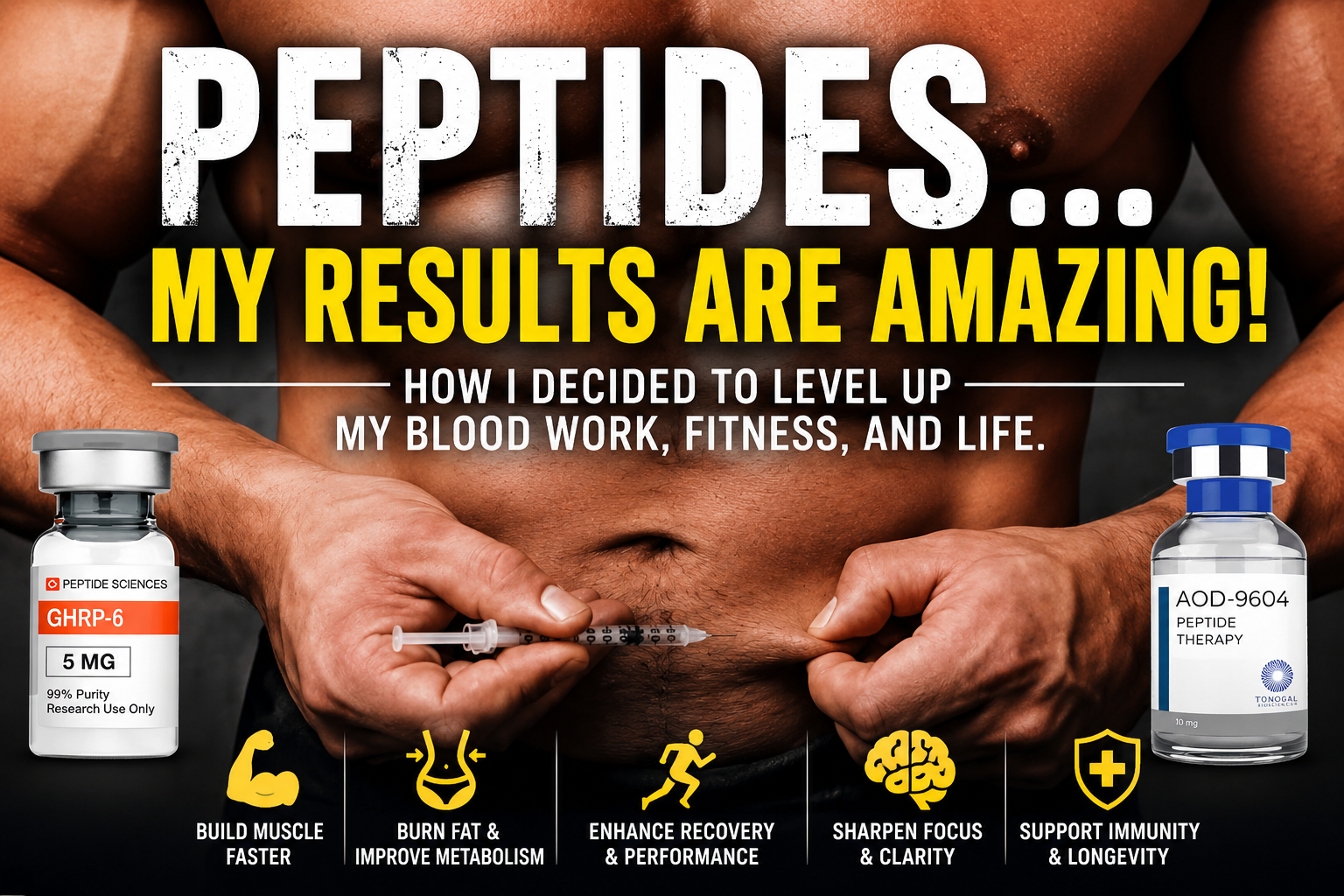
Peptides… My Results Are AMAZING!
How I Decided to Level Up My Blood Work, Fitness, and Life
The Day I Realized Discipline Wasn’t The Entire Answer
Three years ago, if you had suggested that I would someday write an article about peptides, I probably would have smiled politely, thanked you for your concern, and changed the subject. It was not that I was against them. I simply did not believe I needed them.
I have spent most of my life believing in the power of discipline. Train hard. Eat well. Sleep. Pray. Lead. Serve. Repeat. As a psychologist, performance coach, martial artist, and lifelong student of human behavior, I have watched people transform their lives through better habits, better decisions, and greater personal responsibility. I have seen broken marriages healed, businesses rebuilt, addictions overcome, faith renewed, bodies strengthened, and lives completely redirected. The lesson seemed obvious to me: discipline works.
And it does.
One of the dangerous lies of our modern age is that there is always a shortcut around personal responsibility. There is not. No supplement, medication, peptide, hormone, injection, or medical intervention can replace the ordinary disciplines that build an extraordinary life. You still have to eat in a way that honors your body. You still have to move. You still have to sleep. You still have to manage stress. You still have to repair relationships. You still have to pursue purpose. You still have to become the kind of person who can steward the life, body, influence, and mission God has entrusted to you.
But somewhere in my early fifties, I began noticing a frustrating reality. Despite continuing to train, coach, travel, teach martial arts, lead events, and pursue a demanding mission, my body seemed to be negotiating a different contract than the one I had signed twenty years earlier. Recovery took longer than it used to. Minor injuries became major annoyances. A hard workout that once left me energized could now leave me sore for days. Losing body fat required significantly more effort than it had in previous decades. Nothing was catastrophically wrong, but neither was everything operating the way it once had. It felt as though some invisible force had quietly reached over my shoulder and started turning down the dimmer switch on my vitality.
Most mornings had started to feel like I was Captain Kirk standing on the bridge of the Enterprise after another battle with the Klingons. “Scotty, give me the damage report.” What hurts today? What is inflamed? What needs attention? What is making noise that was not making noise yesterday? If you are over forty, you probably understand exactly what I mean. It is not always dramatic. It is not always a crisis. Sometimes aging feels less like falling off a cliff and more like dragging a heavy sled behind you everywhere you go.
The strange part was that my habits had not collapsed. I was not neglecting myself. I was not living recklessly. I was still training, learning, serving, studying, and trying to be faithful with the life in front of me. Yet biology seemed to be quietly pushing back. For a long time, I interpreted that resistance as simply “getting older.” That is what many people do. They feel tired and call it age. They feel inflamed and call it age. They gain weight and call it age. They lose energy and call it age. Sometimes that interpretation is correct. But sometimes what we call aging is actually a signal that something in the system deserves closer attention.
What I failed to appreciate was that discipline and biology are not enemies. They are partners.
When The Data Started Getting Hard To Ignore
As a coach, I spend my life looking for patterns. One client can be an exception. Two clients can be a coincidence. Twenty clients become data. Over the last several years, I began hearing remarkably similar stories from people I respected. Entrepreneurs, physicians, executives, athletes, business owners, and high performers kept describing improvements they were experiencing through physician-guided peptide therapies, metabolic optimization programs, hormone evaluation, and recovery protocols.
These were not lazy people looking for shortcuts. Many of them were already disciplined. They trained. They worked hard. They led organizations. They cared about their families and their futures. Yet many of them were discovering that discipline alone was not always enough to overcome every biological headwind.
What caught my attention was not the hype. It was the consistency of the stories. People told me their blood work was improving. Their recovery was improving. Their body composition was improving. Their inflammation was decreasing. Their energy was returning. Their mental clarity was sharpening. But the phrase I heard most often was the one that stayed with me: “I feel like myself again.”
That phrase mattered to me.
They were not talking about becoming younger in some childish fantasy. They were not trying to become invincible. They were not looking to transform themselves into a social media superhero. They were describing something much more meaningful. They felt like a stronger version of themselves. A clearer version. A more capable version. A version with enough energy to pursue the life they still felt called to live.
As those conversations accumulated, my skepticism gradually gave way to curiosity. Curiosity led to research. Research led to conversations with physicians. Those conversations eventually led me to ask a question I had resisted for years: What if some of what I was experiencing was not simply aging? What if it was biology asking for intelligent support?
Why Andrew Huberman Finally Got My Attention
One of the voices that significantly influenced my thinking was my friend Andrew Huberman.
What I appreciate about Huberman is that he does not approach performance as merely a motivational issue. He approaches it as a biological issue as well. In his discussions on peptides, hormones, recovery, sleep, metabolism, and performance, he repeatedly returns to a principle that resonated deeply with me as both a psychologist and coach: your brain does not operate independently from your biology.
That insight is far more important than most people realize. Your motivation is influenced by your physiology. Your emotional resilience is influenced by your sleep. Your focus is influenced by your metabolic health. Your recovery influences your performance. Your hormones, inflammation, nutrition, stress load, and cellular energy all help shape the internal world from which you make decisions.
In other words, mindset matters enormously, but mindset is not operating in a vacuum.
That observation struck me because it aligns perfectly with what I have seen in clinical work and coaching for decades. We like to imagine that our thoughts, emotions, and decisions exist independently of our physical condition. Yet anyone who has gone three nights without sleep, struggled through chronic inflammation, or experienced significant hormonal disruption knows that is not true. The body and mind are not separate systems. They are one integrated system.
Joe Rogan has explored similar themes through countless conversations with physicians, researchers, fighters, scientists, and longevity experts. One of the strengths of Rogan’s platform is that he often brings together people from medicine, performance, combat sports, nutrition, and human optimization. Those conversations, at their best, keep pointing toward the same unavoidable conclusion: the body is not an accessory to life. The body is the vehicle through which we experience life.
Peter Attia has also helped sharpen this conversation through his work on health span, not merely lifespan. His idea of the “Centenarian Decathlon” asks a powerful question: what do you want to be physically capable of doing in the final decade of your life? That question reframes health entirely. You are not merely training for this summer. You are training for your eighties, nineties, and beyond. You are training for the ability to carry groceries, climb stairs, pick up grandchildren, travel, think clearly, remain independent, and participate fully in the life God allows you to live.
Tony Robbins has spent decades teaching that energy is one of the master resources of life. Having been around Tony’s world and his obsession with vitality, peak performance, and life force, I have seen the same principle again and again. When energy declines, leadership suffers. Relationships suffer. creativity suffers. mission suffers. When energy increases, possibility expands.
That was the idea that finally got my attention.
Health is not separate from performance.
Health is performance.
The body is not merely carrying you through life. The body is the vehicle through which you love people, pursue purpose, build relationships, serve others, create value, and leave a legacy.
What Happened During My First Four Months
Approximately four months ago, after considerable research and consultation with qualified physicians, I decided to begin my own peptide and optimization journey. I did not do this casually. I did not do it because of a social media trend. I did it because I had studied, asked questions, watched outcomes, reviewed my own goals, and decided it was time to stop merely observing and begin testing responsibly.
The results have been remarkable.
I have lost approximately twenty pounds. My blood work has improved significantly. My recovery has improved. My energy has improved. My focus has improved. My productivity has improved. My martial arts training has improved. At fifty-five years old, I genuinely feel closer to thirty-five than I have in years. But what surprised me most was not any single number, lab marker, or physical change. What surprised me most was the return of enthusiasm.
When your body begins functioning better, life begins feeling different. You wake up with more energy. Challenges feel less overwhelming. Opportunities feel more attractive. You become more willing to engage, create, lead, train, contribute, and love people well. The world itself begins to feel more accessible.
As strange as it may sound, one of the greatest gifts these changes have given me is not merely physical. It is psychological.
That is where this story becomes especially interesting.
The Psychological Side Nobody Talks About
As a psychologist, I am fascinated by what happens when a person’s biology begins supporting their mission instead of constantly competing against it. Most public conversations about peptides quickly drift toward weight loss, muscle, appearance, recovery, or longevity. Those outcomes matter. However, what captures my attention most is the way improved health can expand possibility.
Over the last twenty-five years of coaching, I have learned that people rarely experience life exactly as it is. They experience life through the lens of their energy, beliefs, emotions, physical state, and internal stories. Two people can wake up in similar circumstances and have completely different experiences of reality because they bring different bodies, minds, histories, and emotional states into the day.
One of the concepts I frequently teach is NAC, Neuro Associative Conditioning. Simply put, our brains create emotional associations with people, places, activities, goals, and experiences. Those associations influence what we pursue, what we avoid, what excites us, and what drains us. When someone feels exhausted, inflamed, overweight, chronically sore, or physically depleted, their emotional associations begin to change. The world feels heavier. Challenges feel larger. Opportunities feel more costly. Even goals they once felt passionate about can begin to feel overwhelming.
Conversely, when energy improves, recovery improves, and vitality improves, something else often improves as well. People become more hopeful. More engaged. More courageous. More willing to pursue meaningful goals. Opportunities that once felt intimidating begin to feel achievable again. In many cases, the greatest transformation is not merely physical. It is the return of emotional and spiritual momentum.
This connects directly to another framework I teach clients: Story Strategy.
Every person is living three stories simultaneously. The Historical Story is what happened. The Interpretive Story is what we decided it means. The Strategic Story is the future we create because of that interpretation. Peptides cannot change your Historical Story. They cannot rewrite your past. They cannot erase mistakes, trauma, disappointments, or failures. But for some people, improved health, energy, and recovery can strengthen their capacity to engage the future with more power.
That distinction matters.
I have watched people who felt trapped by fatigue, weight gain, inflammation, and declining energy begin pursuing goals they had quietly abandoned years earlier. Their circumstances had not necessarily changed. Their capability had. Their interpretation of what was possible began to shift because their body was no longer sending constant signals of limitation.
People often assume they have a motivation problem when they actually have an energy problem. They assume they have a discipline problem when they actually have a recovery problem. They assume they have an aging problem when they may have a metabolic, hormonal, inflammatory, or biological problem.
That is why I became interested. Not because peptides promise transformation, but because they may help remove obstacles that prevent transformation.
What Are Peptides, Really?
At their most basic level, peptides are short chains of amino acids that act as signaling molecules in the body. Think of them as biological messengers. Some influence healing and repair. Some affect inflammation. Some are involved in metabolism, appetite, or insulin sensitivity. Some influence growth hormone pathways. Others are being explored for mitochondrial function, immune modulation, tissue repair, or cellular energy.
That is part of what makes this field both exciting and confusing. The word “peptide” does not refer to one thing. It refers to a broad category of compounds that may affect very different systems in very different ways. Some have stronger evidence behind them than others. Some are still experimental. Some are being studied in formal clinical trials. Others are widely discussed in wellness and performance circles but remain controversial, under-researched, or difficult to evaluate.
That is why wisdom matters.
Peptides are not magic. They are not toys. They are not replacements for discipline. They are not something to casually order from questionable online sources because a social media influencer told you to. A powerful tool used without wisdom can become a dangerous tool. The more I have learned, the more convinced I am that this conversation belongs in the context of qualified medical guidance, proper sourcing, blood work, follow-up testing, and a clear understanding of both potential benefits and potential risks.
Some Of The Most Popular Peptides People Are Talking About
If you are exploring this field, you will quickly encounter a growing list of compounds. While the science continues to evolve, several peptides and peptide-related therapies have generated considerable interest among physicians, researchers, athletes, and health-conscious individuals.
Retatrutide is currently one of the most exciting developments in metabolic health. Researchers have been studying its effects on appetite regulation, weight loss, insulin sensitivity, and overall metabolic function. It is often described as a triple hormone receptor agonist because it acts on GLP-1, GIP, and glucagon pathways. In clinical research, retatrutide has shown substantial weight reduction in adults with obesity, which is why many experts are watching it closely. It is important to understand, however, that retatrutide remains an investigational medication and should not be treated casually.
BPC-157 has attracted attention because of its potential role in supporting recovery, tissue healing, and inflammation management. It is frequently discussed among athletes and active individuals dealing with chronic injuries and recovery challenges. At the same time, people need to understand that not every popular compound has the same level of rigorous human evidence, and some compounded peptides have drawn regulatory concern.
NAD+ is often associated with mitochondrial function and cellular energy production. Since mitochondria are essentially the power plants of our cells, researchers continue to explore how supporting mitochondrial health may influence energy, recovery, and healthy aging. Many people discuss NAD+ in the context of cellular repair, fatigue, brain function, and longevity, though individual responses vary.
CJC-1295 and Ipamorelin are commonly used in protocols designed to support the body’s natural growth hormone pathways. Many people report improvements in recovery, sleep quality, body composition, and overall vitality, but these compounds also deserve careful medical oversight. Growth hormone pathways are powerful, and powerful systems should be approached with respect.
MOTS-c has become increasingly interesting because of its potential effects on energy regulation, exercise performance, and metabolic flexibility. Because metabolism and mitochondrial function are central to aging, performance, and vitality, compounds in this category have naturally drawn attention from the longevity community.
GHK-Cu has gained attention within longevity and regenerative medicine circles because of its potential role in tissue repair, recovery, skin quality, and healthy aging. Like many compounds in this space, the conversation often runs ahead of the evidence, which is why discernment is required.
KPV is another peptide often discussed for its potential role in inflammation regulation, gut health, and immune modulation. For people dealing with inflammatory challenges, the idea of calming excessive inflammatory signaling is naturally appealing. But again, the right question is not, “What is everyone talking about?” The right question is, “What does my body need, what does the evidence support, and what does my physician recommend?”
The important thing to remember is that these compounds serve different purposes. There is no universal solution that works for everyone. The right approach depends entirely on the individual, their goals, their health history, their blood work, their risk factors, and their physician’s recommendations.
How I Help Clients Decide If Peptides Are Right For Them
One of the questions I now hear regularly is, “Keith, should I try peptides?”
My answer is never immediate.
I do not begin by talking about products, protocols, or compounds. I begin by talking about purpose. What are you trying to accomplish? What problem are you trying to solve? Are you dealing with weight gain, fatigue, inflammation, injury, poor recovery, low energy, declining performance, or metabolic dysfunction? What would success actually look like?
Too many people chase solutions before they have honestly defined the problem.
From there, I help clients examine the foundations. How are you sleeping? How are you eating? How consistently are you moving? Are you strength training? Are you managing stress or simply surviving it? Are your relationships draining you or strengthening you? Are you living with purpose or merely reacting to pressure? Are you using medical interventions to support a disciplined life, or are you hoping they will rescue an undisciplined one?
These questions matter because no advanced therapy can compensate for a life that is fundamentally out of alignment. If someone is sleeping four hours a night, eating poorly, avoiding exercise, ignoring stress, and refusing to address broken relationships, peptides are not the first conversation we need to have. The first conversation is about ownership.
Once the foundations are honestly assessed, the next step is data. I encourage clients to get real blood work, consult qualified physicians, examine biomarkers, review medical history, clarify risk factors, and define measurable outcomes. We look at the decision through the same lens I use in coaching, business, relationships, and personal transformation.
What is the outcome?
What is the cost?
What are the risks?
What are the alternatives?
What does wisdom require?
What would responsible stewardship look like?
That is how I use my own experience to help clients. I am not interested in selling anyone on peptides. I am interested in helping people make wise, informed, purpose-driven decisions. I do not sell transformation. I tell true stories of transformation and invite people to explore what may be possible in their own lives. That is true in coaching. It is true in my events. It is true in faith. And it is true here.
My story is not a prescription. It is a testimony. It is one man’s experience of discovering that some of the decline he had accepted as inevitable may have been more adjustable than he realized.
The Stewardship Principle
The greatest lesson I have learned from this journey has very little to do with peptides and everything to do with stewardship.
Many people unconsciously accept unnecessary decline because they assume it is normal. Certainly, some degree of physical change accompanies aging. That reality cannot be avoided. But many symptoms people dismiss as “just getting older” may actually be signals worth investigating. They can become invitations to learn more about our health, improve our habits, explore responsible interventions, and make adjustments that allow us to function at a much higher level than we previously thought possible.
At fifty-five, I do not feel immortal. I do not expect miracles. I still have injuries, responsibilities, challenges, and difficult days. But I no longer feel like my body is fighting me every step of the way. The constant friction between what I wanted to do and what my body was willing to support has diminished considerably. I have more strength, greater clarity, better endurance, and a renewed sense of vitality.
More importantly, I feel increasingly capable of showing up fully for the people and responsibilities that matter most in my life. I want to serve my family well. I want to coach at a high level. I want to continue teaching martial arts. I want to help men reclaim their strength and authority. I want to support causes I care about. I want to contribute. If responsible, evidence-informed tools help me do those things more effectively, I believe they deserve thoughtful consideration.
The goal is not immortality. The goal is stewardship.
I do not want another twenty years simply because I want more years. I want more years because there is still work I feel called to do. There are still people I want to love. There are still clients I want to serve. There are still lessons I want to teach. There are still missions I want to advance. There are still stories I want to tell.
That is why this journey has mattered so much to me.
Not because I wanted to turn back the clock.
Because I wanted more life in my years.
And so far, the results have been amazing.
Recommended Reading and Viewing
If this topic interests you, begin where every wise decision begins: education.
Study Andrew Huberman’s discussions on peptides, hormones, recovery, performance, and longevity, especially his conversation with Dr. Craig Koniver on peptide and hormone therapies. Explore Peter Attia’s work on health span, metabolic health, and the Centenarian Decathlon. Listen to Joe Rogan’s conversations with physicians, longevity researchers, performance experts, and athletes who discuss recovery, hormones, and regenerative medicine. Review Dr. Craig Koniver’s discussions on peptide therapies and performance medicine. Read the emerging scientific literature surrounding metabolic health, mitochondrial function, obesity medicine, recovery science, and healthy aging.
Most importantly, do not confuse curiosity with carelessness. Learn first. Get evaluated second. Decide third. Track results fourth. Adjust with wisdom.
That formula has served me well in coaching, business, relationships, faith, and now, health.