
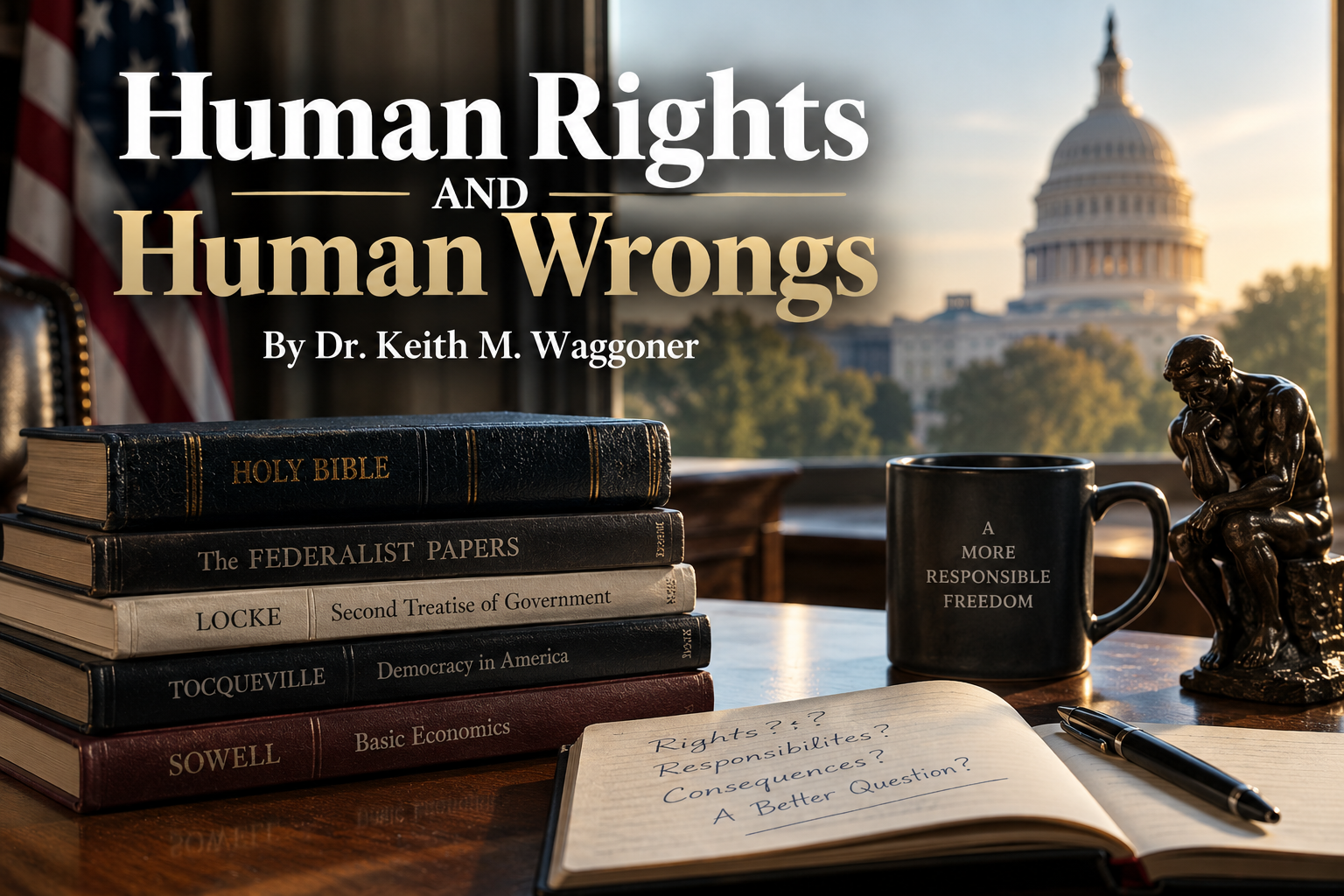
Human Rights and Human Wrongs
And their Responsibilities and Consequences
We hear an awful lot about human rights.
And we should.
Human history gives us plenty of evidence of what happens when powerful people decide that certain human beings don’t have any. Rights matter. They protect human dignity. They restrain power. They give us room to speak, protect ourselves, believe, worship, disagree, own property and make meaningful choices about our lives.
But I’ve been thinking about the other half of this equation.
We don’t hear nearly as much about human wrongs.
Somewhere along the way, we seem to have smuggled a strange idea into our understanding of rights. We have begun to act as though having the right to do something also gives us the right to be protected from the consequences of doing it.
It doesn’t.
Having the right to make a choice does not give me the right to choose the consequences.
That seems simple enough. Yet I believe much of our culture is struggling with exactly this distinction.
We confuse liberty with immunity. We confuse having the freedom to choose with having the power to control what happens after we choose. Then, when consequences arrive, we sometimes interpret the consequences themselves as an injustice.
I see this in marriage. I see it in business and leadership. I see it in families. I certainly see it in politics. And we see the same thinking played out between nations on the world stage.
Everybody knows how to say, “I have a right.”
The harder sentence is, “And this part is my responsibility.”
The Rights-Without-Responsibility Fallacy
There isn’t an established logical fallacy formally called the “Rights-Without-Responsibility Fallacy.” I use that phrase to describe a pattern that overlaps with special pleading and moral inconsistency.
It works something like this: Because I possess the right to make a particular choice, I should somehow be exempt from the unwanted consequences of that choice.
That’s bad thinking.
John Locke understood the distinction hundreds of years ago. In his Second Treatise of Government, Locke argued strongly for natural liberty. But he was equally clear that liberty was not the same thing as license. Freedom did not mean that whatever a person desired suddenly became legitimate simply because he desired it.
That distinction matters.
A free society has to find a way for my freedom to coexist with yours.
John Adams connected rights and obligations even more directly. Writing to his son Charles in 1794, Adams described the natural equality of human beings as an equality of “Rights and Obligations.”
Think about that language.
Rights and obligations.
Modern culture is very good at emphasizing the first word. I wonder whether we are becoming increasingly uncomfortable with the second.
You have the right to say something. Other people don’t have to like what you said. You may have the legal authority to make a decision in your company. Your customers are still free to stop buying from you. You may have the right to leave a relationship. That doesn’t mean leaving won’t cause pain. You have the right to hold an opinion. Having that right doesn’t make the opinion true.
And here’s one that matters enormously:
Being wronged does not make everything you do afterward right.
I have seen that one countless times in working with people.
Rights Inside a Marriage
Marriage may be one of the best laboratories for understanding this problem because two people can both possess legitimate freedoms and still hurt each other badly.
A husband says, “I have the right to tell her how I feel.”
Of course he does.
But she also gets to respond to how he expresses those feelings.
A wife says, “I have the right to make my own decisions.”
Of course she does.
But marriage means some individual decisions create relational consequences.
This is where maturity enters the equation. A mature person eventually has to become capable of holding two truths at the same time:
What you did to me was wrong. And I am still responsible for what I do next.
That’s hard.
One of the great psychological temptations of being wronged is that the offense begins to feel like permission. What someone else did becomes my justification for what I do next.
Children say, “He made me do it.”
Adults learn to make the same argument sound much more sophisticated.
The wound becomes the explanation. Then the explanation becomes the excuse. Eventually, the person is no longer simply asking for justice for what happened. He is using what happened to exempt himself from responsibility for his own behavior.
That is a terrible psychological bargain.
Because now the person who hurt you is still controlling you.
Business Has a Way of Teaching This Quickly
If you own a company, you have tremendous freedom to make decisions. You can change the strategy. You can raise prices. You can restructure the company. You can replace people.
You can also be wrong.
And the marketplace doesn’t particularly care that you had the right to make the decision.
Customers leave. Good employees quit. Competitors capitalize on the mistake. Revenue drops.
The marketplace has a wonderfully brutal way of saying:
Yes, you were allowed to do that. Now here is what happened because you did.
That is consequence.
And consequence is one of life’s greatest teachers.
I worry about what happens to people when we continually interrupt that teacher. If every painful result gets reinterpreted as somebody violating my rights, how do I develop judgment? How do I learn wisdom? How do I learn to repair something I’ve damaged?
More importantly, how do I learn the difference between something I can do and something I should do?
Liberty Was Never Supposed to Mean “Anything I Want”
This is where I think we have sometimes misunderstood the American experiment.
Read the Declaration of Independence carefully. It speaks of life, liberty and the pursuit of happiness.
Pursuit.
There is no guarantee that your pursuit will succeed.
There couldn’t be.
Liberty creates the opportunity to make meaningful choices. But meaningful choice includes the possibility of choosing badly.
The Founders understood this because they did not have a particularly romantic view of human nature.
James Madison famously observed in Federalist No. 51 that if men were angels, government would not be necessary. The Constitution was built around the understanding that people with power need restraints because human beings remain human beings after they receive power.
John Adams went even further in his early writings about liberty. He argued that the foundations of a free political order rested on “truth, liberty, justice and benevolence.” Remove those foundations, he warned, and the structure built upon them eventually comes down.
That is worth considering in our own time.
Rights can survive disagreement. I don’t believe they can survive indefinitely after a culture abandons responsibility.
George Bernard Shaw later put the problem in a wonderfully concise sentence:
“Liberty means responsibility.”
That is why freedom is harder than it sounds.
Freedom means I get to choose.
Responsibility means I have to own what I chose.
Scripture Asked the Better Question Long Ago
The biblical view of freedom is even more demanding.
Paul writes about Christian liberty in 1 Corinthians 10:23 and says, “All things are lawful,” but not all things are helpful. He then adds that not everything builds up.
That’s an extraordinary way of thinking.
Paul moves us beyond the most primitive moral question:
Am I allowed to do this?
That is often where modern discussions about rights stop.
But Paul keeps going.
Is it helpful? Does it build something? What does my freedom produce?
Now we’re thinking at an entirely different level.
The same principle appears in Galatians when Paul tells believers that they have been called to freedom, but warns them against using that freedom merely to serve themselves.
In other words, Scripture doesn’t treat freedom as the removal of responsibility.
It increases responsibility.
The immature question is, “Can I?” The mature question is, “What will this create if I do?”
That’s a question worth teaching our children. It’s worth teaching leaders. It’s worth asking ourselves.
The Question That Exposes Our Hypocrisy
There is another question I’ve learned to ask when somebody is defending a principle very passionately.
I ask it of myself too.
Would I still believe this if the same principle benefited my enemy?
Sit with that one for a minute.
If I believe in freedom of speech, do I believe in it when someone says something I despise? If I believe leaders should be held accountable, do I still believe it when the leader happens to be someone I voted for? If I demand grace for my mistakes, how much grace am I willing to extend when someone else fails?
If I demand fidelity from my spouse, am I faithful? If I expect excellence from the people I lead, what standard do I accept for myself? And if I demand justice when someone hurts me, am I still interested in justice when I am the one who caused the harm?
This is where the subject becomes much less comfortable.
Because it’s easy to talk about what is wrong with “society.”
It’s harder to ask where I am doing the same thing.
Where am I demanding the privilege while resisting the responsibility?
Where have I confused being hurt with being right? Where have I explained my own behavior by my intentions while judging someone else’s behavior by the result? Where do I want understanding for my circumstances but accountability for yours?
And where have I confused having the right to do something with it being the right thing to do?
Those questions will tell us considerably more about ourselves than another political argument ever will.
Rights, Law and Precedent
This becomes especially important when we move from personal morality into law.
Rights in American constitutional law are not simply declarations that nobody can ever experience an unwanted consequence. Rights restrain what government can lawfully do. They establish protections and procedures. They create boundaries around governmental power.
But law also has to think beyond the emotionally compelling case sitting in front of us today.
It has to ask:
What rule are we creating for tomorrow?
That is one reason precedent matters.
The doctrine of stare decisis gives prior judicial decisions weight because consistency matters to the rule of law. Courts can and do overturn precedent. But precedent is not supposed to become meaningless simply because a later group of judges would have preferred a different answer.
The deeper idea matters outside a courtroom too.
I believe culture has precedent.
Every time a parent excuses something, he teaches something. Every time a leader rewards something, she teaches something. Every time an organization tolerates something, it teaches something.
Every time we ignore a violation because we happen to like the person doing it, we teach everyone watching what our principles actually mean.
This is why leaders should learn to ask:
If I make an exception here, what am I actually making normal?
That question belongs in courtrooms and boardrooms. It belongs in marriages, families and churches. It belongs in government.
And it belongs inside each of us.
What Happens If We Keep Going?
This is the part that concerns me most.
What happens to a society that becomes increasingly fluent in the language of rights and increasingly allergic to the language of responsibility?
At first it probably feels like more freedom.
Eventually, I believe it produces less.
When people cannot govern themselves, someone else eventually offers to govern them. When businesses abuse trust, regulation grows. When communities cannot maintain order, enforcement grows. When people continually use freedom irresponsibly, the disorder created by that irresponsibility becomes the argument for restricting freedom.
There is a paradox here:
Freedom requires enough self-restraint to remain free.
That is one reason self-government has always meant more than voting.
Before self-government is political, it is personal.
Can I govern my appetites? Can I govern my anger? Can I govern my mouth? Can I tell myself no? Can I accept correction? Can I admit that I was wrong? Can I take a consequence without immediately turning myself into a victim?
A population increasingly incapable of those things will eventually find constitutional freedom very difficult to maintain.
If You Want to Think More Deeply About This
Part of the answer is learning to read deeply again.
We consume enormous amounts of information, but information is not the same thing as wisdom. Real reading slows us down. It forces us to sit with ideas long enough to understand them before deciding whether we agree.
I would start with John Locke’s Second Treatise of Government because Locke forces us to think carefully about liberty, natural rights and the limits of freedom. Then read the Declaration of Independence and the Constitution themselves. Don’t begin with somebody else’s interpretation. Begin with the documents.
Read The Federalist Papers, especially Madison and Hamilton, because they were wrestling directly with the problem of how to preserve liberty while accounting for human ambition and weakness. Read Alexis de Tocqueville’s Democracy in America because Tocqueville understood that democracy depends on culture and character as much as political institutions.
Read Edmund Burke because he will make you think about inherited structures, social order and what can happen when people destroy institutions before understanding what those institutions were holding together. Read C.S. Lewis’s The Abolition of Man because Lewis asks what happens when a culture loses an objective moral framework and then tries to educate people without one.
Read Viktor Frankl’s Man’s Search for Meaning because Frankl understood that freedom and responsibility belong together at the level of the individual soul. Read Thomas Sowell because he continually forces the reader to look beyond good intentions and examine tradeoffs, incentives and unintended consequences.
And read Scripture slowly. Read Proverbs. Read the Sermon on the Mount. Read Paul’s writings about liberty, conscience, self-control and responsibility.
But don’t merely ask, “Do I agree with this?”
Ask better questions.
What does this writer believe about human nature? What assumption is underneath the argument? What happens if I carry the idea to its logical conclusion? Who pays? Who bears the obligation? What happens when my right collides with yours? Who decides? What precedent does this create?
And keep asking this one:
Would I still defend this principle if someone I completely disagreed with were the one using it?
That is how we begin separating principles from preferences.
Human Rights and Human Wrongs
I believe deeply in human rights.
We should defend them vigorously because human beings are capable of doing terrible things to one another. Governments need limits. Powerful institutions need limits. Leaders need limits.
But there is another truth we need to recover.
Human beings aren’t merely capable of being wronged.
We are capable of being wrong.
Me too. You too.
And there is tremendous power in a person who can look at what happened and say, “I was wrong. That decision was mine, and this part belongs to me. I need to repair what I can, learn from it and do better.”
That isn’t weakness.
I believe the capacity to do that is actually one of the fundamental competencies required for freedom.
John Adams could speak about rights and obligations together. Paul could distinguish between what was permissible and what was beneficial. The Founders could champion extraordinary individual liberty while simultaneously building a government around the reality that human beings cannot safely possess unlimited power.
Maybe they understood something we are in danger of forgetting.
A free society requires more than people who know their rights. It requires people with enough character to be responsible for their wrongs.
So yes, we should keep talking about human rights. We should understand them, teach them and vigorously defend them.
But perhaps every serious discussion of our rights should eventually force us to ask the harder question about ourselves:
Where am I wrong, and what am I responsible to do about it?
That question can save a marriage. It can change a business. It can transform a leader.
And if enough free people recover the courage to ask it of themselves before demanding that everyone else answer it, it might help preserve something much bigger than any one of us.
A society capable of remaining free.