
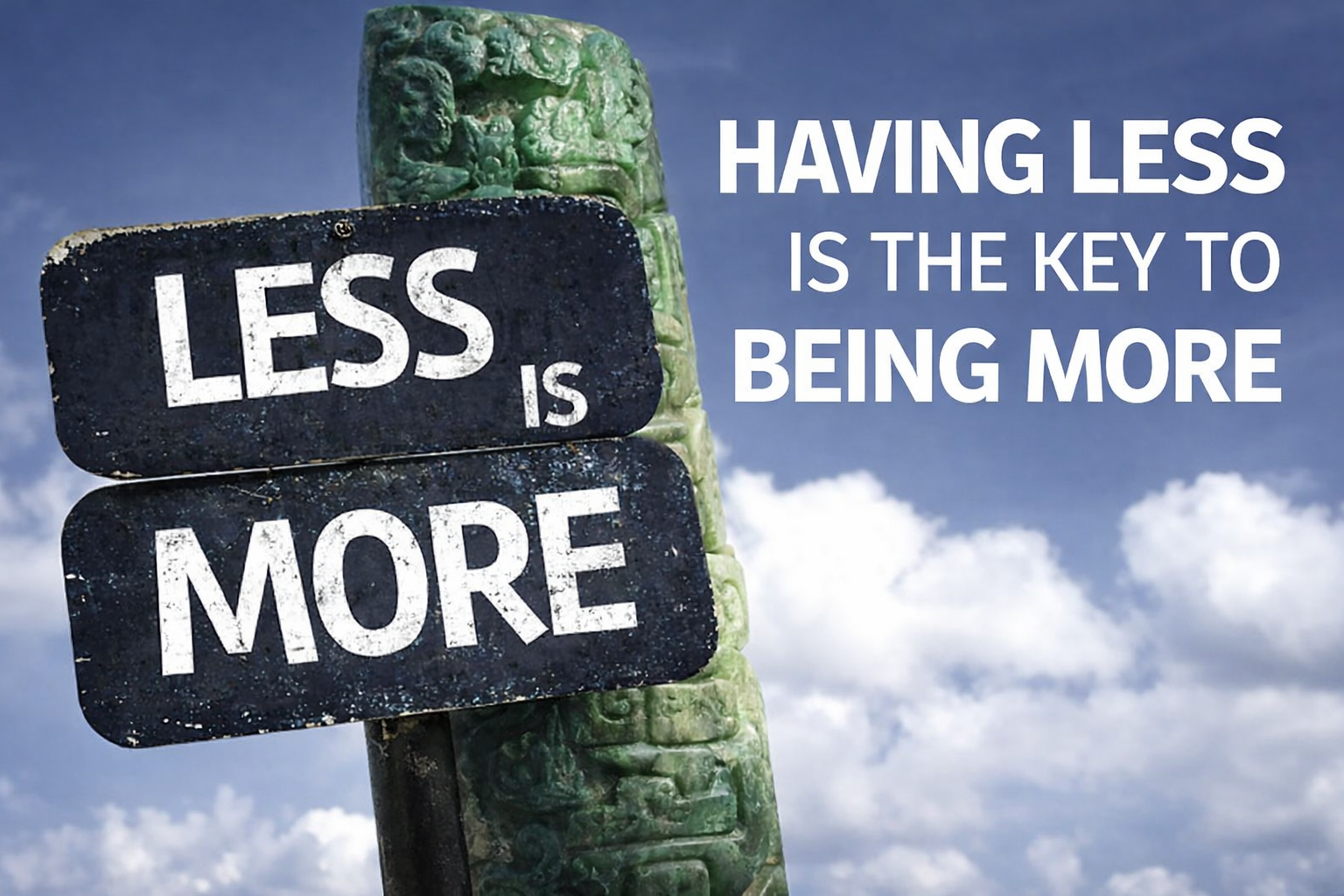
Having Less Is the Key to Being More… by Dr. Keith M. Waggoner
We live in a culture obsessed with more.
More money.
More power.
More pleasure.
More recognition.
More followers.
More relationships.
More success.
But more of what exactly?
And at what cost?
A friend of mine once told me a story that permanently changed how I think about happiness, fulfillment, and the second half of life. He was describing a moment he experienced while visiting the National Palace Museum.
He found himself standing in front of a jade sculpture and immediately knew that what he was looking at was not Western art.
Someone nearby asked a simple question.
“When you think of a work of art yet to be started, what image comes to mind?”
The answer came to him instantly.
“An empty canvas.”
In the Western mind, art comes into being through addition. More brushstrokes on the blank canvases of life… More paint. More effort. More stuff… More, More, More. The assumption is that the art does not exist yet and must be built the endless accumulation of material things. Somehow this is supposed to make us happy.
Then came a very different answer. The art curator said:
“An uncut block of jade.”
His Eastern type philosophy comes from the idea that the art already exists. The work is not to add. The work is to remove everything that is not the art… anything that is unessential and needs to be chipped away, given away, released, freed and even used by others who need it to create their own best life.
He went on to say:
“Westerners believe they are incomplete until they have more. We believe we are incomplete until we have less.”
That single sentence explains an enormous amount of modern frustration.
The Rembrandt Problem
Can you imagine buying a masterpiece painting, let us say a Rembrandt.
Nearly perfect.
Timeless.
You pay ten million dollars for it.
You bring it home.
And the very first thing that happens is your cousin’s wife shows up with a box of watercolor paints.
She starts painting over it.
You shout, “What are you doing?”
She smiles and says, “Relax. I am making it better.”
She adds a little blue here. A splash of pink there. A flower that was never meant to be there. A new stick figure smudge that completely ruined a masterpiece.
Adding more is not always a good thing… in fact… most of the time it’s bad… We can clearly see this when thinking about art.
That is exactly what we do to our lives.
God designs something meaningful and alive, and then we start adding.
Another obligation.
Another purchase.
Another title.
Another distraction.
Another layer of identity.
We tell ourselves we are improving things. In reality, we are burying them.
By midlife, especially for driven and capable people, the canvas is full and life is not better. It is heavier. More cluttered. Less alive.
Happiness, especially in the second half of life, does not come from more paint.
It comes from restraint.
It comes from chiseling away what burdensome, extra, and unessential.
Until the real work of art can finally breathe.
Why More Keeps Failing Us
Psychology has caught up to this idea.
Barry Schwartz demonstrated that more choices increase anxiety and regret, not satisfaction. More options exhaust us and leave us second guessing our lives.
Neuroscience shows that constant stimulation traps the brain in a dopamine loop. Always chasing. Rarely content. Never settled.
Sociology shows that lives filled with speed and consumption become emotionally thin. We are busy but not present. Connected but lonely.
Scripture cuts straight through the noise.
“Life does not consist in the abundance of possessions.” Luke 12:15
Adding more to the painting does not make it more alive.
It makes it cluttered.
The Barns We Keep Building
Jesus tells the story of a wealthy man whose land produced abundantly. His response was simple. Tear down the barns. Build bigger ones.
More storage.
More control.
More self focus.
God calls him a fool.
Why?
Not because he earned.
Not because he succeeded.
But because everything was for himself.
This leads to my favorite definition of greed.
Greed is believing that everything I earn, create, or accomplish belongs only to me.
That belief always produces suffering.
It is like standing in front of a masterpiece and saying, “You know what this needs? More of me.”
My Million Dollar Turning Point
When I made my first million dollars, something important happened.
I remember thinking, “Who actually needs more than a million dollars?”
That question did not kill my ambition. It purified it.
If earning was only about comfort, status, or proving something, it would have become hollow very quickly. It had to become about contribution. About stewardship. About something much bigger than me.
I also remember a quieter realization during that season. My calendar was full. My days were productive. But parts of my life felt thin. Less relational margin. Less stillness. Less presence.
Nothing was broken. But something was crowded.
That was the warning sign.
The shift from accumulation to contribution expanded my imagination instead of shrinking it.
I was no longer trying to add paint to my own portrait. I was trying to use resources to restore other people’s canvases.
This is why Alexander the Great is said to have wept when there were no more worlds to conquer. When expansion remains self focused, the finish line becomes despair.
I say this often because it is true.
There is no such thing as low self esteem. There is only high self focus.
When everything becomes about you, life gets very small.
The Myth of More Money
Research has consistently shown something that challenges our assumptions about wealth and happiness.
In Western societies, once basic needs are met and modest comfort is achieved, usually somewhere between seventy thousand and one hundred thousand dollars of annual income, additional money does not meaningfully increase life satisfaction or long term happiness.
After that point, what tends to change is not joy, but psychology.
People often become more anxious, more status conscious, more guarded, and more disconnected.
This does not mean money is unnecessary or evil.
In our culture, money is required to live responsibly, to provide for family, and to participate fully in society.
But only enough.
What matters far more than the amount of money a person earns is the relationship they have with money and the purpose it serves.
Over the last thirty years, I have coached countless men and women who had more money than they could ever reasonably spend.
From the outside, their lives looked enviable. On the inside, many were a hot mess.
Disorganized.
Relationally strained.
Spiritually thin.
Emotionally scattered.
Wealth had solved certain surface problems, but it had not created order, meaning, or fulfillment.
In many cases, it actually amplified chaos because there was no internal structure to hold the external success.
Money without wisdom does not bring peace.
It removes pressure in one area while quietly exposing weakness everywhere else.
This is why chasing wealth without a clear reason beyond self consumption or comparison rarely makes life better.
More often, it makes life smaller.
Money can remove pressure, but it cannot create order. Without purpose, more wealth does not expand a life. It exposes what is already missing.
Whoever loves money never has enough; whoever loves wealth is never satisfied with their income. Ecclesiastes 5:10
Money itself is not the watercolor ruining the masterpiece.
Our disordered relationship with it is.
When money becomes a tool for provision and contribution, it serves the art of life well.
When it becomes a substitute for meaning, identity, or worth, it becomes just another layer of paint covering what was already beautiful.
Wisdom knows when to stop adding and start preserving.
The goal is not less money for its own sake.
The goal is enough, ordered rightly, so the true work of art can finally be seen.
Self Focus Versus Others Focus
This is where the real dividing line appears.
Self focus asks one question repeatedly.
What do I need next?
Others focus asks a better one.
What do I have that is needed?
Self focus turns life into a mirror.
Contribution turns life into a window.
A self focused life consumes.
An others focused life contributes.
Self focused leaders build impressive resumes and leave relational wreckage.
Others focused leaders build people who outlast them.
Self focus shrinks marriages into scorekeeping.
Others focus turns marriage into a place of refuge and strength.
Self focus makes faith transactional.
Others focus makes faith transformative.
The Five Life Currencies
Over decades of coaching, I have found that fulfillment flows through five primary currencies. These are not ideas. They are diagnostic tools.
Time
Time is your life in minutes.
If your schedule is full but your soul feels rushed, time is misaligned.
Action step: Remove one low value activity and redirect that hour toward something that builds people.
Money
Money is stored labor and problem solving.
If generosity feels stressful instead of joyful, money has become about security, not stewardship.
Action step: Create an intentional giving plan and treat it like a responsibility.
Passion
Passion is the fire of calling.
If you feel competent but not alive, passion is buried.
Action step: Schedule one passion activity weekly and protect it.
Relationships
Relationships multiply meaning.
If people are close to you but not connected to you, relationships are undernourished.
Action step: Make one weekly relational deposit with your spouse, your children, and one trusted brother.
Service
Service grounds a man in purpose.
If your life runs efficiently but not meaningfully, service is missing.
Action step: Choose one place to serve consistently for ninety days.
When these currencies circulate, life becomes meaningful. When they stagnate, life rots.
Five Ways We Overpaint Our Lives
Most people are not suffering because they lack. They are suffering because they are overpainted.
- Identity overload
- Possession creep
- Busyness as validation
- Approval addiction
- Armor accumulation
Bruce Lee said it best.
“It is not daily increase but daily decrease. Hack away the unessential.”
That is not laziness. That is mastery.
The Second Half of Life Truth
Addition works early in life.
You build skills. You build capacity. You build competence.
But in the second half of life, addition stops working.
More success does not fix emptiness. More money does not heal restlessness. More recognition does not create peace.
The second half of life demands subtraction.
You simplify. You clarify. You refine.
You stop asking how much more you can carry and start asking what no longer belongs.
A Common Objection
Some will say, “But does less mean shrinking? Does subtraction mean losing ambition?”
No.
Less means precision.
Less means alignment.
Less means strength without clutter.
The sculptor does not weaken the jade by removing stone. He reveals it.
How to Start Chiseling Today
- Identify one thing you are adding that does not belong
- Remove one commitment this week
- Reduce digital noise
- Plan one intentional act of contribution weekly
- Ask what a lighter, freer life looks like in five years
The Masterpiece Was Never Missing
You were never an empty canvas.
You were always a block of jade.
Whole. Designed. Purposeful.
The tragedy is not that we lack something.
The tragedy is that we keep painting over what was already beautiful.
Less is not loss.
Less is restoration.
An Invitation
If you feel successful but restless, accomplished but unsatisfied, busy but disconnected, you are not broken.
You are overpainted.
This is the work I help men and leaders do. To strip away what does not belong. To clarify purpose. To reorient life toward contribution.
If you are ready to stop adding and start chiseling, reach out. This is not about doing less. It is about becoming more.
Suggested Reading
- The Paradox of Choice by Barry Schwartz
- Essentialism by Greg McKeown
- Man’s Search for Meaning by Viktor Frankl
- The Second Mountain by David Brooks
- Tao of Jeet Kune Do by Bruce Lee
- The Ruthless Elimination of Hurry by John Mark Comer
- Celebration of Discipline by Richard Foster
Let me ask you…
What do you need to stop adding so the masterpiece of your life can finally be seen?
Reach out to me if you’d like to make your life a Masterpiece… one like God intends for it to be.
~Keith