
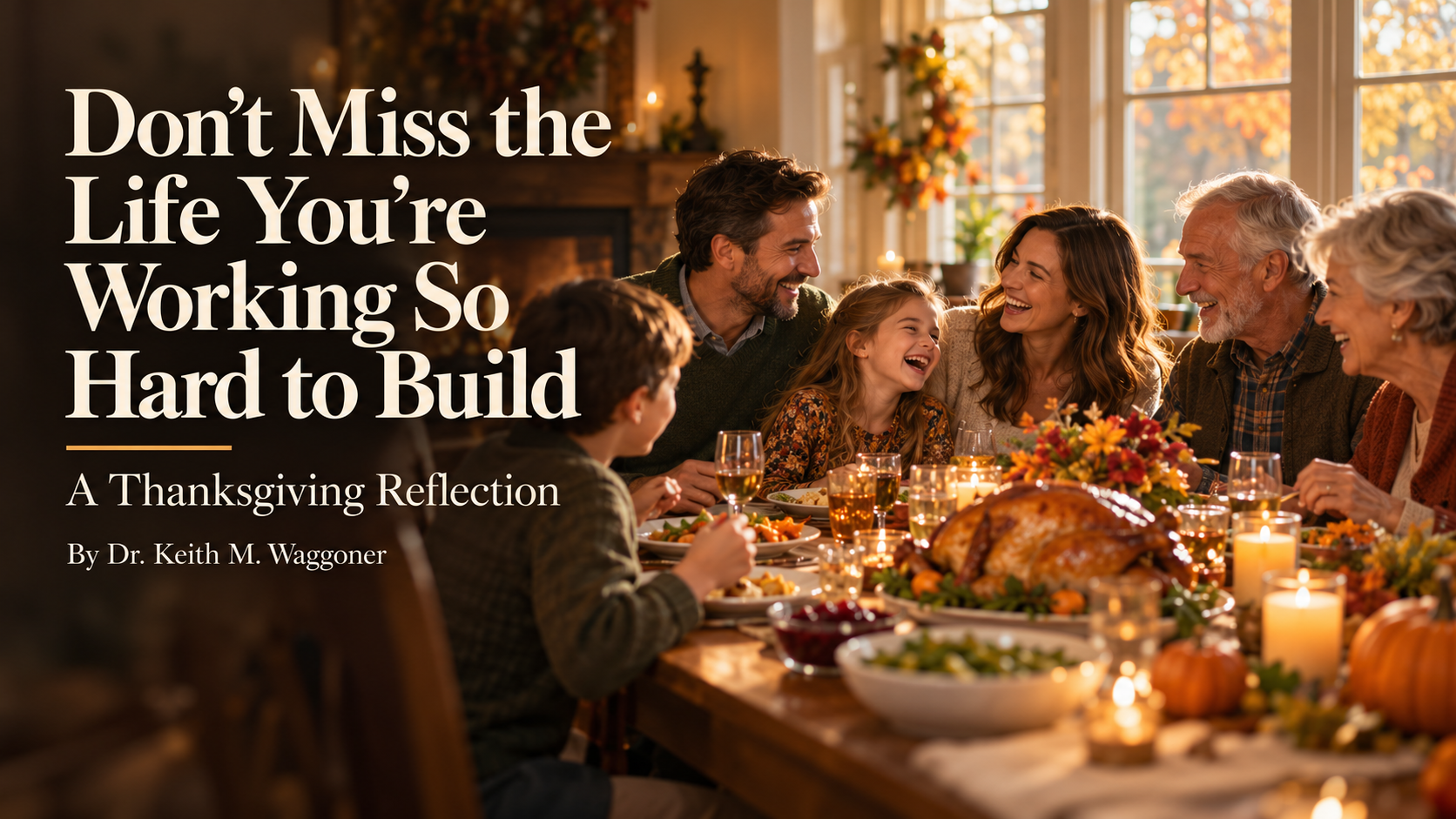
Don’t Miss the Life You’re Working So Hard to Build
A Thanksgiving Reflection
By Dr. Keith M. Waggoner
Somewhere this Thanksgiving, somebody will spend two days preparing a meal that takes twenty minutes to eat. Someone will arrive late, someone will bring up a subject everyone agreed to avoid, and someone will fall asleep in a chair while insisting they’re watching the game.
And somewhere in the middle of it, you may catch yourself thinking about everything you still need to do.
The unanswered emails. The business decision. The family issue that didn’t take the holiday off. The goal you thought you would have reached by now.
Your body will be at the table, but your mind will be back at work, trying to improve a life you haven’t stopped long enough to enjoy.
I know that temptation. Many of the people I coach know it well. You care deeply. You carry responsibility. You see what needs to happen, and you have trained yourself to move toward it. Those qualities have helped you build a business, provide for your family, overcome adversity, and become someone others can count on.
But they can also make it surprisingly difficult to recognize when you are standing in the middle of something good.
When Better Keeps Moving
I believe in getting better. I’ve devoted my life to helping people do it. Better marriages. Better leadership. Better health. Better response patterns. A better relationship with God and a clearer understanding of what He has entrusted to us.
But there is a trap hidden inside the pursuit of better: we can become so practiced at identifying what is missing that we lose sight of what is here.
You pay off one debt and immediately focus on the next. You reach a goal and barely acknowledge it before raising the standard. Your marriage improves, but the first disagreement convinces you that nothing has changed. Your child takes a meaningful step forward, and you respond by explaining the next three steps.
Eventually, the people you love may begin to wonder whether anything they do will ever be enough. If you’re honest, you may wonder the same thing about yourself.
There is nothing wrong with seeing the next mountain. Just take a moment to recognize the one you climbed.
Don’t make the people you love compete with the life you’re trying to give them.
Thanksgiving is a good time to examine that. What have you been working for, and are you allowing yourself to experience any of it?
Give Thanks in the Unfinished Parts
Some of you are coming to this holiday after a difficult year. There may be an empty chair at your table. A relationship may still be strained. You may be carrying a private disappointment that nobody gathering around you knows anything about.
You don’t have to pretend those things are easy.
Scripture says, “In every thing give thanks” (1 Thessalonians 5:18). We can give thanks in the middle of circumstances we would never have chosen. We can acknowledge the hurt and still recognize the person who stood beside us, the help that arrived, or the strength God gave us to take the next step.
Grief and gratitude can sit at the same table.
You can miss someone terribly and be thankful you loved them. You can wish a season had unfolded differently and appreciate what you learned. You can face an unresolved problem and recognize that you have more wisdom, support, and courage to address it than you once did.
That is an honest way to give thanks. It allows you to see more of your life than the part that hurts.
Look at What Has Become Ordinary
Think about something you have complained about recently. Now consider what that same thing might have meant to you ten or twenty years ago.
The house that needs repairs may once have been the home you prayed you could afford. The busy calendar may contain opportunities you spent years trying to create. The person whose habits irritate you may also be the person who has stayed beside you through your hardest seasons.
Of course, repairs still need to happen. Schedules need boundaries. Relationships need attention. Gratitude helps us approach those responsibilities with a fuller understanding of their value.
Try completing this sentence:
“There was a time when I hoped I would someday…”
Have a family. Get another chance. Own a business. Be healthy enough to take a walk. Find someone who believed in me. Have work that mattered.
How many of those things are part of your ordinary Tuesday now?
Familiarity can make extraordinary gifts seem unremarkable. Thanksgiving invites us to look again.
Put Your Gratitude to Work
This year, go beyond naming something you’re thankful for. Ask yourself what your gratitude should cause you to do.
If you’re thankful for your spouse, what could you say that would help them feel appreciated? If you’re thankful for your children, when will you give them your undivided attention? If you’re thankful for your health, what habit would honor it? If you’re thankful for the opportunities God has given you, how will you use them to serve?
At the table, try asking a question that takes a little more thought than the usual holiday answers:
“Who helped make this year better, and have I actually told them?”
Then be specific. “Thanks for everything” is kind. “When I was struggling, you kept calling, and those calls helped more than you knew” gives someone something they can carry.
You may be sitting beside a person who has no idea how much their faithfulness has meant to you. Don’t assume they know. Tell them while you have the opportunity.
My Thank You to You
That brings me to something I want to say directly to my clients.
Thank you.
Thank you for trusting me with the parts of your life that don’t always make it into the public version. Your questions, your fears, your marriage, your leadership, your faith, and the places where you know you are capable of more.
I know that trust carries weight. I don’t take it lightly.
I have watched you face difficult truths, take responsibility, repair relationships, and make decisions you had been avoiding. I have seen you return to the work after a setback, choose a better response when an old pattern would have been easier, and become more deliberate about the influence you have on others.
Some of your most meaningful victories have been quiet. A different tone with your spouse. An apology without an excuse. A promise kept. A boundary held. A moment when you paused and chose the person you wanted to become.
I am grateful to walk beside you in that work. Your willingness to grow encourages me, challenges me, and gives me hope for the families, businesses, and communities your lives touch.
This Thanksgiving, I hope you enjoy the meal, laugh at the stories, and stay at the table a little longer. Let a few things wait. Look around and recognize what is good, even while parts of life remain unfinished.
There will be time to work on the next chapter. Give yourself permission to enjoy the one you’re living.
Happy Thanksgiving to you and your family.
Live Life ALIVE.
Dr. Keith M. Waggoner
Read and Reflect
For a few quiet minutes this Thanksgiving, read Psalm 103:1–5, Philippians 4:11–13, and 1 Thessalonians 5:16–18.
Consider this question: What good thing have I become so accustomed to having that I have stopped treating it as a gift?