
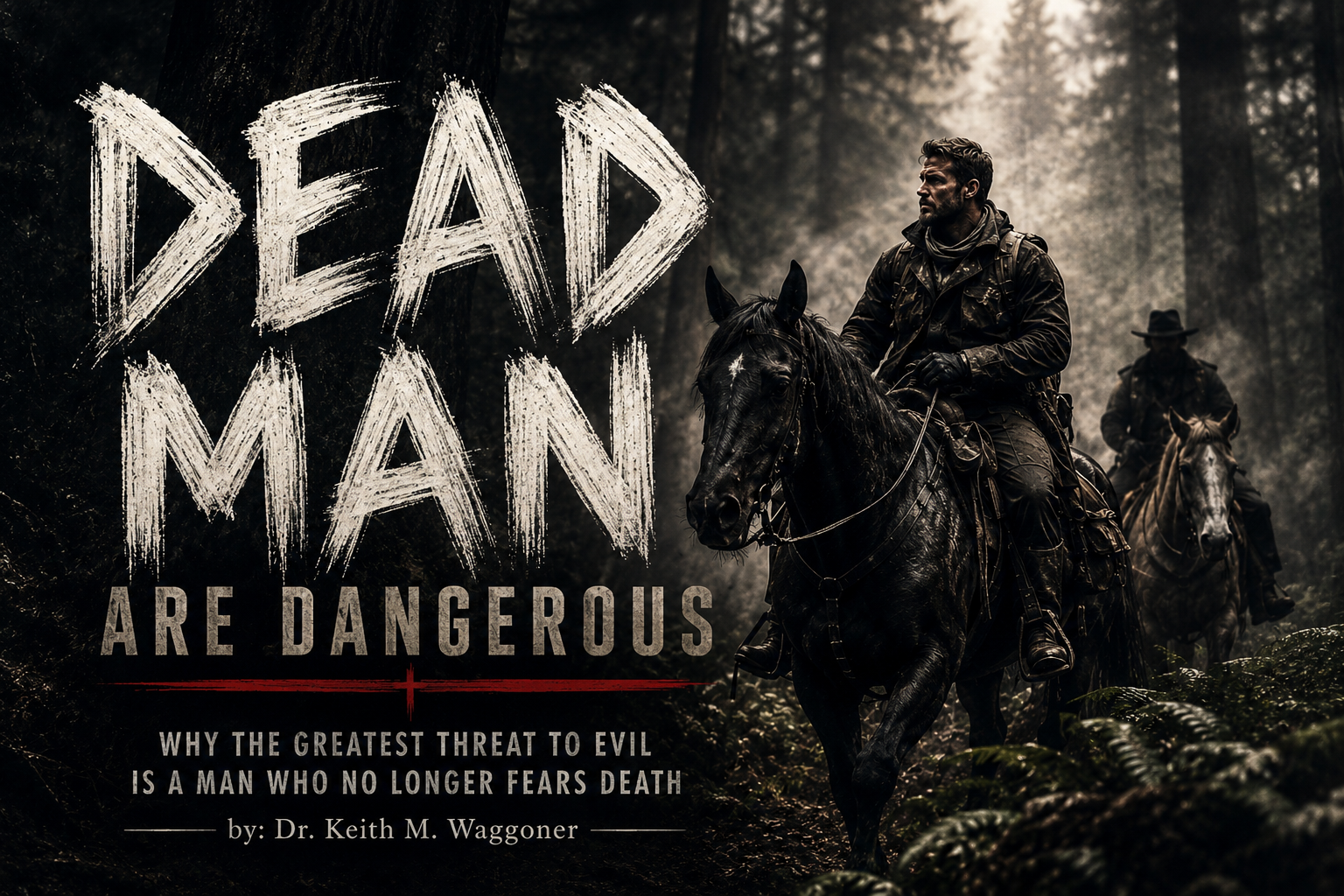
Dead Men Are Dangerous
The Greatest Threat to Evil Is a Man Who No Longer Fears Death
by Dr. Keith M. Waggoner
It is two o’clock in the morning.
Most Americans are asleep. Children are tucked safely into bed. Neighborhoods are quiet. Tomorrow’s biggest concerns for many people will be traffic, deadlines, meetings, and whether the coffee maker works. Few will give a second thought to why they enjoy the freedom to live such ordinary lives.
At that same moment, somewhere in the world, a team of American special operators is loading onto a black helicopter. They are not flying toward comfort. They are flying toward danger. Before the sun rises, they may confront men who have dedicated their lives to spreading violence, terror, and chaos. Some of those enemies may never see another sunrise.
That happened last night.
It happened last week.
It will happen again tomorrow night.
Most of us will never know their names. Their victories rarely make the evening news, and when they do, the details are often hidden from public view. Yet every American benefits from their willingness to stand between evil and the innocent. The safety, security, and quality of life we enjoy are preserved because there are still men willing to run toward the very danger the rest of us spend our lives trying to avoid.
I’ve often wondered what separates those men from everyone else. Certainly, they are exceptionally trained. They possess remarkable discipline and physical ability. But those qualities alone cannot explain why they willingly step into situations where death is a genuine possibility. The answer, I believe, is psychological before it is physical. Somewhere along the way, they settled a question that most people spend their entire lives avoiding.
They settled the question of death.
The Most Dangerous Man in the Room
Most people misunderstand what makes someone dangerous. Hollywood tells us it is the biggest man, the loudest man, or the most intimidating man. In reality, those qualities are often little more than camouflage for insecurity. Truly dangerous people rarely need to advertise themselves.
The most dangerous man in the room is the man who cannot be controlled by fear.
Every form of manipulation ultimately rests upon fear. Fear of failure. Fear of rejection. Fear of embarrassment. Fear of losing money. Fear of losing status. Fear of disappointing people. And beneath every one of those fears lies humanity’s oldest companion: the fear of death itself.
If someone can control your fears, they can often control your decisions. They can influence your behavior, shape your priorities, and cause you to compromise convictions you once believed were immovable. Fear has always been one of evil’s favorite weapons because it requires very little effort. It simply whispers, “Protect yourself,” and many people surrender without a fight.
But what happens when a man is no longer governed by fear?
He becomes extraordinarily difficult to intimidate.
The Warrior’s Greatest Advantage
The ancient samurai understood this principle long before modern psychology gave it a name. They intentionally prepared themselves for battle by embracing the reality that they were already dead. To the modern mind, that sounds almost morbid, but it produced something remarkable. If a warrior had already accepted the possibility of death, then his enemy had lost his greatest source of leverage.
How do you threaten a man who has already surrendered everything?
How do you intimidate someone who has already made peace with the worst possible outcome?
You don’t.
That mindset did not produce recklessness. It produced clarity. Decisions became simpler because fear no longer clouded judgment. The warrior was free to act according to principle rather than panic. He fought with conviction instead of hesitation.
History repeatedly demonstrates that the man who fears death less often possesses the greatest psychological advantage. The issue has never been who is physically stronger. It is who is mentally freer.
Christianity Takes This One Step Further
As powerful as the samurai philosophy was, Christianity reaches even deeper.
The Christian does not simply accept death. He believes death has already been conquered.
The Apostle Paul writes in Romans that believers have been buried with Christ and raised to walk in newness of life. This is far more than theological language. It is a radical transformation of identity. The Christian understands that his ultimate life is not defined by his heartbeat but by his relationship with Christ. As Paul would later write, “For to me, to live is Christ and to die is gain.”
Think about the psychological implications of that statement.
If death itself has lost its final victory, what remains to fear?
You can reject me.
You can ridicule me.
You can cost me a promotion.
You can damage my reputation.
You can even take my life.
But you cannot take what Christ has already secured.
That realization does not make a believer careless. It makes him courageous. His confidence no longer rests in favorable circumstances but in an unshakable identity. He no longer asks, “What if I lose?” Instead, he asks, “What is the right thing to do?” Those are two completely different ways of living.
The Enemy’s Greatest Weapon
Throughout Scripture, Satan repeatedly uses fear as a tool of bondage. Fear causes otherwise capable men to remain silent. It keeps husbands from leading their homes. It convinces fathers to seek comfort instead of responsibility. It persuades business owners to play small and leaders to avoid difficult conversations.
Fear rarely announces itself dramatically. More often, it disguises itself as wisdom, caution, or practicality. It tells us to wait for a better opportunity, gather a little more information, or avoid taking unnecessary risks. Before long, years have passed, and the life we were called to live has quietly slipped away because fear was allowed to make our decisions.
Paul reminds Timothy that “God has not given us a spirit of fear, but of power and of love and of a sound mind.” That verse is not merely comforting. It is deeply practical. Fear clouds judgment. Fear distorts reality. Fear narrows possibilities. A sound mind, by contrast, allows a leader to think clearly even when circumstances are uncertain.
That is why courage is not the absence of fear. Courage is refusing to grant fear authority over your decisions.
What This Means for Business, Leadership, and Life
Most of us will never board a military helicopter in the middle of the night. Our battlefields look different, but the psychology remains exactly the same.
Business owners face the fear of failure. Entrepreneurs fear rejection. Fathers fear not measuring up. Husbands fear difficult conversations. Leaders fear criticism. Every meaningful pursuit eventually confronts us with the same fundamental question: Who or what will determine my decisions?
If fear is your master, your potential will always remain smaller than your calling.
But when your identity is settled, something remarkable happens. You negotiate differently because you are no longer desperate. You lead differently because you no longer crave everyone’s approval. You make difficult decisions because your convictions matter more than your comfort. You stop living defensively and start living purposefully.
That kind of confidence cannot be manufactured through positive thinking. It is forged through surrender. Ironically, the man who has already surrendered everything to God becomes the freest man in the room.
Dead Men Are Dangerous
Don’t misunderstand the title.
This article is not about glorifying death. It is about defeating the fear of it.
The special operator who willingly flies into danger. The samurai who entered battle having already accepted death. The Apostle Paul proclaiming that to die is gain. They are all pointing toward the same profound truth.
The greatest threat to evil has never been the strongest man.
It has always been the man whose identity can no longer be manipulated by fear.
That is the husband who remains faithful when temptation offers an easier path.
That is the father who refuses to compromise his convictions to gain his children’s approval.
That is the business leader who tells the truth even when dishonesty appears more profitable.
That is the Christian who stands firm because eternity has already settled the outcome.
The world has always tried to control men through fear. But once a man truly understands who he is in Christ, fear begins to lose its grip. And when fear loses its grip, evil loses one of its greatest weapons.
That is why dead men are dangerous.
Not because they seek death.
But because they have already found something worth living for that is greater than death itself.