
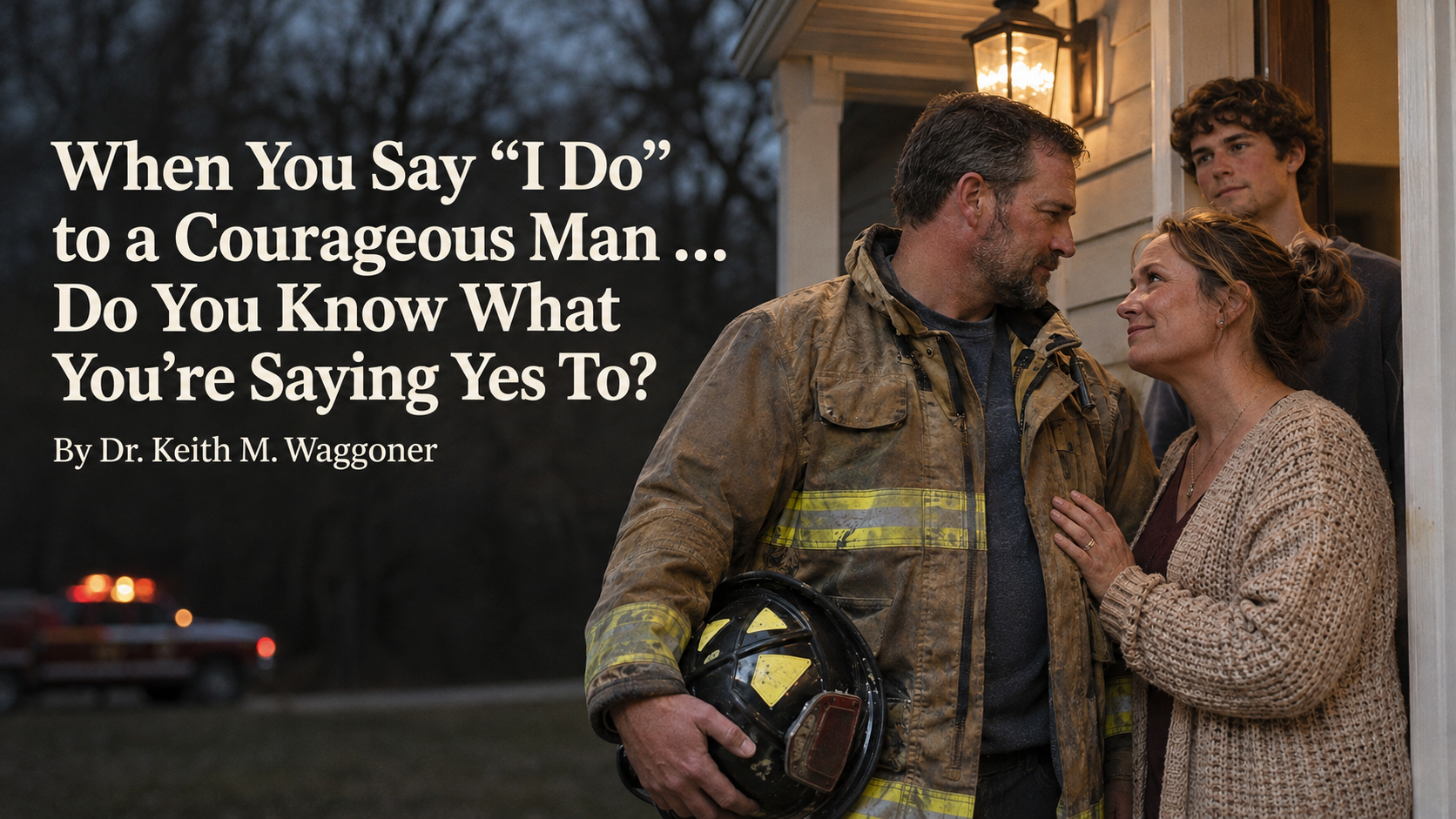
When You Say “I Do” to a Courageous Man
Do You Know What You’re Saying Yes To?
By Dr. Keith M. Waggoner
I could save your son and leave mine without a father.
That thought stopped me cold.
I’d been thinking about my son Seth and how hard he’s working to stand on his own two feet. But there are still ways he depends on me.
It’s easy to imagine the relief I’d feel if somebody brought him home to me … even if another man had to sacrifice his life to save him.
It’s a bit harder to imagine my wife Adrianne having to tell Seth why I wasn’t coming home … because I sacrificed my life for someone else.
And if I’m honest, before I got that far in my thinking, part of my fantasy was that Seth would grieve me. That I would be missed. I can hear my own need for validation in that. We enjoy one another, and I’m grateful for it. Still, I sometimes wonder whether I take the ways he needs me as evidence of how much he loves me. If I do my job well as his father, he’s going to need me less. I hope he’ll still call me just because he wants to.
Then I thought about the other father. If somebody gave his life to save Seth, I’d want that man’s wife and children to know what his life meant to me. I’d also go home with my son. They’d go home without their husband and father. I can imagine being grateful for the rest of my life and still having very little idea what it cost them when they sat down together that first Christmas.
So what do we expect of a man in a moment of truth? What do wives really say yes to when they marry a man who’s courageous and willing to sacrifice himself? And what does a man owe his wife, his children, and the people who love him when a decision he makes could change all of their lives forever?
Sit Down, Shut Up … Now Stand Up and Do Something
We can spend years telling a boy to sit down and shut up and be tame, meek, and harmless …
Then shame him because he hesitates to stand up in a matter of truth or come to someone’s rescue when it asks something of his strength, sacrifice, and resolve.
Picture a man at work who tells his boss the company is about to pass a cost on to a customer it promised to take care of. He’s told to quit making trouble. A few months later, the customer finds out, the owner calls a meeting, and somebody says, “Why didn’t anyone speak up?” The man who did speak up is sitting right there. He remembers exactly what it cost him the first time. The people who told him to let it go may have forgotten they ever said it.
A boy can start getting versions of that message in school. He has a hard time learning by sitting still and listening for long stretches. Give him a loose hinge to fix or something he can take apart and figure out, and you may find he’ll stay with it well past the point where you expected him to give up. Now you know something about him you couldn’t learn by watching him at his desk. You’ve seen him concentrate, work through frustration, and take some pride in figuring out what he couldn’t do ten minutes ago.
John Eldredge put words to something a lot of men recognized in Wild at Heart. He writes about a man’s longing for a battle to fight, an adventure to live, and a beauty to rescue. I believe God put the appetite for courage and adventure in boys for a reason. A boy needs adults who will give him real work and trust him with enough responsibility to find out what he’s capable of. He also needs somebody who can tell him to sit down when it’s another person’s turn to speak. If all he hears is the last part, we’ve left much of the job undone. John Eldredge, Wild at Heart
This is where I take issue with how quickly a boy’s behavior can become a conversation about ADHD and medication. ADHD is real, and treatment can help children whose difficulties are impairing their lives. A boy who struggles at school also deserves a careful look at what’s happening across his life. A review in Pediatrics notes that boys are diagnosed more than twice as often as girls and that diagnostic and cultural biases contribute to differences in who receives a diagnosis. Research also finds that the youngest children in a grade are more likely to receive an ADHD diagnosis than their older classmates. Those findings give us good reason to ask about a boy’s age, what his parents see at home, and where he has already shown that he can focus. A quieter room tells me the room got quieter. I want to know how the boy is doing. Pediatrics review on ADHD diagnosis · JAMA Network Open review on ADHD diagnosis in children and adolescents
We can spend years treating a boy’s readiness to act as a problem, then turn around and ask what kind of man he is when he hesitates.
I understand why men are angry about that. Some say it out loud. Others get good at keeping their heads down. They learn to wait for somebody else to make the call, and then they hear from their wives, their bosses, or their friends that they ought to take more initiative. You can see why a man would eventually say, “Make up your mind. What do you want from me?”
There comes a time when a man needs to ask what God expects of him and what he’s promised the people in his care. He can tell the truth about the double bind. Then he has a decision to make about how much authority he’s going to give it. If his wife brings him a concern and he hears every person who ever told him he got it wrong, she’s going to have a hard time getting through to him. She deserves a husband who can hear what she said. And he deserves to be free enough to answer her without settling an old score.
Who Bears the Cost of a Man’s Courage?
Most of us know the old proverbial question about whether a man would jump on a grenade. We know what it’s testing. When something terrible is about to happen and there’s a price to be paid, would you pay it for somebody else?
I want men to take that question seriously. I’d want a man to care enough to help my family if I couldn’t get to them. I have to be willing to reckon with what that same obligation might ask of me.
And I have to reckon with the part of the cost I can’t volunteer to pay myself. If I lose my livelihood because I refuse to go along with something dishonest, my family has to live on less too. If I get hurt badly enough, Adrianne may find that a good part of her life now involves caring for me. If I die, she may spend the next several years doing things we expected to do together. The rest of us get to admire what a man did. His wife has to figure out how to get through Christmas.
A man may volunteer to make a sacrifice. The people who love him may spend years making it with him.
That puts an obligation on the people who praise him, too. If you were moved by what a man gave, check on the people who are living without him after the meals stop coming. Invite his son to do something his dad used to do with him. Ask his wife how she’s doing a year later, when everybody assumes she’s doing better and she’s just had to make another decision she used to make with him.
The people entrusted to me have a claim on my judgment before I act. A stranger may still need my help. As a father, I have to think as clearly as I can about the help that person actually needs and what I’m putting at risk to give it. Some of what I stand to lose belongs to other people.
The Man Who Needs to Prove Something
There’s a part of a man I call the Gambler Persona. You’ll hear him when a man starts talking as if the moment in front of him could settle something about who he is. Maybe somebody questioned his nerve. Maybe he’s spent years feeling overlooked. Maybe he was the boy who got told to sit down and shut up, and there’s a part of him that would love to do something nobody could dismiss. He can end up making a decision today to answer a grievance from twenty years ago.
I recognize some of that in the thought that started this article. I was thinking about Seth losing his father, and there I was wondering how much he’d miss me. What if my appetite to know I matter ever got tangled up with my desire to do the right thing? I’d like to believe I’d know the difference immediately. I’m old enough to know how convincing a man can sound to himself when his pride is on the line.
Take something as ordinary as an email. A man at work has taken credit for something you did, and you sit down to tell him the truth. By the time you’ve written the message, you’ve copied two people who had nothing to do with it. You’ve added a sentence about the last time he pulled something like this. You read it back and feel pretty good about finally saying what needs to be said.
Then your wife asks, “What do you need him to understand?”
You can answer her in two sentences. Here’s the work I did. I want you to correct the record with the people you told. The rest of the message was there because you wanted him to feel as small as he made you feel. You still have something true to say. Now you can say it without asking the whole office to watch you say it.
That’s a small place to practice the judgment you’ll need when the stakes are higher. A man can genuinely care about doing what’s right and genuinely want to be seen doing it. Both motives can be present when he acts. One question I want to be able to ask myself is, Would I still feel compelled to do this if nobody ever knew I did it?
What a Woman Says “I Do” To
A woman may love that a man keeps his word when it costs him. She’s seen him take responsibility in situations where other people found a way to back out. She has good reason to believe that when life gets hard, she’ll have someone beside her who will face it with her.
Here’s what I want her to understand. The man she trusts to stand up for their children may believe he has a duty to stand up for somebody else’s child. The integrity she’s counting on in him at home is something he takes with him when he goes to work. Sooner or later, that may ask something of her, too.
Imagine he comes home and tells his wife, “I told them I wouldn’t put my name on those numbers. I think I’m going to lose the account.”
She might say, “I’m glad you refused. I’m scared about how we’re going to pay for things now. And I wish you’d told me when you first saw this coming.”
A man can hear the fear and disappointment in that answer and immediately start defending the decision. But she already told him she was glad he refused. She’s also telling him that she had plans for their life that counted on that income, and she’s hearing about the threat to it after he’s spent two weeks thinking about it alone.
He could say, “I’ve known this might happen since the first meeting. I didn’t want to worry you until I knew for sure. I can see what that did. I got two weeks to think, and you got ten minutes at the end of the day. Let me tell you what I know, and let’s look at what we’ll have to change together.”
That’s a man taking responsibility for the decision and for how it entered his marriage. And that’s a woman standing with a man whose decision she respects while telling him something he needs to hear. She may still be scared tomorrow. There will be bills to look at and things they were planning to do that they may have to set aside. She has a voice in what happens next because she’s going to live it with him.
And pay attention to what you ask of each other. If a woman asks a man to take initiative and treats every suggestion he makes as an intrusion, he hears both messages. If a man asks his wife to be straight with him and gives her the silent treatment when she is, she hears both of his. Over time, each of them learns which response keeps the peace. Then they wonder why he waits to be told what to do and she only tells him what he wants to hear.
Protect the Protector
There’s a privilege in being the person people turn to when something goes wrong. I enjoy that. I’m grateful that people trust me enough to bring me things they’re having a hard time carrying. A man can spend a whole day doing that, come home and take care of what needs doing there, and go to bed without anybody knowing what shape he’s in. Sometimes he’s the one who’s made sure nobody knows.
What does it look like for a wife to protect the protector? She might notice that her husband has been taking calls from a family member every evening for two weeks. Maybe he’s glad to help. Maybe he’s also becoming short with everybody in his own house by eight o’clock. She can ask what’s happening on those calls. She can tell him she sees why they matter and that the kids have noticed he hasn’t been around much after dinner. Now there’s something they can talk about. He can explain what the person actually needs, and they can decide together what he can give and what time he needs to keep for home.
Men, how she talks to you next time depends in part on what you do this time. If you cross-examine her about her tone until she forgets what she was trying to tell you, she’ll eventually decide the conversation costs too much. If you tell her everything is fine and bring home the irritability that comes with carrying too much, she’s already living with the burden. You can give her the dignity of knowing what it is.
Then take a look at what she’s been carrying. If you’ve been on those calls every evening, who made sure the kids got fed, answered their questions, and noticed what was bothering them? When did she get to tell you what happened in her day? Ask her what she set aside while you were helping somebody else. You may find she was glad you could help and would still like you to sit down with her and figure out how much longer she’s going to be handling dinner on her own.
If You Would Die for Her, Would You Live for Her?
“Many men would willingly die for their wives. If you truly would die for her, you would also live for her.”
In Ephesians 5:25, Paul tells husbands to love their wives as Christ loved the church and gave Himself for her. When I read that, I find very little room to calculate how much love I owe Adrianne according to what she gave me this week. Christ gave Himself. I have to ask what it means to give myself to the woman I married in the actual life we have together.
Jesus speaks in John 15:13 about laying down one’s life for one’s friends. Look at how He lived among the people He loved before He laid down His life. He ate with them. He patiently taught men who kept misunderstanding Him. He washed their feet. The people who knew Him had years of experience with His love by the time they had to make sense of His death.
Say you would take a bullet for your wife. What happens when she needs twenty minutes of your attention at the end of a day when you’d rather be left alone?
Maybe she tells you she’s worried you’re growing apart. You can already hear the answer you want to give. You worked late because you’re trying to cover an expense both of you are worried about. You got up early Saturday to fix something she asked you to fix. You want her to see what you’ve been doing. Fair enough. You can talk about that. Right now, she’s telling you she misses you. Ask her when she started feeling that way, put your phone down, and stay at the table for the answer.
Living for her can also mean praying with her when you feel awkward and have no idea what to say. It can mean taking care of your health because she’s planning a life that includes you twenty years from now. It can mean hearing that you hurt her and giving up the satisfaction of defending yourself long enough to find out what you did.
First Timothy 5:8 takes providing for one’s household seriously. Proverbs 22:3 takes seeing danger and exercising prudence seriously. Read those alongside the passages about laying down your life. They all have a claim on the man who wants to love well. Some days, love will ask him to risk something dear. On an ordinary Friday, it might ask him to come home when he said he would, eat dinner with his family, and find out what’s been happening in the lives of the people he works so hard to provide for.
What This Asks of Us
If you’re married, ask each other this weekend, “What’s one thing you carry for our family that I’ve gotten so used to counting on, I’ve stopped asking what it costs you?”
Then give each other time to answer.
Let your spouse finish even if you think you already know what they’re going to say. You may find that something you’ve thought of as a burden is a responsibility they’re proud to carry. They might also tell you there’s one part of it they’d like help with. Find out what that part is. You’ll have something you can do when the conversation is over.
Men, if you’ve spent years getting mixed messages about your strength, think of one place where you’ve gone quiet and somebody you love needs you to speak. Tell them the truth plainly. If you’re married, tell your wife one thing you’re going to do this week to live for her. Pick something she’ll actually experience. Bring her into the decision you’ve been trying to make on your own. Come home for the dinner you keep missing. Pray with her about what she’s been carrying. Then do what you said you would do.
The Privilege of Being Here
When I started thinking about Seth that morning, I was imagining what my death would do to him. I suppose I wanted the answer to tell me something about how well I’d loved him, or whether I’d mattered as much as I hope I do. But I can call him this afternoon. I can ask how things are going. When he tells me his plans, I can give him a little more room to finish before I start telling him what I’d do. He’s learning how to carry more of his own life. I get to know the man he’s becoming while he does it.
Adrianne and I still get to find out what we meant when we said “I do.” We’ve had years to learn it, and there are things about growing older together that neither of us has had to learn yet. I hope she’ll keep telling me what she sees in me, including the things she knows I’ll have a hard time hearing. I want her to know I take her counsel seriously because I take her life seriously. My choices reach into it every day.
I still hope I’d have the courage to act if another man’s son needed me. I hope I’d have the judgment to give him the help he actually needed. And if I get to come home afterward, I hope I remember what a privilege it is to walk through my own front door and have people there who are glad I made it home.
One day Seth may be able to handle everything I’m helping him with now. I’m looking forward to that. I hope he still calls because something happened that made him laugh and he wants to tell me about it.
When he calls, I want to be there to pick up.
A Personal Invitation to Coaching
If you read this and thought about a decision you keep turning over in your head, bring me that decision. Maybe you’ve been saying yes to a responsibility your family can feel the cost of, and you haven’t told them why it matters to you. Maybe you know there’s something you need to say, and every time you rehearse it you get angrier. We can work through what you actually want to say, who will be affected by what you do, and what you’re prepared to take responsibility for afterward.
If you’re a couple, bring the conversation you keep putting off. Maybe you both remember the decision, but you remember paying for it differently. I’ll help you hear what the other person lived through and decide what you want to do differently the next time it’s your family’s future on the table.
Tell me a little about what’s going on and whether you’re interested in individual or couples coaching. Contact Dr. Keith Waggoner about coaching
Recommended Reading
- John Eldredge, Wild at Heart. Read this if you’ve wondered what happened to the boy who wanted an adventure, or if you’re raising a boy and want to give him something worthy of the strength he’s still learning to use. Explore Wild at Heart
- Richard V. Reeves, Of Boys and Men. Reeves examines where boys and men are struggling in education, work, and family life and what institutions can do about it. It’s a place to start if the classroom section made you think of a boy you know. Explore Of Boys and Men
- Ephesians 5:21–33, John 15:12–17, 1 Timothy 5:8, and Proverbs 22:3. Read these together. Talk about where laying down your life, caring for your household, and exercising prudence meet in a decision your family is facing now.
Recommended Watching
-
- John Eldredge, “The Heart of a Man.” The opening session of The Wild at Heart Experience develops Eldredge’s Christian account of a man’s desire for adventure, purpose, and a worthy battle. Watch “The Heart of a Man”
- Richard Reeves, “How to Solve the Education Crisis for Boys and Men.” A fifteen-minute introduction for parents, teachers, and mentors to where boys are falling behind in school and what Reeves thinks can change. Watch the TED talk
- BibleProject, “Ephesians.” Watch this together before reading Ephesians 5. It puts Paul’s words to husbands and wives in the context of the whole letter and gives you a starting point for talking about what it means to give yourselves to one another. Watch the Ephesians overview