
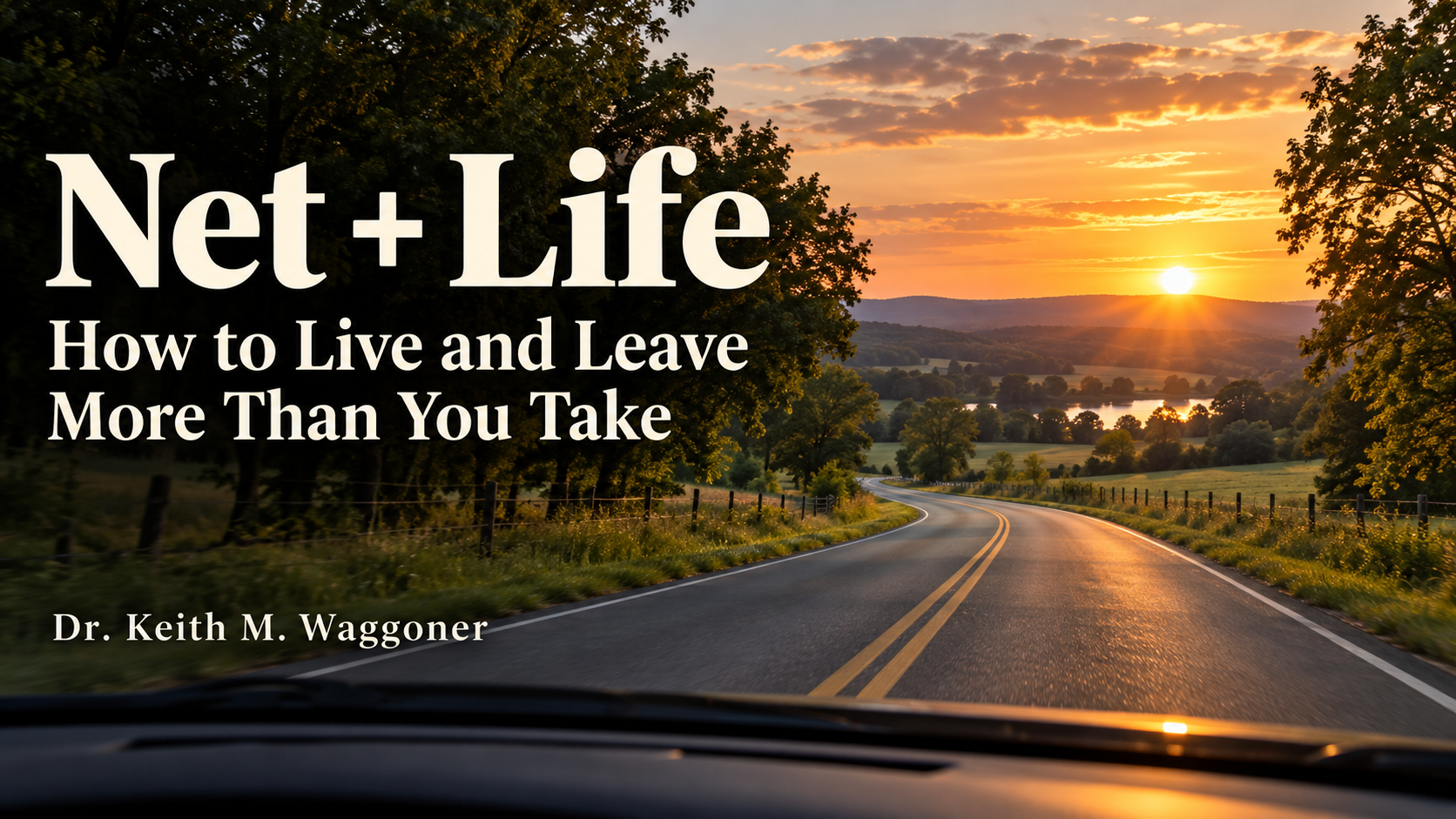
Net + Life
How to Live and Leave More Than You Take
By Dr. Keith M. Waggoner
You and I are driving down a road. We’re making great time, and we’re having a great time. We’re laughing, talking, enjoying the ride. Then we look out the window, look at each other, and ask, “Where in the world are we going?”
Because this road is going somewhere. And if we stay on it, that’s where we’re going to end up. We’ve got to ask ourselves… “Do we actually want to go there?”
I love to use that story with my clients. Whenever there’s a fifth day of the week in a month, like a fifth Thursday, we get an extra session together. It’s a great opportunity to stop, look up, and evaluate the bigger picture.
You see, we can all spend so much time trying to get better at what we’re doing in life that we forget to ask whether we should be doing it in the first place. We’re working harder. Making more money. Checking things off our lists. But where is all of this taking us? And is that a place we really want to go?
These are ultimately important questions we must ask ourselves or we can wind up down the road of life and look up astonished about why our life SUCKS. And like a vacuum… when our life “sucks”… we have a tendency to become much more of a taker… a consumer… and the type of person who lives in regret. You know, the type of person that is a warning of how NOT to live life.
How do we prevent this? We start by taking a good look at your habits, your relationships, your work, and how you spend your time. Then we ask… If you keep living this way for another five years, will you be grateful for where you arrive? And, even more importantly, “Am I becoming the person I really want to be?”
That requires honest answers and real introspection. Even the best of us can wind up down a road in life, look back with regret, and say, “How in the world did I get here?!” The awakening demands that we stop and ask even more questions. Is the life you’re building filling you with gratitude and giving you something good to give back? Or are you getting through the days, just hoping something will change while you keep traveling the same old wrong road and doing nothing about it?
I always tell my clients:
“You’ve got to make sure that what you’re doing is really what you want to get.”
One way I measure a great life is by whether, each night, I can lay my head on the pillow, smile, and say, “Thank You, God. What a great day.”
This is so important because when we build enough of those days, when I take my last breath, I can look back and say with a smile, “Thank You, God. What a great life.” That my friends is the only way to live!
This is how we begin to measure whether we’re really living Net Positive. We begin to ask great questions that diagnose the road we’re on and the path that road will take us to. We ask “Are we building a life we are grateful for, becoming someone we respect, and producing good that reaches beyond us?” To answer those honestly, we have to examine both what our life is giving us and what we are giving through it all.
Your Legacy Is Already Happening
We tend to talk about legacy as something we’ll leave when we die. But every day, we leave something behind. After a meal with your family, a meeting with your team, or a difficult exchange with someone you love, your influence remains after you leave the room.
What did you leave there? Did your presence create more security, courage, clarity, and love? Or did someone have to recover from the frustration you brought in and the uncertainty you left behind?
Those questions make legacy personal. Your children are learning from how you live. Your spouse is experiencing what your priorities mean in practice. The people you lead are discovering whether your words and your behavior agree. Over time, those experiences become part of what they carry forward.
“Your legacy is what you leave behind every moment of your life.”
Living Net + means taking responsibility for that influence. We want to leave people and places better because we were there. And to do that consistently, we need to develop enough strength, wisdom, and abundance to have something worthwhile to offer.
Recharge Your Batteries Before You Run Your Life Dry
Do you know how to charge your own batteries? Do you know what restores your energy, clears your mind, reconnects you with God, and helps you enjoy being alive? Knowing the answers matters, but the next question matters just as much. Are you actually doing it?
For me, I constantly seek to invest in prayer, exercise, time outdoors, meaningful work, and time with the people I love most… yes this recharges my batteries nicely. But they also drain my charge as well. In order to keep giving… I also must make sure these things are more than activities. They must also be areas of reciprocation where my own needs are meet too. If not, then I can run dry before I know and wind up taking more than I give in any given moment because my battery… when drained… will find ways of trying to recharge itself even at the detriment of those things I love. When I neglect what restores me, the people around me can end up paying for it. I have less patience, less energy, and less of myself available to give.
This is why we have to look deeper than whether an activity is supposed to be good for us. You can spend an evening with your family and still feel alone if you never let them know what is going on inside you. You can love your work and still wear yourself out doing it. So we need to ask, “What am I receiving here? What am I giving? And what needs to change so this part of my life can remain healthy?”
Reciprocation takes honesty. Sometimes you need to ask for help, accept encouragement, or allow someone to care for you instead of insisting you can handle everything yourself. Sometimes you need quiet, rest, or a boundary you have been afraid to set. The people who love you cannot always know what you need if you never tell them.
And we have to pay attention to how we seek that recharge. Am I asking my wife for connection, or demanding that she absorb my frustration? Am I resting so I can return with something to give, or disappearing into distraction while everyone else carries my responsibilities? These are the kinds of questions that reveal whether we are restoring ourselves wisely or making the people around us pay for our depletion.
Make Sure Your Greatest Aim Deserves Your Life
Once we begin restoring our strength, we need to decide what we are going to do with it. Otherwise, we can recharge our batteries and go right back to driving faster down the same wrong road.
What is your greatest aim? Think about what actually governs your decisions. Is it approval? Comfort? Money? The need to prove somebody wrong? If those things keep getting the final vote, they are helping determine where your life is going.
For me, there is no greater aim than Christ. That gives me a standard for how I love Adrianne, lead, coach, and use the gifts God has entrusted to me. It requires me to ask whether what I am pursuing is helping me become the man I say I want to be.
Marcus Aurelius put the responsibility for character plainly:
“No longer talk at all about the kind of man that a good man ought to be, but be such.”
Marcus Aurelius, Meditations, Book 10, section 16. www.gutenberg.org
That is a challenge worth taking seriously. We can talk about our values for years, but the people living with us experience our choices. If I say my marriage matters, where does it show up in my schedule? If I say I want to be generous, who is receiving something from me? Our aim becomes real when it changes what we do.
Measure the Whole Trade… Not Just the Paycheck
This is where my Currencies of Life and Business framework helps us evaluate the road we are on. Time and money are our two currencies, and meaning is the bridge between them. That bridge is supported by five pillars of purpose: health, passion, competency, service, and relationships. We measure all seven because every important decision involves a trade.
An opportunity can pay beautifully and cost terribly. Perhaps it gives you more money but leaves your spouse with less of you, your children waiting for you, and your health running down. Before you call that success, you need to look at the entire transaction.
| Currency or pillar | What we need to inspect |
|---|---|
| Time | Where are my hours going, and is this where I want to spend my life? |
| Money | What am I earning, keeping, spending, and giving? |
| Health | Is the way I live strengthening me or wearing me down? |
| Passion | Am I cultivating what brings me alive and using it toward a worthy aim? |
| Competency | Am I becoming more capable, and who benefits from what I know? |
| Service | What good am I doing, and whose life is better because of it? |
| Relationships | Are we building trust, connection, and healthy reciprocation? |
Seneca warned about how easily our time slips away:
“We do not have a very short time assigned to us, but we lose a great deal of it.”
Seneca, On the Shortness of Life, chapter 1. www.gutenberg.org
Before an important decision, score its effect on each area from 1 to 10. Write down the upside and downside, then ask what could raise a weak score by two points. Could you change the hours, establish better boundaries, or redesign the commitment so the trade becomes worthy?
My Worthy Currency Trade Index averages the seven scores. Seven or higher is a green light. Five to below seven calls for mitigation or redesign. Below five means the weak areas need repair before proceeding. And if time or relationships remain below five after mitigation, the answer is no, regardless of the average.
Why? Because a high score in money does not erase what your family is losing. We need to stop letting one attractive benefit keep us from examining the cost of the life we are building.
Your Blessings Need Somewhere to Go Beyond You
As we inspect those currencies, we also need to ask whether we are selfishly hoarding them. Here is my favorite definition of greed:
“Greed is the practice of thinking everything we possess, or have earned, is for our own consumption.”
– Keith M. Waggoner
That old quote of mine reaches into places a bank statement cannot show us. You can hoard your knowledge, your attention, your abilities, and your connections. You can have very little money and still live as though everything that reaches you should stop with you.
So ask yourself, “Who benefits from what God has given me?” If I have learned something that could help my son, am I taking the time to teach him? If I can open a door for somebody, am I willing to make the introduction? If I have the resources to help, have I made generosity part of how I use them?
Scripture gives us a clear responsibility:
“Each of you should use whatever gift you have received to serve others”
1 Peter 4:10, NIV, excerpt. www.biblegateway.com
Enjoy your life. Provide for your household. Save wisely and prepare for the future. But examine what those practices are producing. Are they helping you build a life with more capacity to love and serve, or are you always postponing generosity until you have a little more?
We do not need to wait until we are wealthy to begin living Net +. We can give attention, teach what we know, keep our word, and strengthen the people already within our reach. The gifts differ, but the responsibility to put them to good use remains.
What Are You Going to Do With Your Pain?
Of course, some days we feel as though we have very little to offer. We are hurting, grieving, disappointed, or facing something we would never have chosen. And this is where our understanding of a great day needs to be deeper than whether we felt good all day.
When someone comes to me in pain, I care about what they are facing. But I also want to help them see what is still possible. Sympathy alone will not tell them what to do next, so we begin asking:
“What am I going to do with this? What am I going to make this mean ultimately?”
Pain often shows us where something matters deeply. Grief can reveal the depth of love. Disappointment can expose a hope we need to examine. The pain of facing our own behavior can be the beginning of a change we have needed for years. Some pain requires treatment, some requires grieving, and some requires us to take action. We need to respond to what is actually happening.
As we do, we must watch the trap of excessive self-focus. We can become so absorbed in what happened to us, what we did not receive, or what we dislike about ourselves that every question brings us back to the same place. Even self-criticism can keep our attention revolving around ourselves.
How do we begin moving beyond that? We ask who can help us, what responsibility we can take today, and how what we are learning might eventually help someone else. The person who has known loneliness may recognize it in someone others overlook. The person who has worked through a hard season may have patience and guidance to offer somebody entering one.
That does not mean we have to pretend the hurt was good. It means we can seek help and work toward a response that produces good. We can receive care while discovering what we still have to give.
Inspect the Day… Then Do Something With What You Learn
This is why I want us to stop each evening and take a good look at the day. If we never inspect what our choices are producing, we can keep repeating the same problems and calling them our life.
Ask yourself:
- What am I grateful for today?
- What restored me, and where did I run myself dry?
- How did my choices affect all seven currencies and pillars?
- What did I give, and who benefited?
- Where did I take more than I should have, and what needs repair?
- If I keep living this way, where will this road take me?
- What will I do differently tomorrow?
This is CANI: Constant and Never-Ending Improvement. The inspection must lead to a response. If I hurt someone, I need to make the repair. If a commitment keeps draining my marriage, I need to examine that commitment. If I know what restores me but keep neglecting it, I need to make room for it.
And we need to recognize the good, too. A hard day can contain an honest admission, a courageous decision, or a moment of love that mattered deeply to someone. Those are reasons for gratitude. We can celebrate them while taking responsibility for what still needs improvement.
Build a Life You Will Be Grateful to Have Lived
Henry David Thoreau described wanting to avoid reaching the end and discovering he had missed life:
“and not, when I came to die, discover that I had not lived.”
Henry David Thoreau, Walden, “Where I Lived, and What I Lived For,” excerpt. www.gutenberg.org
That brings us right back to the road. We can make great time and have a great time, but we still need to know whether we want the destination our choices are taking us toward. The time to examine that is while we have an opportunity to change direction.
I want the people I love to experience my love now. I want the gifts God has entrusted to me to do some good now. And I want to recognize the blessings in my life while I am here to enjoy them and pass them on.
As we practice that, our influence can keep moving. Our children carry our example into their homes. Someone we teach passes the wisdom on. A person we encourage finds the courage to strengthen somebody else. This is how the good we leave today can become part of a legacy that continues after us.
So tonight, ask what you received, what you gave, and what you need to change. Find the good worth celebrating and thank God for it. Then use what you learned to live tomorrow with greater intention.
“Thank You, God. What a great day.”
As those days become years, we are building the life we will one day look back on. My hope is to reach that last breath grateful for the life I lived, the people I loved, and the good that will remain.
“Thank You, God. What a great life.”
Live Life ALIVE. Leave it Net +.
So pay attention to what happens after the things you call rest. Does another hour on your phone replenish you? Would a walk, some quiet prayer, an honest talk, or a good night’s sleep serve you better? Learn the difference between an activity that helps you escape for a while and one that helps you return to life with greater strength.
Then take responsibility for making room for it. Put it on your calendar. Let others encourage and support you, too. Receiving care is part of a healthy life, and the strength you receive can become strength you share. That gives restoration a purpose beyond simply feeling better.
Check Your Direction Before You Pick Up Speed
Once you have strength to spend, you have to decide where it belongs. That brings us back to the road and the question of your greatest aim.
If approval is your highest aim, other people’s opinions can govern your choices. If comfort is your highest aim, you may avoid the very responsibilities that would help you grow. If money is your highest aim, you may keep making trades that increase your income while diminishing the life you hoped that income would support.
For me, Christ is the greatest aim. That gives direction to how I love Adrianne, lead, coach, and live when nobody is watching. It also gives me a standard by which to examine the things I say I want. Will pursuing this help me become more faithful to what matters most?
Marcus Aurelius challenged the gap between discussing character and practicing it:
“No longer talk at all about the kind of man that a good man ought to be, but be such.”
Marcus Aurelius, Meditations, Book 10, section 16
We can spend years describing the person we intend to become. Eventually, that person needs to show up in our choices. When you know who you want to be, you have a better basis for deciding what deserves your time and what you need to change.
Count the Cost in Every Currency
That decision requires us to look at the whole trade. You can make more money and still make a terrible deal with your life. If the opportunity costs you your health, your marriage, or years of connection with your children, you need to account for those costs before calling it success.
In my Currencies of Life and Business framework, time and money are the two currencies. Meaning is the bridge between them, supported by five pillars of purpose: health, passion, competency, service, and relationships. We measure all seven because a gain in one area can hide a serious loss in another.
| Currency or pillar | The question to ask |
| Time | Where are my hours going, and is that a worthy use of my life? |
| Money | Am I managing it wisely, providing, building, and giving? |
| Health | Am I caring for the strength God entrusted to me? |
| Passion | What brings me alive, and am I directing that energy toward something worthy? |
| Competency | What am I learning, improving, and passing on? |
| Service | Whose life is better because of what I do? |
| Relationships | Are the people closest to me receiving my attention and love? |
Seneca warned about how easily time slips away:
“We do not have a very short time assigned to us, but we lose a great deal of it.”
Seneca, On the Shortness of Life, chapter 1
Before an important decision, score its effect on each area from 1 to 10. Identify the upside and downside, then ask what could raise a weak score by two points. Perhaps the opportunity becomes worthwhile when you change the hours, clarify expectations, or protect time with your family.
My Worthy Currency Trade Index averages the seven scores. Seven or higher is a green light. Five to below seven calls for mitigation or redesign. Below five means the weak areas need repair before proceeding. And there is an important guardrail: if time or relationships remain below five after mitigation, the answer is no, regardless of the average.
The point is to make the trade visible so you can decide wisely. Once you know what you have and what it costs, you also need to ask what you are doing with it.
Let Your Blessings Reach Beyond You
Here’s my favorite definition of greed:
“Greed is the practice of thinking everything we have, earn, or have been given by God is for our own consumption.”
Dr. Keith M. Waggoner
That reaches far beyond money. We can hoard our time, attention, knowledge, connections, and abilities. We can become so accustomed to asking what we will get that we rarely consider what we have to give.
Who benefits from what God has given you? If the answer is consistently just you, that deserves an honest inspection.
Scripture gives us a clear direction:
“Each of you should use whatever gift you have received to serve others”
1 Peter 4:10, NIV, excerpt
If you’ve learned something useful, teach it. If you can open a door, consider who needs the opportunity. If you have resources, manage them wisely and make room for generosity. Your experience, abilities, and relationships can all become ways of strengthening someone else.
Enjoy your life, provide for your family, prepare for the future, and rest well. These are responsibilities worth honoring. As you do, make sure the good reaching you also has a way to reach beyond you. This is how abundance becomes contribution, and contribution becomes part of your legacy.
Give Your Pain Somewhere Worthwhile to Go
Of course, some days leave us wondering what we have to give. We are tired, hurting, disappointed, or facing something we would never have chosen. That is why we need to understand that a great day can still contain pain.
When someone comes to me hurting, I care about what they are facing. I also want to help them see the future that is still available to them. We need to ask questions that help them take their next step:
“What am I going to do with this? What am I going to make this mean ultimately?”
Dr. Keith M. Waggoner
Grief can reveal how deeply we loved. Disappointment can expose a hope we need to examine. The discomfort of facing our own behavior can become the beginning of a needed change. Some pain requires treatment, some requires grieving, and some calls for a decision we have been avoiding. We need to respond to what is actually happening.
As we do, we also need to examine where our attention goes. Excessive self-focus can keep us circling the same questions about our wounds, inadequacies, and what we did not receive. Even harsh self-criticism can keep our whole world centered on ourselves.
We can begin widening that view by asking who can help us, what responsibility we can take today, and who might eventually benefit from what we are learning. Your experience may help you recognize someone else’s loneliness or guide them through a difficulty you know well. You can receive care while discovering what you have to give.
We cannot always choose what happens to us. We can work toward a response that produces something meaningful for our own lives and the lives we touch.
End the Day With Gratitude and an Honest Inspection
This is why I want us to stop before bed and evaluate the day. We need to notice what was good, account for what needs attention, and choose what we will do next.
- What am I grateful for today?
- If I keep living this way, where will this road take me?
- How did my choices affect all seven currencies and pillars?
- What did I give, and who benefited?
- Where did I create a cost that I need to repair?
- What will I do better tomorrow?
That is CANI: Constant and Never-Ending Improvement. Sometimes the next action is an apology. Sometimes it is changing a habit, protecting time, or keeping a promise you have postponed. Make it concrete enough to act on.
And give yourself credit for the good. A difficult day may include a courageous decision, an honest admission, or a moment of love that mattered deeply to someone. Learning to recognize those things helps us end the day with gratitude while still taking responsibility for growth.
Build the Life You Want to Remember
Henry David Thoreau described wanting to avoid reaching the end and discovering he had missed life:
“and not, when I came to die, discover that I had not lived.”
Henry David Thoreau, Walden, “Where I Lived, and What I Lived For,” excerpt
I want to live with gratitude now. I want the people I love to experience that love now. And I want what God has entrusted to me to produce something worth leaving behind.
Your children may carry your example into their own homes. Someone you teach may pass that wisdom on. A person you encourage may find the courage to strengthen somebody else. The good you give can keep moving long after you are gone.
So look up from the road. Are you grateful for where it is taking you? Are you becoming the person you really want to be? Make the adjustment you need to make while you have today to work with.
Charge your batteries so you have strength to offer. Measure your decisions so the gains do not blind you to the costs. Share your gifts so the blessings entrusted to you reach others. And when the day is done, take a moment to recognize the good you received and the good you gave.
“Thank You, God. What a great day.”
Keep building those days, learning from them, and leaving something worth carrying forward. That is how I want to arrive at my last breath, grateful for the life I lived and the good that will remain.
“What a great life.”
Live Life ALIVE. Leave it Net +.