
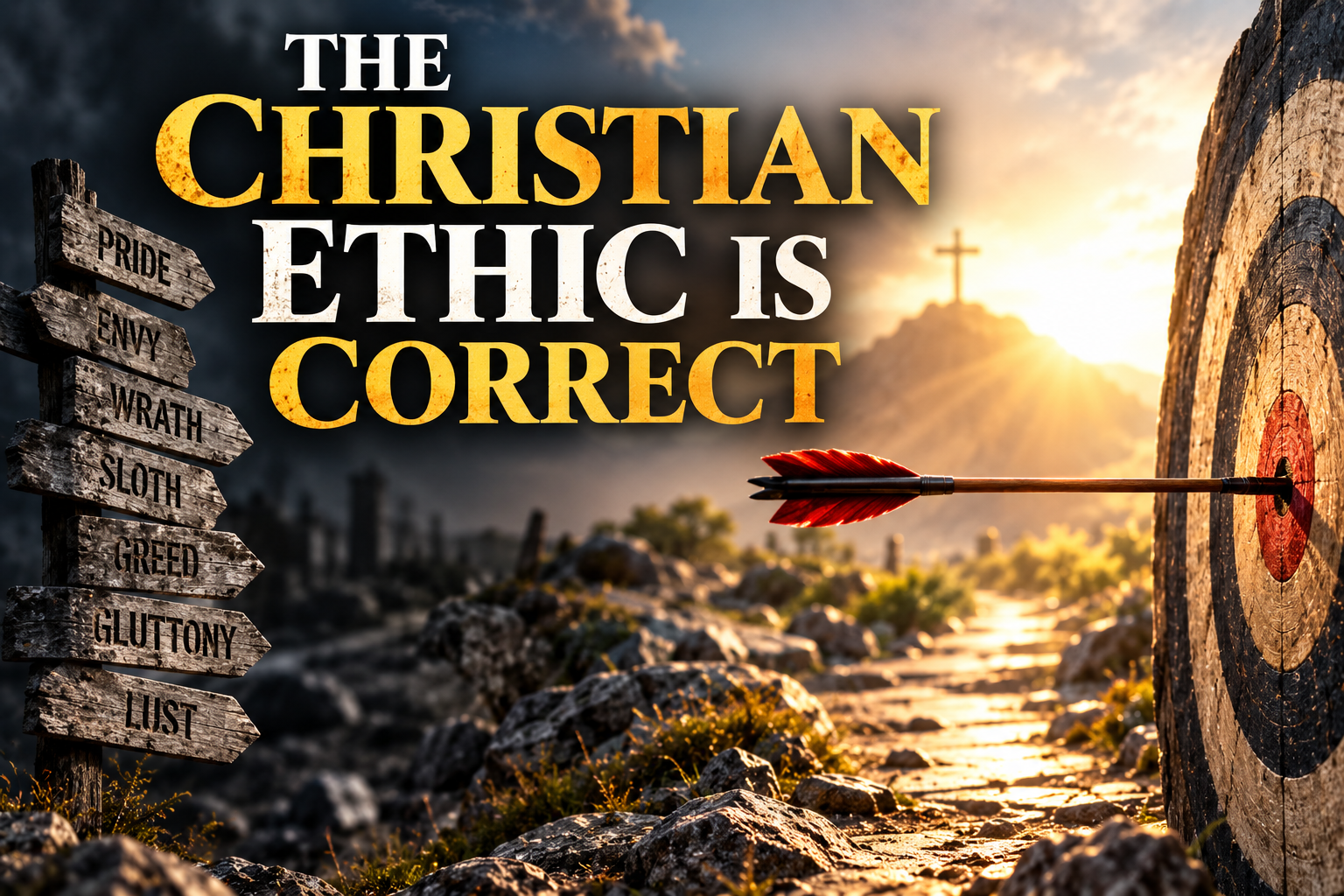
The Christian Ethic Is Correct
I believe the Christian ethic is correct, and I think most people know this instinctively, even if they would never describe themselves as Christian. Let me explain what I mean.
Christianity has spent thousands of years describing the characteristics that either elevate or destroy human beings. One traditional way of organizing these characteristics is through the Seven Deadly Sins and the virtues that oppose them. But for a moment, don’t think about these merely as religious concepts. Think about them as types of people.
Here is the contrast:
| The Sin | The Opposing Virtue | What Is Being Trained |
|---|---|---|
| Pride | Humility | Accurate self-knowledge, teachability, and willingness to admit when you are wrong |
| Envy | Kindness / Gratitude | Celebrating another person’s good instead of resenting it |
| Wrath | Patience | Governing anger rather than allowing anger to govern you |
| Sloth | Diligence | Taking responsibility and doing what ought to be done |
| Greed | Generosity / Charity | Giving rather than grasping and using resources for good |
| Gluttony | Temperance / Self-Control | Governing appetite rather than being governed by it |
| Lust | Chastity | Ordering sexual desire toward love, fidelity, and the dignity of another person |
Imagine a person increasingly ruled by the left side of that chart. What kind of person eventually emerges?
He becomes arrogant and easily offended. He constantly compares himself to other people and resents their success. His anger controls him. He avoids responsibility when responsibility becomes difficult. He lacks discipline over his appetites. He wants what other people possess. Eventually, he begins rationalizing selfish behavior and seeing other people as instruments for getting what he wants.
Now imagine someone moving in the opposite direction. He is deliberately developing humility, gratitude, patience, diligence, generosity, self-control, and chastity. He can admit when he is wrong. He can celebrate another person’s success. He controls his appetites, accepts responsibility, keeps his word, remains steady when angry, and refuses to use another human being simply for his own gratification.
Which person would you trust with your children? Which one would you want your daughter to marry? Which would you hire to manage your company? Which would you want as your business partner? Which would you trust with your money? Which would you want living next door? Which would you want leading your community?
Most people don’t have to think very long about the answer.
That is what I mean when I say the Christian ethic is correct.
But What Is Sin?
Before going any further, we need to understand what the Bible means by sin.
One of the biblical words translated as sin is the Greek word hamartia. At its root is the idea of missing the mark. Think of an archer firing an arrow at a target. There is an intended mark, but the arrow misses it.
That gives us a much more useful way to think about sin.
Sin is not merely breaking a rule. Sin is missing the mark.
And if sin means missing the mark, then we immediately have to ask a more fundamental question:
What is the mark?
Or said another way:
What am I aiming at?
This is where psychology and theology begin to intersect in a fascinating way.
Jordan Peterson has repeatedly emphasized the importance of aim. Human beings don’t simply look at the world neutrally. What we value and what we are aiming toward helps determine what we notice, what we ignore, what sacrifices make sense, and ultimately what kind of person we become.
That means your aim isn’t merely something you hope to achieve someday.
Your aim is organizing you right now.
If your highest aim is money, that aim begins organizing your decisions.
If your highest aim is pleasure, pleasure begins organizing your decisions.
If your highest aim is status, status begins organizing your decisions.
If your highest aim is avoiding discomfort, your life begins organizing itself around safety.
If your highest aim is approval, other people’s opinions begin controlling you.
This is why one of the most important questions I ask in coaching is a question of fundamentals:
What is my greatest aim?
Because eventually everything underneath your greatest aim gets organized around it.
The Greatest Aim Must Be Transcendent
This leads us somewhere even deeper.
If your greatest aim is something temporary, what happens when you get it?
Suppose your greatest aim is money. How much is enough?
Suppose it is success. What happens after you succeed?
Suppose it is physical beauty. What happens when age begins taking it away?
Suppose it is the approval of other people. What happens when they change their minds?
Every finite aim eventually encounters a limit.
This is why the greatest aim must ultimately be transcendent. You need something above immediate appetite, comfort, money, achievement, reputation, and even your own life that tells you what those lesser things are for.
There must be a cause above you that orders the causes beneath you.
For the Christian, there is no greater transcendent cause than Christ.
Jesus says, “Seek first the kingdom of God and his righteousness” (Matthew 6:33). When asked about the greatest commandment, He answers that we are to love God with all our heart, soul, and mind, and to love our neighbor as ourselves.
There is the aim.
Not merely: Don’t sin.
Aim at the Highest Good.
Aim at truth.
Aim at righteousness.
Aim at love.
Aim at courage.
Aim at sacrifice.
Aim at service.
Aim at the Kingdom of God.
Ultimately, aim at Christ.
Paul describes this beautifully when he writes, “I press on toward the goal for the prize of the upward call of God in Christ Jesus” (Philippians 3:14).
There is a target. There is an aim. There is a direction.
Now sin becomes easier to understand.
Sin is not merely God standing over humanity saying, “Don’t do that.”
Sin is anything that causes us to miss the mark, corrupts our aim, or trains us into becoming the kind of person incapable of hitting it.
The Seven Sins Corrupt the Aim
Now go back to the Seven Deadly Sins and notice what they actually do.
Pride turns the aim toward self-exaltation.
Envy turns the aim toward comparison and resentment.
Wrath allows anger to replace righteous judgment.
Sloth abandons the responsibility required by the aim.
Greed substitutes possession for purpose.
Gluttony places appetite above authority.
Lust reduces another human being from someone to love into something to consume.
These aren’t merely seven naughty things God arbitrarily decided He doesn’t like.
They are seven ways human beings lose the target.
And the virtues do the opposite.
Humility corrects the aim. Gratitude corrects the aim. Patience corrects the aim. Diligence keeps us moving toward the aim. Generosity frees us from worshiping possessions. Temperance places appetite underneath purpose. Chastity orders sexuality toward love rather than consumption.
The virtues help us become the kind of people capable of aiming higher.
This Idea Is Bigger Than Christianity
What is fascinating is that you don’t have to begin with the Bible to recognize this pattern. Some of history’s greatest thinkers arrived at remarkably similar conclusions simply by studying human beings.
More than three centuries before Christ, Aristotle argued that human flourishing required virtue and that virtue had to be developed through habit and practice. He understood that repeated actions eventually form character.
Centuries later, Benjamin Franklin approached the same problem almost like a behavioral scientist. Franklin identified thirteen virtues he wanted to develop, including temperance, industry, sincerity, justice, moderation, chastity, and humility. Then he created a system to monitor himself daily and record where he failed.
Franklin wasn’t simply admiring virtue. He was training it.
His final virtue was Humility, which he summarized with the remarkable instruction: “Imitate Jesus and Socrates.”
The language changes across cultures and centuries, but the discovery keeps resurfacing: character matters, appetites must be governed, responsibility must be practiced, and virtue must become habitual.
Sin Is Not an Arbitrary List of Rules
We sometimes talk about sin as though God created an arbitrary collection of rules designed primarily to restrict human enjoyment. I think that badly misunderstands the biblical view of human nature.
If sin is missing the mark, then God’s commandments begin looking less like arbitrary restrictions and more like instructions for hitting the target.
A good father doesn’t tell his son not to run into traffic because he enjoys restricting his freedom. He gives the boundary because he understands reality better than the child does.
In the same way, the Christian ethic is not simply saying, “God doesn’t like these behaviors.” It is warning us that certain ways of living eventually deform the person practicing them.
Pride does something to you. Envy does something to you. Uncontrolled anger does something to you. Greed does something to you. Lust does something to you. Gluttony does something to you. Sloth does something to you.
Practice these things long enough and they don’t merely remain behaviors. They begin becoming character.
That is one of the most important truths about human development:
You are becoming something.
Every repeated action is training. Every indulgence strengthens something. Every act of discipline strengthens something else. We are constantly practicing who we will eventually become.
The question is not simply, “Can I get away with this?”
A much better question is:
“What kind of person will I become if I continue practicing this?”
Virtue Must Be Trained
The same principle works in the opposite direction. You don’t become courageous because you agree that courage is important. You become courageous by repeatedly doing courageous things when fear tells you not to. You don’t develop self-control by admiring disciplined people. You develop it by saying no to yourself when appetite demands yes.
You don’t become generous because you believe generosity is good. You become generous by giving. You don’t become faithful because you have good intentions. You become faithful by keeping your commitments when keeping them becomes inconvenient.
This is why virtue requires training.
Aristotle understood this long before modern psychology began talking about behavioral conditioning. His ethical system taught that people acquire virtue through properly formed habits and then develop the practical wisdom necessary to live those virtues well.
Christianity goes even further. The Christian life was never intended to be merely a collection of beliefs we intellectually affirm. Christianity calls us toward transformation. It asks not only, “What do you believe?” but also, “What are you becoming?”
Jesus repeatedly addressed this at the level of character. A good tree produces good fruit. A bad tree produces bad fruit. What exists inside a person eventually becomes visible through what that person produces.
Our marriages have fruit. Our parenting has fruit. Our businesses have fruit. Our habits have fruit. Our private decisions eventually produce public consequences.
Freedom Requires Self-Control
Our culture often defines freedom as the ability to do whatever we want. Christianity presents almost the opposite idea.
If you cannot tell yourself no, you are not free.
If you cannot control your anger, anger controls you. If you cannot control your appetite, appetite controls you. If you cannot stop consuming pornography, pornography controls you. If you cannot stop drinking, alcohol controls you. If you cannot tolerate someone disagreeing with you without becoming emotionally hijacked, their opinion controls you.
That isn’t freedom. It is slavery with better marketing.
The disciplined person possesses a kind of freedom the undisciplined person cannot understand. He can experience desire without obeying it. He can experience anger without becoming wrathful. He can experience fear without surrendering his responsibility. He can experience temptation without allowing temptation to determine his behavior.
This insight isn’t exclusively religious either. Franklin put Temperance first in his own list of virtues and spent years deliberately monitoring his behavior. The Greeks placed temperance among the essential virtues of a flourishing human life.
Christianity’s insistence on self-control is not an arbitrary prohibition against pleasure. It is recognition of a basic human reality:
Whatever you cannot govern eventually has the potential to govern you.
You Are Training Someone Every Day
One of the biggest mistakes we make is imagining that character is something we simply possess. Character is continually being trained.
Every time you tell the truth when lying would be easier, you train something. Every time you control your anger rather than unleashing it, you train something. Every time you get out of bed and fulfill your responsibility when you don’t feel like it, you train something.
Every time you keep your word, resist temptation, forgive someone, admit that you were wrong, confront something difficult, or sacrifice for another person, you are casting a vote for the kind of person you intend to become.
The opposite is also true.
We become what we repeatedly practice.
That is why small decisions are rarely as small as they appear.
Look at the Fruit
Jesus gave us an extraordinarily practical standard: “You will know them by their fruits” (Matthew 7:16).
Look at the fruit.
What does pride eventually produce? What does envy produce? What does uncontrolled lust produce? What does greed produce? What does wrath produce?
Then ask the same questions about humility, gratitude, patience, diligence, generosity, self-control, and chastity.
Don’t judge a philosophy only by what it promises. Look at what it produces when someone actually lives it.
Then turn the question inward.
What is my life producing? What kind of husband am I becoming? What kind of wife? What kind of father, mother, leader, friend, employer, employee, Christian, or human being?
If I continue practicing my current habits, attitudes, appetites, and responses for another ten years, who will I become?
That question is far more important than whether you feel good about yourself today.
Aim at the Best
This brings us back to the fundamental question.
What is my greatest aim?
Your answer matters because your highest aim organizes everything beneath it.
Christianity does not simply give us a list of things we should avoid. It gives us something toward which we can aim.
Humility instead of pride. Gratitude instead of envy. Patience instead of wrath. Diligence instead of sloth. Generosity instead of greed. Self-control instead of gluttony. Chastity and genuine love instead of using another person to satisfy lust.
But even the virtues are not the ultimate aim. They prepare us to live toward something higher.
For the Christian, the highest aim is not self-improvement.
It is Christ.
“Seek first the kingdom of God and his righteousness.”
That is the transcendent cause capable of ordering everything beneath it.
Your business matters, but it isn’t your god. Your body matters, but it won’t last forever. Your marriage matters enormously, but even your spouse cannot carry the weight of being your ultimate source of meaning. Money, achievement, influence, pleasure, reputation, and comfort can all be good things in their proper place.
But none of them is big enough to be your greatest aim.
Christ is.
So perhaps the most important question you can ask yourself isn’t simply, “Am I a good person?”
Ask:
What am I aiming at?
Then ask:
Is the person I am becoming capable of hitting that target?
And finally:
What is my greatest aim?
Get that right, and the lesser aims begin finding their proper place.
Miss that target, and you can succeed at almost everything else and still miss the point.
Aim at the Best.
Aim at the Highest.
Aim at Christ.