
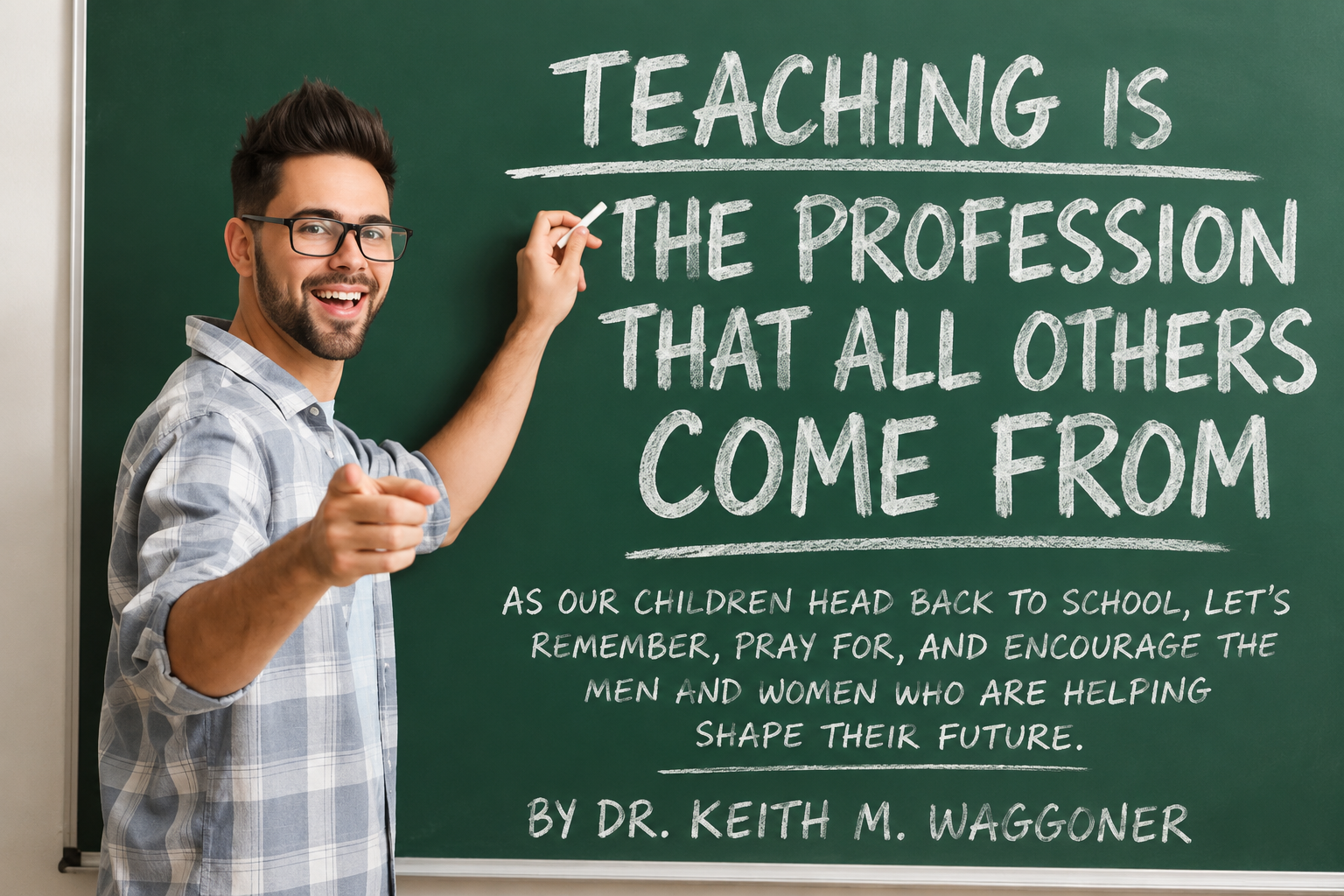
Teaching Is the Profession That All Others Come From…
As Our Kids Go Back to School, Remember Who Is Helping Shape Their Future
Kids are going back to school.
Some of you reading this have children headed back this week. Some have grandchildren starting another year. Some of you don’t have children in school at all.
Either way, you once were or still are someone who has teachers that greatly impact your life.
Think back over your own life for a moment and ask yourself a question…
Who was the teacher who changed your life?
Maybe it was a schoolteacher. Maybe it was a coach… or a pastor, martial arts instructor, professor, the list can go on and on. It may even be somebody who took you under their wing at exactly the right time in your life that didn’t have an official title of teacher.
Now ask yourself why you still remember them.
I doubt it’s because they helped you memorize the state capitals or taught you how to diagram a sentence.
You probably remember them because somehow they got through to you.
They believed in you when you needed somebody to believe in you. Maybe they challenged you when you were settling. Maybe they saw a gift in you before you knew it was there. Maybe they introduced you to a subject that fascinated you and changed the direction of your life. Maybe they gave you some desperately needed structure when there wasn’t much structure anywhere else.
That’s why I’ve always loved this phrase:
“Teaching is the profession that all others come from.”
Think about how true that is.
Every doctor, lawyer, psychologist, entrepreneur, scientist, coach, carpenter, and professional athlete was taught by somebody.
We tend to celebrate people when they become successful. We see the degree on the wall, the thriving business, the championship…
But we rarely see all the teachers standing in the background.
But they’re there.
Teaching Carries an Incredible Responsibility
There is a verse in the Bible that I think anyone who teaches should take very seriously.
“Not many of you should become teachers, my fellow believers, because you know that we who teach will be judged more strictly.”
James 3:1
That’s a serious statement.
And I don’t believe James is saying that people shouldn’t teach. Obviously Scripture can’t mean that. Jesus taught constantly. He was called Rabbi, Teacher. The apostles taught. Paul told Timothy to pass what he had learned to faithful people who would be capable of teaching others.
The warning is about the gravity of influence.
If you’re going to influence another human being, especially a child, understand what you’re taking on.
Your words matter.
Your example matters.
What you reward matters.
What you tolerate matters.
What you teach as true matters… because it creates all of the above in the hearts and minds of others.
Jesus said something else about teaching that makes the responsibility even clearer:
“The student is not above the teacher, but everyone who is fully trained will be like their teacher.”
Luke 6:40
Read that again.
Everyone who is fully trained will be like their teacher.
That’s one of those verses that ought to make every teacher, coach, pastor, parent, and mentor stop for a moment.
Because ultimately we’re never only teaching information.
We’re modeling what a human being looks like.
A child is watching how you handle frustration. They’re watching whether you keep your word. They’re watching how you treat the weak kid in the room. They’re watching what you do when you’re wrong. They’re watching whether the values you’re teaching are actually the values you’re living.
That’s why James warns teachers about greater accountability.
Influence is an honor… Yes, it sure is.
But influence is a responsibility… And you and I who call ourselves teachers are copiable for this.
Whoever Teaches the Children Helps Shape the Future
Several years ago I watched the famous interview with Yuri Bezmenov, a former Soviet journalist and propagandist who defected to the West.
One of the observations he made has stayed with me ever since.
Bezmenov argued that if you wanted to fundamentally change a nation, you didn’t necessarily begin with military conquest. You began with ideas. His warning was that if you could influence what an entire generation believed about truth, history, responsibility, freedom, human nature, and even themselves, eventually those ideas would begin shaping the culture itself.
He described a long process of ideological subversion, beginning with what he called “demoralization,” followed by destabilization, crisis, and eventually normalization. One of the primary places that battle could take place, he believed, was education.
Now, I don’t take everything a Soviet defector said decades ago as Holy Scripture, and neither should you.
But the larger principle is difficult to argue with.
If you influence how a generation of children understands the world, eventually you influence the world that generation creates.
Children grow up.
They become parents, teachers, professors, pastors, business owners, police officers, military leaders, journalists, judges, politicians, and voters. The ideas they were taught when they were young don’t simply remain in a classroom. Those ideas eventually become families, organizations, institutions, laws, and culture.
That’s why education matters so much.
And that’s why I become concerned whenever education moves away from teaching young people how to examine reality, wrestle honestly with competing ideas, evaluate evidence, and think critically, and instead begins telling them which conclusions they are expected to reach.
We should be teaching young people to ask better questions.
Is this true?
How do we know?
What is the evidence?
What does history tell us?
What might someone who disagrees with me say?
Could I be wrong?
What happens if this idea is carried to its logical conclusion?
Those are the kinds of questions that produce thoughtful, resilient adults.
The goal of education should never be to make students overly sensitive to disagreement, suspicious of everyone who sees the world differently, or convinced that every difficulty in life is evidence that they are oppressed. Life is hard enough without teaching children to interpret normal struggle as victimization.
We should be preparing them to encounter reality with courage.
To think.
To reason.
To disagree without hatred.
To recognize injustice when it is real, but also to recognize responsibility, opportunity, gratitude, and the incredible privilege of living in a society where they are free to question almost everything they are being taught.
Every civilization eventually becomes whatever it consistently teaches its children to become.
That is why teachers matter.
And that is why the responsibility of teaching reaches far beyond the classroom.
Education Has Always Been About More Than School
Children become adults. Students become voters, parents, teachers, pastors, judges, business owners, journalists, politicians, police officers, professors, and leaders.
And ideas have consequences.
That’s why I become concerned when education moves away from teaching young people to examine reality, evaluate evidence, wrestle honestly with competing ideas, and think critically, and moves toward telling them which conclusions they’re expected to reach.
Those are two very different things.
I don’t want young people who simply agree with me.
I want young people capable of thinking.
Thomas Sowell has spent much of his career making this point in his writing about education. One of his harder statements is:
“Education is not merely neglected in many of our schools today, but is replaced to a great extent by ideological indoctrination.”
Thomas Sowell
You don’t have to agree with every one of Sowell’s positions to understand the danger he’s pointing toward.
Education should enlarge a child’s ability to engage reality.
It should teach them to ask, “Is this true?”
How do we know?
What is the evidence?
What are the consequences?
What does history tell us?
What might the other side say?
Where could I be wrong?
Those are extraordinarily important questions.
Sowell has also emphasized a principle that sounds almost absurdly obvious until you realize how easily institutions can forget it:
“Schools exist for the education of children.”
Thomas Sowell
That’s it.
The institution exists for the student, not the other way around.
I Know What a Teacher Can Mean to a Child
This subject is very personal for me.
I grew up in a home where there was abuse.
That meant the adults I encountered outside my home sometimes had a bigger, more positive effect on me than they probably ever knew.
There are teachers I can still picture today.
I had a history teacher who told incredible stories… two of them actually – Mr. Walton and Dr. Startup. That may sound like a small thing, but it wasn’t. He made history real to me. The people weren’t just names printed in a textbook. These were human beings making decisions, fighting wars, showing courage, making terrible mistakes, building civilizations, destroying things, overcoming things. I became fascinated with the story of humanity.
Years later, when people hear me teach history, leadership, psychology, theology, martial arts, or human behavior through stories, I sometimes wonder how much of that was planted in me sitting in his classroom.
Then there was an English teacher who took a special interest in me. Mr. Early paid attention to me.. and made me feel welcome and worth the effort. There’s tremendous power in that.
When you’re a young person and an adult you respect really sees you, something happens. They can lend you belief before you’ve developed enough belief of your own. I needed that.
I also had a martial arts instructor, Grand Master Weeks, who had a profound impact on the direction of my life. I couldn’t always afford to train. He could have simply said, “Come back when you can pay.” Instead, he found a way. I could clean the school and live my dream of learning the art of the knife hand.
So I cleaned. I swept floors, did the work that needed to be done, and earned the privilege of continuing my training.
At the time, I probably thought the lesson was martial arts.
It wasn’t. Or at least that wasn’t the whole lesson.
I was learning that there is dignity in work and being short on money didn’t mean I had to become helpless. I was learning to exchange value… gratitude… responsibility. I was also discovering a world in which discipline, competence, courage, respect, and mastery mattered.
If you know me today, you know how deeply those ideas eventually became woven into my life.
Then there was my basketball coach… Coach Haygood.
He was tough. Bobby Knight tough. He had standards, and he expected you to meet them. I’m sure there were moments when I didn’t enjoy that very much. But as a young man, I needed it. I needed somebody who wasn’t going to negotiate with every excuse I could produce. And I needed somebody who understood that one of the ways you communicate belief in a young man is to expect something from him.
There is a form of love that comforts. There is also a form of love that demands that you become stronger. A good coach understands both.
Looking back now, I realize something that I couldn’t have understood as a teenager…
Those people were helping raise me into a man who became more than he could have been otherwise.
They weren’t replacing my parents. But they were contributing to my formation as a human being. And that’s one reason I have such tremendous respect for great teachers and coaches today. I know what they can mean to a kid who needs them.
I was one.
Fred Jones and the Difference a Great Teacher Can Make
This brings me to someone who had a major influence on how I came to think about teaching.
Years ago, an old friend of mine who has spent his life in education introduced me to the work of Dr. Fredric H. Jones.
My friend wasn’t casually familiar with Jones’ material. He eventually taught Fred Jones seminars around the country, and he encouraged me to really study Jones’ work.
I’m glad he did.
Fred Jones was a clinical psychologist who studied teaching, classroom management, discipline, motivation, and instruction for decades. He spent years observing highly successful teachers and trying to understand what they were doing differently. His work eventually became the Tools for Teaching model. Education World describes Jones as having studied highly successful teachers for more than thirty years, focusing especially on prevention, responsibility, and positive classroom management.
What fascinated me was that so much of what Jones discovered about excellent teachers also applies to excellent coaches, excellent parents, and excellent leaders.
Great teaching isn’t simply knowing your subject. We’ve all met brilliant people who couldn’t teach their way out of a paper bag.
Knowing and teaching are different competencies.
A great teacher understands the learner. They can read the room. They know when students are drifting and they understand how to make expectations clear.
They know how to correct behavior without turning every correction into a war and they understand that endless punishment isn’t the same thing as discipline.
They create structures where success becomes more likely. And perhaps most importantly, great teachers help students become responsible for their own learning.
That’s leadership.
Sometimes a Teacher Lends a Child a Future
I’ve spent decades studying human behavior.
One thing I know for certain is that people respond to expectation.
If every adult around a child treats him like he’s stupid, troublesome, hopeless, weak, or destined to fail, don’t be surprised when some part of that child starts building an identity around those expectations.
But the opposite can happen too.
A good teacher can interrupt that story.
“You are better than this.”
“I know you can do this.”
“Try again.”
“You’re capable of more.”
“I expect more from you because I believe there’s more in you.”
Those aren’t meaningless words when they’re spoken by somebody who has earned a child’s respect.
Sometimes they’re life changing.
I can tell you from personal experience that a child can live in one environment that tells him one thing about himself and encounter a great teacher somewhere else who introduces him to an entirely different possibility.
Never underestimate that.
Children Need Play, Challenge and Meaningful Work
Another person worth listening to on this subject is Dr. Jordan Peterson.
Peterson has talked extensively about the developmental importance of play, including rough-and-tumble play. In his discussions of child development, he argues that physical and social play gives children opportunities to learn boundaries, reciprocity, emotional regulation, confidence, and how to participate successfully with other people. He has discussed the subject both in his university lectures and in longer conversations specifically devoted to rough play and child development.
I think sometimes adults misunderstand play.
We think play is the opposite of learning.
It isn’t.
Watch children play together when the adults aren’t micromanaging every second. They’re constantly learning… Who’s leading? What’s fair? What happens when I go too far? Can I handle losing?
That’s real development.
Healthy rough play can be especially important because it lets children experience intensity inside appropriate boundaries. They can become excited, physical, competitive, even aggressive in the proper meaning of that word, while also learning control.
That’s enormously valuable.
Our job isn’t to raise children who never experience discomfort. Our job is to help them develop the competence to deal with discomfort. And I would extend Peterson’s point beyond play.
Children need purposeful work too.
Give them something to do. Let them help. Let them carry something. Let them clean something. Let them make a mistake while they’re building something.
Give them chores. Let them earn things. Let them experience the satisfaction of becoming useful.
Sometimes the most loving thing you can do for a child is stop doing everything for them.
Think About How Much Time Teachers Have With Our Children
Here’s something parents don’t always stop to calculate.
There are twenty-four hours in a day.
A school-age child may sleep around eight of them.
Then consider school itself, transportation, practice, tutoring, clubs, after-school programs, and everything else attached to the school day.
Now everybody finally gets home.
Dinner. Homework. Laundry. Phone calls. Getting ready for tomorrow. And maybe Mom and Dad are exhausted from work too.
How much genuine, engaged, eye-to-eye time do parents actually get with their children on an average weekday?
I’m not asking that to make anyone feel guilty. I’m asking because it puts the importance of teachers into perspective.
For an enormous portion of our children’s waking lives, they’re with other adults.
That’s why the teacher matters.
That’s why the coach matters.
That’s why the school culture matters.
And for some children, it matters even more.
There are kids going back to school this month who don’t have a healthy home waiting for them.
Some are living with addiction.
Some are surrounded by violence.
Some don’t have an engaged father.
Some don’t have anybody at home who asks about their homework.
Some have never heard an adult tell them, “I’m proud of you.”
For that child, a teacher may be much more than a teacher.
A coach may become the first healthy model of manhood he has ever seen.
A female teacher may become the first adult woman who consistently treats a young girl with dignity.
A martial arts instructor may introduce a kid to discipline for the first time.
You have no idea where those seeds will eventually grow.
So, Teachers, Understand How Important You Are
If you’re a teacher reading this, I hope you understand something.
Your job matters.
I know you’re tired sometimes.
I know there are bureaucracies, paperwork, policies, meetings, parents, testing requirements, discipline problems, budgets, and a hundred other things that can make you forget why you entered the profession in the first place.
Remember the child.
There’s probably one sitting in your classroom this year who needs you more than you know.
You may never see the result.
The teacher who encouraged me decades ago couldn’t possibly have known where my life would go.
My martial arts instructor couldn’t have known that the kid cleaning the school would someday spend decades teaching martial arts himself.
My basketball coach probably had no idea which of his lessons I would still remember in my fifties.
That’s how influence works.
You don’t always get to see the harvest.
Sometimes you simply plant.
“The student is not above the teacher, but everyone who is fully trained will be like their teacher.”
What an honor.
And what a responsibility.
A Few Things Worth Reading, Watching and Listening To
If this article stirred something in you, I’d encourage you to go deeper. These are some places I would start.
Fredric H. Jones, Tools for Teaching. This is the obvious starting point for understanding Jones’ practical approach to instruction, discipline, classroom leadership, responsibility, and motivation. His official materials and training resources are also worth exploring. (Education World)
Thomas Sowell, Inside American Education. If you want to understand Sowell’s criticism of educational institutions, incentives, ideology, and accountability, this is more directly relevant to this subject than starting with his economics books. His later work on charter schools is also valuable for examining educational outcomes rather than educational intentions. (Hoover Institution)
Yuri Bezmenov’s 1984 interview on ideological subversion. Watch the interview itself rather than relying entirely on somebody else’s summary of it. Then think critically about his argument. Ask what still applies, what doesn’t, and what it teaches us about the relationship between ideas and institutions. (YouTube)
Jordan Peterson’s lectures and podcast conversations about play, child development, responsibility, and personality. His discussion with Rafe Kelley on rough-and-tumble play is particularly relevant to the ideas I’ve touched on here. (PodScripts)
Greg Lukianoff and Jonathan Haidt, The Coddling of the American Mind. Whether you agree with every argument or not, their examination of resilience, emotional reasoning, disagreement, and the educational environment is worth wrestling with.
C.S. Lewis, The Abolition of Man. It’s short. It’s old. And I think it’s becoming more relevant, not less. Lewis asks what happens when education separates the development of the intellect from the formation of character.
And I’d also spend time listening to Charlie Kirk’s campus discussions and educational work, particularly with the question of how ideas are formed and challenged among young adults. Turning Point USA’s work has intentionally focused on high school and college students because Kirk believed education and culture were inseparable. (TPUSA)
Don’t read any of these people because I told you to agree with them.
Read them because thoughtful people should expose themselves to serious arguments and then think.
That’s what education is supposed to teach us to do.
This Is Also Why I Still Coach
Let me finish with something personal.
People ask me fairly often:
“Keith, why do you work so much?”
They know I have nine other businesses and organizations I’m involved with including being the Co-Founder of Operation Rescue Children. They know how much time I spend teaching, speaking, writing, building companies, working in martial arts, and doing the other things God has given me to do.
So they’ll ask me why I still coach.
Why keep taking calls?
Why keep meeting with people?
Why keep walking somebody through their marriage, leadership, business, faith, health, identity, or the next difficult season of their life?
I’ve thought about that question a lot.
The answer is that I truly count it an honor.
I mean that.
Every life God leads to me is a person with a story.
They’ve been hurt somewhere.
They’ve won somewhere.
They’ve failed somewhere.
They’re trying to figure something out.
They’re carrying dreams they may not have told anybody else about.
They’re sometimes fighting battles nobody around them knows they’re fighting.
And for some reason God allowed our paths to cross.
How could I take that lightly?
I get the privilege of walking a stretch of the road of Mastery with another human being.
Sometimes it’s for a few months.
Sometimes it’s for years.
Sometimes my job is to encourage them.
It’s to tell them something they don’t want to hear… helping them see a possibility.
Sometimes it’s helping them recognize the pattern that’s been defeating them for twenty years.
And sometimes it’s simply standing beside them while they do something incredibly difficult.
That’s teaching.
That’s coaching.
And somewhere along the way, I realized I’m now doing for other people what some very important people once did for me.
I had teachers who believed in me.
I had coaches who demanded more from me.
I had a martial arts instructor who found a way to keep me in the school when I couldn’t afford to be there.
They walked part of the road with me.
Now I get to do that for someone else.
I don’t know how many more years God will give me to do it, but I know I don’t want to waste them.
So yes, I still coach.
And if you’re reading this and you know you’re capable of more than the life you’re currently experiencing, maybe it’s time for somebody to walk part of that road with you.
You don’t need somebody to live your life for you.
You need somebody who can see clearly, ask the right questions, challenge the story you’ve been telling yourself, help you identify where you’re stuck, and hold you accountable to becoming the person you already know you’re supposed to become.
That’s the heart of great coaching.
And it’s also the heart of great teaching.
My Challenge to You as School Begins
This week, pray for a teacher.
Better yet, pray for several of them.
Find out the names of your children’s teachers and your grandchildren’s teachers and actually pray for them by name.
Pray for their wisdom.
Pray for their patience.
Pray for their courage.
Pray that they’ll recognize the child who’s struggling before everyone else misses it.
Pray that they will love truth enough to teach it and love their students enough to challenge them.
Pray for the coaches too.
Pray for the principals, counselors, professors, Sunday school teachers, youth leaders, martial arts instructors, and all the other men and women who are helping shape our children.
And if one of your old teachers is still alive, reach out.
Call them.
Write them.
Tell them what they did.
There are people walking around today who changed our lives and may have absolutely no idea that they did.
I wish I had thanked more of mine.
Because now, looking back over all these years, I understand something I couldn’t possibly have understood when I was the kid sitting in their classroom.
They weren’t just teaching me history.
Or English.
Or basketball.
Or martial arts.
They were helping teach me how to become a man.
I thank God for them.
And as another generation of children walks through those school doors this year, I pray God gives them teachers worthy of the incredible responsibility they’ve been given.
Because teaching truly is the profession that all others come from.
And a great teacher can change the course of a life.
I know.
Several of them changed mine.