
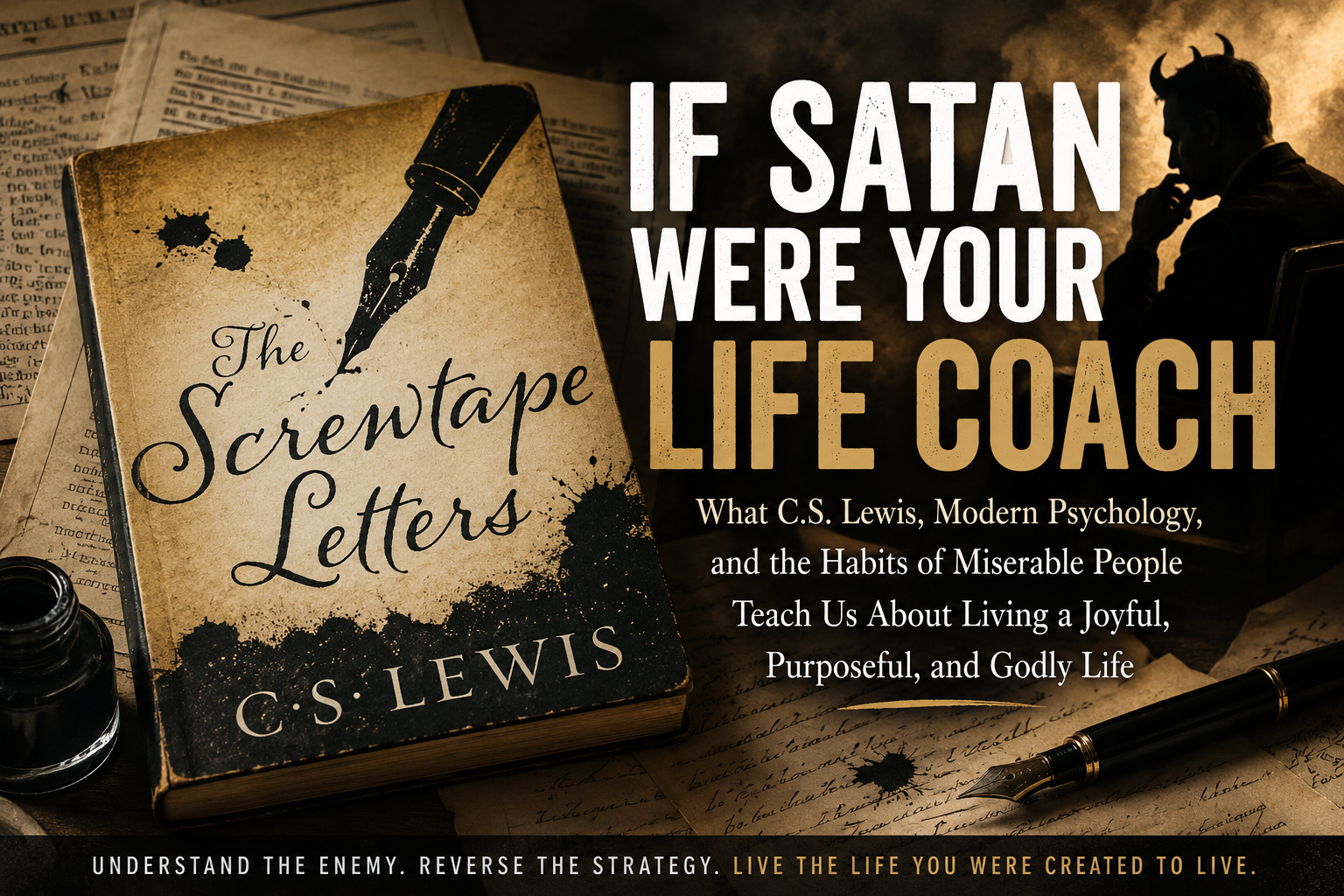
If Satan Were Your Life Coach
What C.S. Lewis, Modern Psychology, and the Habits of Miserable People Teach Us About Living a Joyful, Purposeful, and Godly Life
“The safest road to Hell is the gradual one… the gentle slope, soft underfoot, without sudden turnings, without milestones, without signposts.”
C.S. Lewis, The Screwtape Letters
What if Satan became your life coach?
Not the Hollywood version with horns, fire, you know the red suited buffoon with a cartoonish pitch fork. Imagine something far more subtle… much more Sidious… really evil. Imagine sitting across from a polished executive, an insightful psychologist, or a trusted mentor who genuinely seems to have your best interests at heart. He smiles warmly, nods with empathy, and offers advice that feels perfectly reasonable.
“Take care of yourself first.”
“You deserve to be happy.”
“Don’t let anyone judge you.”
“You’ve been hurt. You have every right to stay angry.”
“Life is short. Do what feels good.”
Nothing sounds overtly malevolent. In fact, much of it sounds like modern self-help.
That is precisely why C.S. Lewis’s The Screwtape Letters remains one of the most insightful books ever written about spiritual warfare. Lewis understood that the devil rarely succeeds through spectacular evil. His greatest victories are won through ordinary habits, subtle compromises, and almost imperceptible shifts in attention. Satan doesn’t usually convince people to reject God outright. He simply distracts them long enough that God slowly disappears from the center of their lives.
As a psychologist and performance, results, and life coach, I have become convinced that Lewis was describing something we now recognize through modern psychology. Human beings almost never destroy their lives in one catastrophic decision. They drift. They rehearse unhealthy patterns until those patterns become identities. They cultivate habits of misery while sincerely believing they are pursuing happiness.
Perhaps the greatest tragedy is that many people spend their entire lives climbing the wrong mountain only to discover, far too late, that it was leaning against the wrong wall.
“Satan is less interested in making you obviously wicked than quietly ordinary. Because an ordinary faith eventually produces an ordinary marriage, an ordinary family, an ordinary legacy, and a life that never fully reflects the glory of God.”
Dr. Keith M. Waggoner
Reverse Engineering the Good Life
One of the most effective ways to understand excellence is to study failure.
Elite pilots investigate crashes. World class surgeons study medical errors. Championship teams analyze losses. The purpose is never to glorify failure but to understand the decisions that produced it.
Lewis does the same thing spiritually.
Rather than writing a manual on holiness, he writes from the perspective of a senior demon mentoring his inexperienced nephew on how to quietly destroy a human soul. It is brilliant because it forces readers to reverse engineer righteousness. Every piece of demonic advice reveals a corresponding path toward wisdom.
This same principle appears throughout Scripture. Proverbs continually contrasts wisdom with foolishness. Jesus describes the narrow road and the broad road. Psalm 1 contrasts the righteous person with the wicked. God often teaches us what to pursue by first revealing what to avoid.
In coaching, I frequently ask clients a simple but powerful question:
“If you wanted to completely ruin your life over the next ten years, what habits would you begin practicing today?”
The answers come quickly.
Neglect your marriage.
Quit learning.
Become defensive.
Blame everyone else.
Avoid difficult conversations.
Spend more than you earn.
Live for comfort instead of purpose.
Now reverse every answer.
You have just created the blueprint for an extraordinary life.
The Habits of Highly Miserable People
Psychiatrist and family therapist Dr. Cloé Madanes identified fourteen habits that consistently characterize deeply unhappy people. Reading her list feels strangely familiar because it echoes Lewis almost perfectly. I was first introduced to Dr. Madanes in grad school while studying about brief strategic therapy. Then I had the honor of working with her and Tony Robbins in their work in Robbins/Madanes school of coaching.
Cloe expertly points out that highly miserable people constantly compare themselves to others. They hold grudges. They seek approval. They complain more than they express gratitude. They replay old offenses. They focus on problems rather than solutions. They expect the world to satisfy needs only God can ultimately fulfill.
None of these habits appear dramatic.
They are simply repeated.
Modern neuroscience tells us that repeated thoughts strengthen neural pathways. Psychologists call this neuroplasticity. Proverbs said it another way nearly three thousand years ago: “As a man thinks within himself, so he is.”
Our brains become efficient at whatever they repeatedly practice.
Practice gratitude and gratitude becomes easier.
Practice resentment and resentment becomes your default.
Practice courage and courage grows stronger.
Practice fear and fear begins making decisions for you.
Misery is rarely accidental.
It is rehearsed.
“The devil doesn’t usually destroy people through dramatic acts of evil. He patiently trains them in the ordinary habits of misery until they mistake them for normal.”
Dr. Keith M. Waggoner
The Enemy’s Favorite Distraction
The most dangerous lies are rarely outrageous.
They are almost true.
The serpent did not begin in Genesis by denying God’s existence. He simply invited Eve to reinterpret reality.
“Did God really say…?”
That question has echoed through every generation.
Did God really mean forgiveness?
Did God really design marriage this way?
Did God really create you for service rather than self?
Did God really know what would make you happiest?
Spiritual warfare almost always begins with interpretation before it ever reaches behavior.
In my coaching practice, I teach what I call the NAC Principle: Negative Automatic Conclusions. We instinctively assign meanings to circumstances that often are not true.
“They ignored my text because they don’t like me.”
“I failed once, so I’ll probably fail again.”
“My spouse didn’t notice my effort because they don’t appreciate me.”
Screwtape would applaud these conclusions because they quietly poison relationships, confidence, and faith without requiring any obvious sin.
The battlefield is not merely behavior.
The battlefield is interpretation.
The Religion of Self
Perhaps Lewis’s greatest insight is that Hell does not necessarily want people worshipping Satan.
Hell is perfectly satisfied if people simply worship themselves.
“The enemy’s greatest victory isn’t convincing you to worship Satan. It’s convincing you to spend your life worshipping yourself.”
Dr. Keith M. Waggoner
Our culture calls this authenticity.
Jesus calls us to deny ourselves.
Our culture says to follow your heart.
Scripture reminds us that the heart can be deceptive.
Our culture teaches self-expression.
Christ teaches self-surrender.
There is an enormous difference.
Ironically, the more obsessed we become with ourselves, the less fulfilled we become. Study after study in positive psychology demonstrates that meaning, purpose, contribution, gratitude, forgiveness, healthy relationships, and service produce far greater well-being than the endless pursuit of pleasure or self-gratification.
Jesus knew this long before psychologists did.
“Whoever wants to save his life will lose it, but whoever loses his life for My sake will find it.”
The Kingdom of God has always operated by paradox.
The first become last.
The servant becomes great.
The humble are exalted.
The giver receives.
The surrendered become free.
Every Life Teaches
One lesson has stayed with me throughout my career.
Every life eventually becomes one of two things.
An example.
Or a warning.
Every father teaches.
Every marriage teaches.
Every leader teaches.
Every coach teaches.
Even when we say nothing, our habits are speaking.
Our children are watching.
Our coworkers are watching.
Our friends are watching.
The question is not whether your life influences others.
The question is what it is teaching.
That realization should sober us.
But it should also inspire us.
Because habits can change.
Stories can be rewritten.
Legacies can begin today.
Coaching Through the Screwtape Lens
Whenever I feel anxious, resentful, discouraged, distracted, or tempted toward self pity, I have found one question remarkably clarifying.
What advice would Screwtape give me right now?
He would encourage comparison.
He would encourage offense.
He would encourage comfort.
He would encourage procrastination.
He would encourage endless scrolling.
He would encourage blaming.
He would encourage distraction disguised as busyness.
Now reverse every answer.
That reversal often points directly toward wisdom.
Choose gratitude over complaint.
Purpose over comfort.
Forgiveness over resentment.
Service over self-promotion.
Truth over assumption.
Presence over distraction.
This simple exercise has become one of the fastest ways I know to expose unhealthy thinking before it becomes unhealthy living.
The Greatest Story Ever Written
Every day you wake up holding a pen.
Whether you realize it or not, you are writing the next chapter of your story.
The enemy wants you focused on comfort instead of calling.
Consumption instead of contribution.
Self instead of service.
Fear instead of faith.
Christ invites you to something infinitely greater.
A life of courage.
A life of purpose.
A life of sacrifice.
A life that points beyond itself.
Lewis understood something that every great coach, psychologist, pastor, and leader eventually discovers. The battle for your future is rarely won in dramatic moments. It is won in ordinary decisions repeated faithfully over time.
Your habits become your character.
Your character shapes your legacy.
Your legacy tells your story.
Choose your habits wisely.
Because someday your life will become someone’s blueprint.
Or someone’s cautionary tale.
“Every life eventually becomes one of two things: an invitation or a warning. The habits you practice today will determine which one your life becomes tomorrow.”
Dr. Keith M. Waggoner
Coaching Reflection
Spend a few quiet moments with these questions.
- If Screwtape were mentoring me today, what habit would he encourage me to continue?
- Where have I confused comfort with peace?
- Am I pursuing God’s calling or simply protecting my own comfort?
- What story am I rehearsing through my daily thoughts and routines?
- What one habit, if reversed today, would most transform my marriage, leadership, health, faith, or legacy?
Choose one habit. Practice its opposite intentionally for the next thirty days. Small decisions, repeated consistently, become extraordinary lives.
Recommended Reading
- The Screwtape Letters by C.S. Lewis
- The Great Divorce by C.S. Lewis
- Mere Christianity by C.S. Lewis
- Atomic Habits by James Clear
- Man’s Search for Meaning by Viktor Frankl
- The Ruthless Elimination of Hurry by John Mark Comer
Recommended Podcasts and Videos
- John Mark Comer on spiritual formation and the habits of discipleship
- Jordan Peterson’s biblical lecture series on Genesis
- Huberman Lab episodes on habit formation and neuroplasticity
- The Bible Project series on wisdom literature
- C.S. Lewis Doodle videos by the C.S. Lewis Foundation
References
- Lewis, C.S. The Screwtape Letters.
- Lewis, C.S. Mere Christianity.
- Madanes, Cloé. “The 14 Habits of Highly Miserable People.”
- Clear, James. Atomic Habits.
- Frankl, Viktor E. Man’s Search for Meaning.
- Seligman, Martin E.P. Flourish.
- The Holy Bible, Proverbs 4:23; Proverbs 23:7 (various translations); Psalm 1; Romans 12:2; Philippians 4:8; Ephesians 6:10-18; Matthew 16:24-25; John 10:10.