
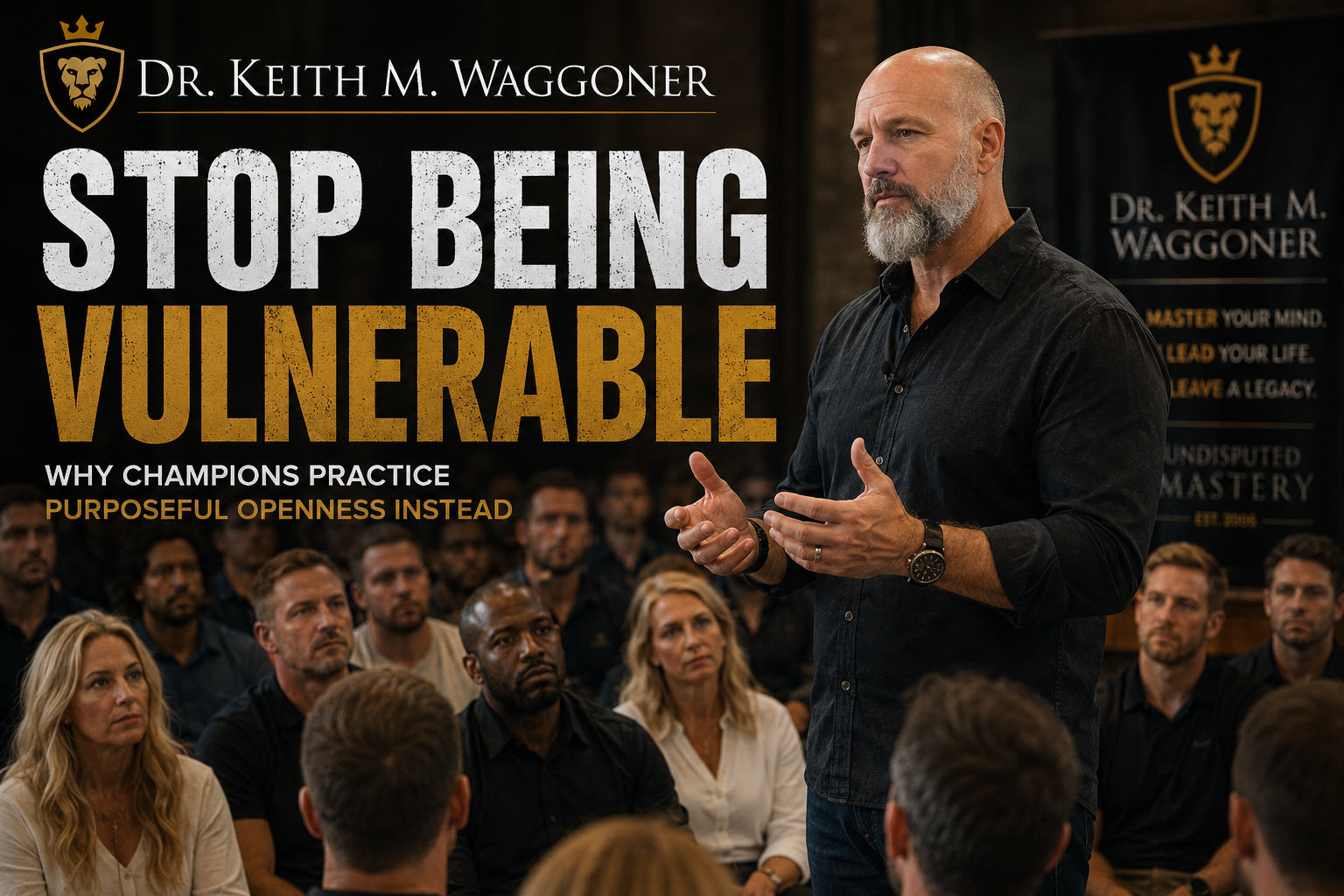
Stop Being Vulnerable
Why Champions Practice Purposeful Openness Instead
By Dr. Keith M. Waggoner
The arena was deafening.
More than twenty thousand fans were on their feet. Millions more were watching from living rooms, sports bars, airport terminals, and military bases around the world. The game hung in the balance, and once again the basketball found its way into the hands of the man everyone expected to save the day.
Michael Jordan rose into the air.
He released the shot.
And he missed.
The crowd groaned. Opponents celebrated. Television analysts would replay the moment from every conceivable angle. For many athletes, that miss would have become the defining moment of the game. For Jordan, it became nothing more than another possession.
What fascinates me has never been that Michael Jordan missed.
Every great athlete misses.
Every great entrepreneur loses deals.
Every great leader makes costly mistakes.
Every great husband occasionally says the wrong thing.
Every great father discovers there are moments he wishes he could do over.
Failure has never been the dividing line between ordinary people and extraordinary ones.
Response is.
What happened inside Michael Jordan’s mind after the miss is what made him Michael Jordan. He did not stand there shaking his head. He did not curse himself. He did not allow a single failure to become the story he carried into the next possession.
He immediately redirected his attention to what I call The Positive Next.
His focus shifted from the shot behind him to the opportunity in front of him. He was already preparing to compete again before everyone else had finished reacting to the last play.
Years later Jordan reflected on his career with one of the most quoted statements in sports history:
“I’ve missed more than 9,000 shots in my career. I’ve lost almost 300 games. Twenty-six times I’ve been trusted to take the game-winning shot and missed. I’ve failed over and over and over again in my life. And that is why I succeed.”
Most people read that quote and conclude that success requires enduring failure.
I think there is an even deeper lesson hidden inside Jordan’s words.
Jordan never became emotionally attached to failure. He learned from it, certainly. He studied it. He adjusted because of it. But he refused to make failure the center of his identity. The missed shot was simply information. It was never permission to stop competing.
The Positive Next is the discipline of immediately redirecting your attention toward your next opportunity rather than allowing your previous disappointment to define your present reality. Champions do not become resilient because they experience less adversity than everyone else. They become resilient because they recover their focus faster. They refuse to camp in failure. They extract the lesson, thank the moment for its instruction, and immediately return their eyes to the target.
Unfortunately, much of our culture is teaching the opposite.
Acknowledgments
I want to give credit where credit is due. Many of the ideas in this article were sharpened through countless conversations with my friend, brother, Martial Arts Instructor, and events teaching partner, Tuhon Harley Elmore. During a recent Principled Savage event, we found ourselves delineating with one of our Logical Order of Thought (L.O.T.) exercises, asking a deceptively simple question: Are we really teaching men to become vulnerable, or are we teaching them to become purposefully open?
That conversation sparked a line of thinking that has continued to grow long after the event ended. Like many worthwhile ideas, this framework was forged through respectful disagreement, thoughtful debate, and a shared commitment to helping men become stronger rather than more fragile. I am grateful for Harley’s willingness to challenge assumptions, ask better questions, and help refine what I believe is an important distinction.
The Vulnerability Trap
Over the past two decades, the language of vulnerability has become woven into nearly every conversation about leadership, marriage, parenting, counseling, and personal growth. To be fair, there has been tremendous value in encouraging people to remove their masks, confront shame, and tell the truth. Researchers like Brené Brown have helped millions understand that authentic connection requires courage.
I applaud that.
Where I believe we’ve taken a wrong turn is in the way many people now frame vulnerability.
The nervous system does not simply respond to our experiences. It also responds to the stories we tell ourselves about those experiences. If a man continually tells himself that opening his heart makes him vulnerable, exposed, and susceptible to injury, his mind begins preparing for injury before he has even spoken the first word.
He becomes hesitant.
He chooses his words too carefully.
He apologizes for emotions that require no apology.
He enters conversations already bracing for rejection.
Without realizing it, he has shifted from pursuing connection to avoiding pain.
That subtle shift changes everything.
At Undisputed Mastery, we challenge men to ask a different question before they speak, before they lead, before they love, before they build.
What do you really want?
That question immediately changes the direction of attention.
If I truly want connection with my wife, then my attention belongs on connection, not rejection.
If I truly want to become a better father, my attention belongs on becoming the father my children need, not on my fear of making mistakes.
If I truly want to build an extraordinary business, my attention belongs on serving clients exceptionally well, not on worrying about whether every decision will succeed.
Where focus goes, energy flows.
This principle appears repeatedly in psychology, performance science, and even Scripture.
The Apostle Paul wrote in Philippians 3:13-14:
“Forgetting what lies behind and straining forward to what lies ahead, I press on toward the goal…”
Notice Paul’s direction.
Forward.
Toward the goal.
Not backward toward regret.
Not sideways toward distraction.
Forward.
That is the language of pursuit.
That is the language of purpose.
That is the language of champions.
Playing to Win Instead of Playing Not to Lose
Several years ago, I noticed a fascinating pattern while coaching executives, military leaders, physicians, entrepreneurs, law enforcement officers, professional athletes, and couples.
The highest performers all understood something instinctively.
They played to win.
The struggling performers almost always played not to lose.
Those sound similar, but psychologically they are worlds apart.
A husband who plays not to lose avoids difficult conversations because he fears conflict. A husband who plays to win pursues intimacy because he values connection more than temporary comfort.
A business owner who plays not to lose hesitates to make investments because he fears making mistakes. A business owner who plays to win studies the risks, prepares wisely, and then moves decisively because growth requires action.
A police officer who freezes during a dangerous encounter is rarely lacking courage. More often, his attention has become consumed by everything he hopes does not happen. Elite officers train until their attention automatically returns to mission, movement, communication, and execution.
The same is true inside elite military units.
The same is true inside championship locker rooms.
The same is true inside healthy marriages.
Mission must become greater than fear.
Tim Grover, who trained Michael Jordan, Kobe Bryant, and Dwyane Wade, writes extensively in Relentless about the mentality of elite competitors. They do not become great because they never experience fear. They become great because fear never becomes the organizing principle of their behavior.
Jordan Peterson makes a remarkably similar observation when he writes that meaning is found not in the absence of responsibility but in voluntarily accepting it. Responsibility transforms suffering into purpose.
I believe the same principle applies here.
Purpose transforms vulnerability into purposeful openness.
That is a fundamentally different way of living.
It changes posture.
It changes attention.
It changes identity.
It changes outcomes.
The Invisible Prison
One observation has become impossible for me to ignore after coaching hundreds of men over the past three decades.
Whether I am sitting across from a physician, a Fortune 500 executive, a police officer, a combat veteran, an entrepreneur, a pastor, or a husband fighting to save his marriage, their presenting problems almost always look different. Yet after enough conversation, I usually discover they are trapped inside the same invisible prison.
Their attention has become organized around self-protection.
The executive is protecting his reputation.
The husband is protecting himself from rejection.
The father is protecting himself from failure.
The entrepreneur is protecting himself from financial loss.
The leader is protecting himself from criticism.
On the surface, those appear to be different battles. At their core, they are all expressions of the same story. The mind has quietly shifted from pursuing purpose to preventing pain.
That is a dangerous trade.
Because the longer we organize our lives around avoiding pain, the less energy remains for pursuing purpose.
That realization became one of the foundational ideas behind my coaching process. Transformation rarely begins by asking, “What are you afraid of?” It begins by asking, “What do you really want?”
That question immediately changes the direction of a man’s attention.
Purposeful Openness: The Better Frame
This is why I believe we need a stronger framework than vulnerability alone.
I call it Purposeful Openness.
Purposeful Openness is not emotional hiding. It is not denial. It is not pretending men do not feel deeply. It is the opposite. Purposeful Openness is the courageous decision to reveal what is true, pursue what is valuable, and accept the risks of action without becoming emotionally enslaved to the response of others.
In my coaching process, this begins with one of the most important questions I ask clients:
What do you really want?
Not what are you afraid of. Not what are you trying to avoid. Not what might go wrong. What do you really want?
A man who wants connection with his wife must stop organizing his energy around the fear of rejection. A leader who wants to build a great company must stop organizing his attention around criticism. A father who wants to restore trust with his children must stop rehearsing shame long enough to take the next courageous step.
This is where Story Strategy becomes critical. Every person is living from a story. Some stories make men hunters. Other stories make men prey.
The prey story says, “I hope I don’t get hurt.”
The champion story says, “I know what I want, and I am willing to pursue it.”
The prey story says, “What if they reject me?”
The champion story says, “Connection is worth pursuing.”
The prey story says, “What if I fail?”
The champion story says, “The next attempt may be the breakthrough.”
Viktor Frankl wrote, “Those who have a ‘why’ to live, can bear with almost any ‘how.’” That quote has endured because it points to one of the deepest truths of human transformation. Meaning changes suffering. Purpose changes pain. Mission changes fear.
That is also why this work connects so closely to what I call NAC: noticing, accepting, and choosing. A man first notices the story he is living from. He accepts responsibility for the current pattern without collapsing into shame. Then he chooses a stronger story and a more purposeful next action. This is not theory. This is the practical work of changing how a man sees himself, his relationships, his leadership, and his mission.
The Story You Rehearse Becomes the Life You Live
One of the central ideas behind Story Strategy is that every human being is constantly rehearsing an internal narrative. That narrative becomes the blueprint from which decisions, emotions, relationships, and habits are built.
If the story sounds like, “I hope I don’t get hurt,” the mind begins collecting evidence that supports the story.
If the story becomes, “People always reject me,” the brain becomes remarkably efficient at noticing rejection while overlooking acceptance.
Modern neuroscience continues to reinforce this idea. Our attentional systems become increasingly sensitive to whatever we repeatedly practice noticing. In other words, the brain becomes better at finding whatever we train it to look for.
This is why the question, “What do you really want?” is so powerful.
It interrupts an old story and begins writing a new one.
Suddenly, the husband starts looking for opportunities to create connection instead of evidence that his wife doesn’t understand him.
The entrepreneur begins noticing opportunities instead of obstacles.
The leader begins looking for solutions instead of blame.
The story changes.
Then attention changes.
Then behavior changes.
Finally, life changes.
Long before circumstances improve, identity begins to improve.
That is how transformation almost always happens.
“As a man thinks in his heart, so is he.”
— Proverbs 23:7 (NKJV)
Whether Solomon intended it as a lesson in neuroscience or not, the principle remains astonishingly relevant. The life we repeatedly imagine eventually becomes the life we begin creating.
The Invisible Prison
One observation has become impossible for me to ignore after coaching hundreds of men over the past three decades.
Whether I am sitting across from a physician, a Fortune 500 executive, a police officer, a combat veteran, an entrepreneur, a pastor, or a husband fighting to save his marriage, their presenting problems almost always look different. Yet after enough conversation, I usually discover they are trapped inside the same invisible prison.
Their attention has become organized around self-protection.
The executive is protecting his reputation.
The husband is protecting himself from rejection.
The father is protecting himself from failure.
The entrepreneur is protecting himself from financial loss.
The leader is protecting himself from criticism.
On the surface, those appear to be different battles. At their core, they are all expressions of the same story. The mind has quietly shifted from pursuing purpose to preventing pain.
That is a dangerous trade.
Because the longer we organize our lives around avoiding pain, the less energy remains for pursuing purpose.
That realization became one of the foundational ideas behind my coaching process. Transformation rarely begins by asking, “What are you afraid of?” It begins by asking, “What do you really want?”
That question immediately changes the direction of a man’s attention.
Keith Principle: “Your future is not determined by the fears you overcome as much as it is by the purpose you pursue.”
The Difference Between Confidence and Courage
One misunderstanding I frequently encounter is the belief that courageous people simply possess more confidence than everyone else.
I don’t believe that is true.
Confidence is often the result of repeated success.
Courage exists long before confidence arrives.
Every meaningful accomplishment begins before confidence has had a chance to grow.
David walked toward Goliath before he had any evidence that the battle would end in victory.
Joshua stepped into the Jordan River before the waters parted.
Peter climbed out of the boat before he knew whether his feet would remain above the waves.
Faith has always required movement before certainty.
Purposeful Openness works the same way.
You do not wait until you are confident enough to pursue what matters.
You pursue what matters because it matters.
Confidence often arrives somewhere along the journey.
“Have I not commanded you? Be strong and courageous. Do not be frightened, and do not be dismayed, for the Lord your God is with you wherever you go.”
— Joshua 1:9
Notice that God never promised Joshua certainty.
He promised His presence.
That distinction changes everything.
How I Coach This in High-Performance Environments
I have used this principle with men in military contexts, law enforcement, professional sports, executive leadership, entrepreneurial growth, marriage work, and Fortune 500-style performance cultures. The language may change depending on the room, but the principle remains the same.
With military leaders, the question becomes: What is the mission, and what mental story is interfering with execution?
With law enforcement, the question becomes: Are you focused on fear, or are you focused on training, communication, awareness, and the next right action?
With professional athletes, the question becomes: Are you replaying the last mistake, or are you already moving toward The Positive Next?
With executives and business owners, the question becomes: Are you protecting your ego, or are you pursuing the outcome?
With husbands, the question becomes: Are you trying not to be rejected, or are you pursuing love?
This is why Purposeful Openness is so powerful. It does not weaken a man. It restores agency. It teaches him to act from values instead of fear, mission instead of mood, and purpose instead of self-protection.
Andrew Huberman frequently discusses how attention, stress, and physiology interact. Where attention goes, the nervous system follows. A man who repeatedly focuses on threat trains his body to prepare for threat. A man who repeatedly focuses on the next meaningful action trains his nervous system toward readiness, response, and resilience.
This is also why the old skier principle matters: if you stare at the tree, you hit the tree. You do not avoid the tree by obsessing over it. You avoid the tree by finding the opening and moving toward it.
In Scripture, Proverbs 4:25 says, “Let your eyes look directly forward, and your gaze be straight before you.” That is not just poetic wisdom. It is performance psychology. It is leadership psychology. It is spiritual formation. Your gaze matters because your gaze determines your direction.
The Hero’s Journey and the Courage to Pursue
Joseph Campbell described the Hero’s Journey as a movement from the known world into the unknown, through trial, transformation, and return. In my coaching work, I see this pattern constantly. A man feels a call. He resists the call. He fears what it will cost. He wants the reward without the risk. But eventually, if he is going to become who he was born to become, he must cross the threshold.
That threshold is where many men misuse the word vulnerable.
They say, “I feel vulnerable,” when what they really mean is, “I am standing at the edge of something meaningful.”
That edge is not a sign to retreat. It is often the doorway into transformation.
John Eldredge has written powerfully about the masculine heart and the need for battle, adventure, and beauty. Men are not designed merely to be safe. They are designed to pursue something worthy. They are designed for mission, love, sacrifice, brotherhood, and courage.
That does not mean recklessness. Purposeful Openness is not foolish exposure. A hunter does not wander into the woods unprepared. A warrior does not enter the battle without training. A husband should not dump emotion on his wife and call it honesty. A leader should not speak impulsively and call it authenticity.
Purposeful Openness includes preparation.
You consider the risks. You prepare for the possible responses. You accept that others may not respond the way you hope. But because you chose the action from purpose, you are not destroyed by their reaction.
That is the key.
The man who acts from purpose remains powerful regardless of the response.
The Navy SEAL Paradox
There is a saying often attributed to the Navy SEAL community:
“When we are vulnerable to each other, we become invulnerable together.”
That statement only makes sense when vulnerability is understood as purposeful openness, not fragility.
A team becomes stronger when truth can be spoken. A marriage becomes stronger when reality can be named. A brotherhood becomes stronger when men no longer have to hide behind false strength. A company becomes stronger when leaders can admit problems early enough to solve them. A family becomes stronger when hard conversations are no longer avoided.
The goal is not emotional exposure for its own sake.
The goal is strength through truth.
The goal is trust.
The goal is alignment.
The goal is mission.
Jocko Willink’s phrase “discipline equals freedom” applies here. Emotional discipline does not mean emotional suppression. It means emotions are brought under the authority of mission, values, and truth. A disciplined man can feel deeply without becoming controlled by feeling. He can speak honestly without becoming needy. He can pursue connection without becoming a victim if the response is disappointing.
That is a rare man.
That is the kind of man we are building.
The Marriage Application
Nowhere is this more important than marriage.
Many men say they want deeper intimacy with their wives, but they approach the relationship like prey. They scan for danger. They anticipate criticism. They measure every word. They wait for permission. They become tentative, passive, and resentful.
Then they wonder why the relationship feels distant.
A man cannot create deep connection while organizing his heart around self-protection.
The better question is: What do I really want?
If I want connection, then I must pursue connection. If I want trust, then I must become trustworthy. If I want passion, then I must bring presence. If I want respect, then I must live respectably. If I want spiritual unity, then I must lead with humility, courage, and conviction.
Ephesians 5 calls husbands to love their wives as Christ loved the church and gave Himself up for her. That is not passive love. That is sacrificial, courageous, pursuing love.
Christ did not love from self-protection. He loved from mission.
That is the model.
Purposeful Openness in marriage means a man can say, “This is what I desire for us. This is what I feel. This is where I have failed. This is what I am committed to pursue. I cannot control your response, but I can control the man I choose to become.”
That is not weakness.
That is strength under humility.
The Positive Next in Real Life
The Positive Next is one of the most practical tools in this entire framework. When something goes wrong, most people ask low-quality questions.
Why did this happen to me?
What is wrong with me?
What if I fail again?
What will they think?
These questions turn pain into identity.
The Positive Next asks a better question:
What is the next right action?
That question restores movement.
In business, The Positive Next may be making the follow-up call after losing the deal. In marriage, it may be initiating the conversation after a poor response the night before. In parenting, it may be apologizing without defending yourself. In athletics, it may be sprinting back on defense after missing the shot. In leadership, it may be gathering the team, naming reality, and setting the next standard.
This is not denial. This is not fake positivity. This is disciplined attention.
Philippians 3:13-14 says, “Forgetting what lies behind and straining forward to what lies ahead, I press on toward the goal.” Paul is not recommending emotional avoidance. He is describing spiritual focus. He is refusing to let the past become the prison of the present.
Champions do the same thing.
They learn. They adjust. They repent when needed. They repair what they can. Then they move.
From Fragility to Dominion
This is why Undisputed Mastery exists.
We are not gathering men to teach them how to become more fragile. We are gathering men to help them become more awake, more honest, more disciplined, more connected, and more dangerous to the darkness that has ruled their lives.
Dominion is not about domination of others.
Dominion is about rightful stewardship over the life God has entrusted to you.
Your body.
Your marriage.
Your fatherhood.
Your business.
Your mission.
Your brotherhood.
Your spiritual authority.
At Dominion this October, we will challenge men to stop playing not to lose and start playing to win. We will help them identify the stories that have kept them small, the fears that have kept them passive, and the habits that have kept them reactive. Through challenge, brotherhood, coaching, and action, men will be invited to reclaim the part of themselves that still knows they were made for more.
And at our Relationship Event in January 2027, we will take this same framework into the sacred territory of love, marriage, communication, conflict, intimacy, and covenant. Couples do not become extraordinary by avoiding discomfort. They become extraordinary by learning how to pursue truth and connection with courage, wisdom, humility, and skill.
The world does not need more people who stare at the tree.
The world needs men and women who can see the opening.
The world does not need more people playing not to lose.
The world needs champions who know what they want, pursue what matters, and recover quickly when life does not go as planned.
Michael Jordan missed.
Then he wanted the next shot.
That is the mindset.
That is the lesson.
That is The Positive Next.
And that is the invitation.
Stop organizing your life around the fear of being hurt.
Stop calling hesitation wisdom.
Stop mistaking self-protection for maturity.
Stop playing not to lose.
Become purposefully open.
Pursue what matters.
Tell the truth.
Take the shot.
And when you miss, learn what must be learned, lift your eyes, and prepare for the next one.
Because the next shot may be the one that changes everything.
One Final Thought
Perhaps the opposite of vulnerability is not strength.
Perhaps the opposite of vulnerability is purpose.
When purpose becomes large enough, fear begins losing its authority.
Not because fear disappears.
But because purpose finally has something greater to say.
That may be the greatest lesson Michael Jordan ever taught us.
Not that champions never miss.
But that champions never allow the miss to become the mission.
Suggested Reading
Man’s Search for Meaning by Viktor Frankl
A foundational work on meaning, suffering, purpose, and the human ability to choose one’s response even under extreme conditions.
Relentless by Tim Grover
A powerful look at the mindset of elite competitors, especially those who refuse to be controlled by comfort, fear, or average standards.
Winning by Tim Grover
A direct and intense exploration of what it costs to pursue greatness rather than simply talk about it.
12 Rules for Life by Jordan Peterson
A serious reflection on responsibility, meaning, order, truth, and the necessity of voluntarily carrying a meaningful burden.
Beyond Order by Jordan Peterson
A helpful companion to Peterson’s work on chaos, transformation, and the courageous engagement of life’s unknown territory.
Wild at Heart by John Eldredge
A meaningful exploration of the masculine heart, mission, battle, beauty, and the deep longing men have for a life that matters.
Fathered by God by John Eldredge
A valuable look at masculine development, initiation, and the stages of a man’s growth.
Extreme Ownership by Jocko Willink and Leif Babin
A leadership classic on responsibility, discipline, mission, and the refusal to live as a victim.
Daring Greatly by Brené Brown
Important work on shame, courage, and openness, even though this article reframes vulnerability through a more mission-driven lens.
The War of Art by Steven Pressfield
A short but powerful book on resistance, discipline, creative work, and the necessity of moving toward the work that matters.
Recommended Videos and Podcasts
Tim Grover interviews on Michael Jordan, Kobe Bryant, and elite performance
Useful for understanding the difference between average effort and championship obsession.
Andrew Huberman podcast episodes on stress, attention, dopamine, and performance
Helpful for understanding how attention, physiology, and behavior interact.
Jordan Peterson lectures on responsibility, meaning, sacrifice, and truth
Strong material for understanding why maturity requires voluntarily accepting responsibility.
Jocko Podcast episodes on discipline, ownership, and leadership under pressure
Excellent for military, law enforcement, executive, and team leadership applications.
John Eldredge and the Wild at Heart Podcast
Helpful for connecting masculine development, spiritual formation, adventure, and restoration.
The Bible Project videos on courage, wisdom, exile, and calling
Useful for grounding these concepts in biblical narrative and spiritual formation.
Ed Mylett interviews with elite performers
Good practical conversations on identity, discipline, confidence, and the next level of personal performance.
Modern Wisdom podcast episodes on resilience, masculinity, discipline, and meaning
A broad source for conversations with authors, researchers, and high performers on modern strength and purpose.