
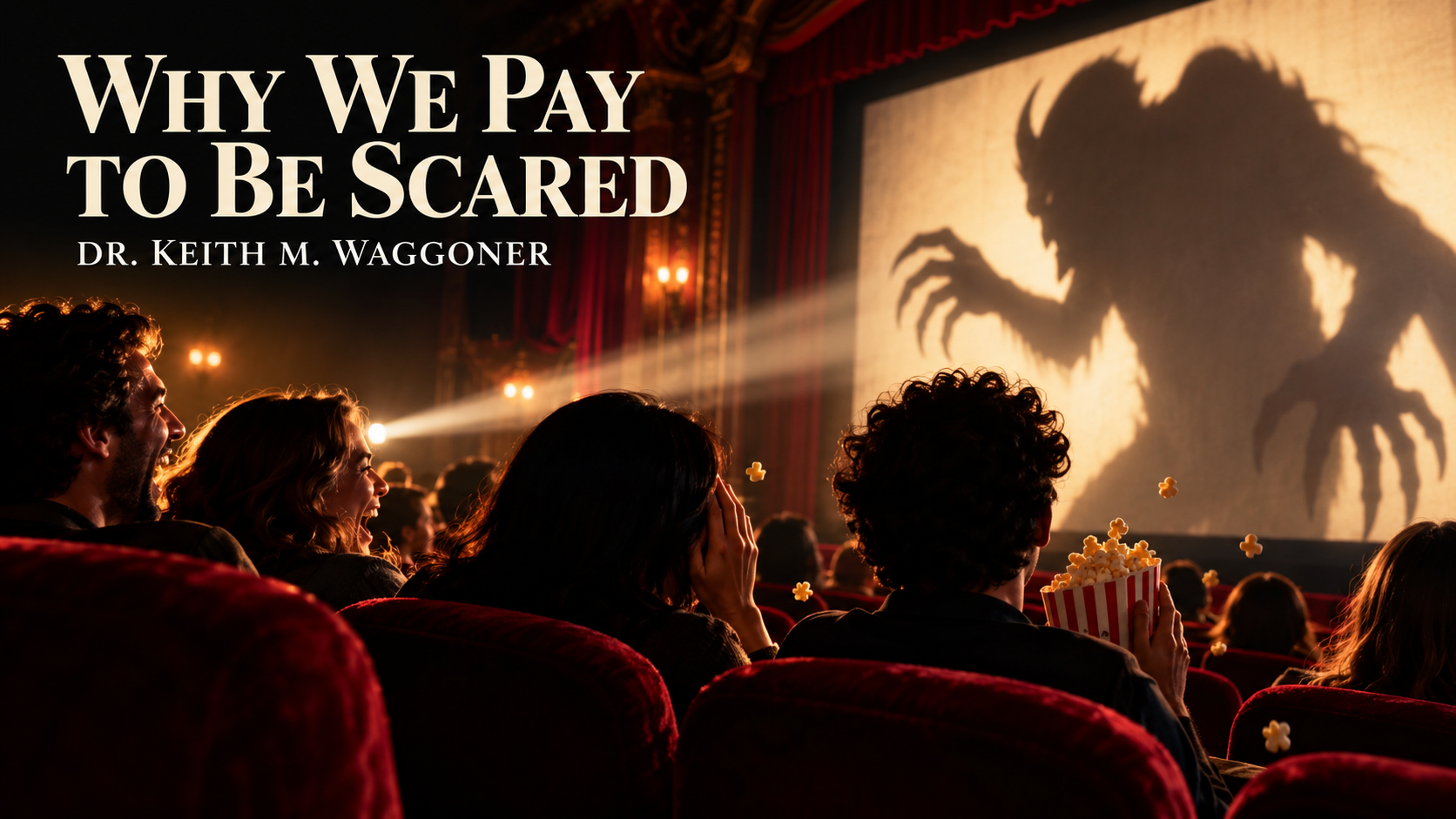
Why We Pay to Be Scared
By Dr. Keith M. Waggoner
Every October, people stand in line and pay good money to enter a building designed to make them scream. They know someone is hiding behind a wall. They know the chainsaw probably has no chain. They know the exit is just around the corner.
And they go in anyway.
If a stranger leapt from the bushes while you were taking out the trash, you would not thank him for the experience and recommend him to your friends. So why do we pay for the haunted-house version? Why do we turn off the lights and watch a movie about people who should have left that cabin 45 minutes ago?
Stephen King put it beautifully in his essay Why We Crave Horror Movies: we are “daring the nightmare.”
I think the answer is more interesting than “we like adrenaline.”
Psychologist Jordan Peterson has asked what we are doing when we voluntarily watch a horror movie. His answer is that we are choosing to face something frightening from a position where we can endure it. Behind the movie monster is an older human concern: danger, suffering, losing the people we love, and ultimately the fact that life ends.
Halloween lets us peer at those things with a bowl of popcorn in our laps.
Of course, some of us peer from behind a pillow. No judgment. The pillow is a legitimate piece of safety equipment.
Why this night carries death in its name
Halloween is short for All Hallows’ Eve, the evening before All Saints’ Day. Its customs also have a long and complicated relationship with older autumn traditions about the boundary between the living and the dead. In Mexico, Día de los Muertos, the Day of the Dead, is a distinct tradition in which families remember and honor loved ones who have died. It falls in the same season, but it should not be mistaken for another name for Halloween.
These observances are not all saying the same thing. Still, it is striking how often people turn toward death at this time of year, sometimes with remembrance, sometimes with costumes and laughter, sometimes with fear. Beneath the plastic skeletons and the movie monsters is a serious human question: What do we do with the knowledge that our lives, and the lives of the people we love, are finite?
We can keep that question at a comfortable distance when the skeleton is hanging from a neighbor’s porch. A good horror story brings it a little closer.
Fear with an exit door
There is a crucial difference between being trapped in danger and choosing to visit a convincing imitation of it. At a haunted house, you know there is an exit. At a movie, you can pause it. Your body still reacts. Your heart speeds up. You grab the arm of the person next to you. But another part of you knows, “I am safe enough to stay and see what happens.”
Researchers call this recreational fear. In one study, visitors to a haunted attraction wore heart-rate monitors while researchers tracked both their reactions and their enjoyment. The most enjoyable experience was not necessarily the least frightening one. There seemed to be a sweet spot: enough fear to make the experience exciting, without so much that it became overwhelming.
That sounds a lot like life. Too little challenge and we get bored. Too much and we shut down. Somewhere in between, we discover what we can handle.
When the movie follows you home
There is another side to this. More horror is not automatically more courage.
The same story that feels like a thrilling game to one person can leave another checking the locks, replaying an image in bed, and feeling on edge the next morning. Sometimes the image shows up again in a nightmare days later. A review of research on horror films found evidence of short-term anxiety and disturbed sleep, although it did not find evidence of lasting mental-health harm from horror films in otherwise healthy people. Responses vary. We should not treat a frightened child as though enduring the movie is a character-building assignment.
Nor should we confuse getting used to a disturbing image with becoming stronger. If the experience leaves you curious, amused, and able to return to ordinary life, fine. If it keeps you awake, feeds intrusive thoughts, or makes the world feel more threatening, pay attention. That is useful information about your response, regardless of what your friends can watch without blinking.
I would ask a simple question: After I watch, do I feel more capable of facing life, or more consumed by fear?
You do not win a prize for forcing yourself through the next installment. There is no championship belt for watching a slasher movie before bed.
A rehearsal, not a cure
One study during the early COVID-19 pandemic found that people who identified as horror fans reported less psychological distress than those who did not. Fans of disaster and survival stories also reported feeling more prepared. That does not prove scary movies made anyone resilient. It does raise a fascinating possibility: frightening stories may give us a safe place to imagine trouble and practice our response to it.
That is close to what Peterson is getting at. We do not become brave by waiting until fear disappears. We grow when we choose to approach something difficult and discover that we can remain present. A scary movie is only a small, playful version of that experience. It will not resolve a real phobia or replace the work of dealing with grief, trauma, or anxiety. Watching ten of them will not substitute for one honest conversation.
Seneca observed that “we suffer more often in imagination than in reality.” He was writing about the mind’s ability to torment us with what might happen. A good scary story gives that imagination a temporary stage. Our real lives ask us to distinguish the imagined catastrophe from the next action we can actually take.
The monster you refuse to look at tends to grow in the dark.
In ordinary life, the monster may be the test result you have avoided opening, the conversation you need to have, the apology you owe, or the decision you have postponed for months. None of those comes with dramatic music to announce its arrival. Most of them are scarier precisely because they are real.
What are you willing to face?
This Halloween, enjoy the costumes, the candy, the ridiculous amount of fake cobwebs, and the friend who insists that the movie “wasn’t even scary” while checking every window before bed. Choose the kind of fright that is actually fun for you, and know when you have had enough.
Then consider why we are drawn to these stories in the first place. Perhaps we want a brief encounter with what frightens us, followed by the pleasure of finding ourselves still here. We walk out of the haunted house laughing. The monster did not get the last word.
When the decorations come down, that is worth remembering. You do not need to enjoy fear. You do not have to face everything at once. But you can take one honest, manageable step toward the thing you know you need to face.
The movie monster will be gone when the credits roll. The courage you practice in real life has a way of staying with you.
Recommended reading
- Stephen King, Danse Macabre. A lively exploration of what horror stories reveal about our culture and our fears.
- Seneca, Letters from a Stoic, especially Letter 13. An ancient, practical reflection on fear and what our imagination does with it.
- Rollo May, The Courage to Create. On acting with courage amid uncertainty rather than waiting for certainty to arrive.
- Viktor E. Frankl, Man’s Search for Meaning. A profound account of purpose and human response in the face of suffering. This is serious reading, far beyond Halloween entertainment.
If this raised a question about the fear or decision you have been avoiding, I would welcome the chance to work through it with you in a coaching session. You can contact me about coaching or explore our Undisputed Mastery events for opportunities to practice courage with others.
Sources
-
- Jordan Peterson, “What Are You Doing When You Watch a Horror Movie?” https://www.youtube.com/shorts/qqZD2RRw-7c
- Stephen King, “Why We Crave Horror Movies.” https://academic.shu.edu/english/1201/Directed%20Self-Placement/excerpt_from_stephen_king.htm
- Seneca, Moral Letters to Lucilius, Letter 13, trans. Richard M. Gummere. https://en.wikisource.org/wiki/Moral_letters_to_Lucilius/Letter_13
- Andersen et al., “Playing With Fear: A Field Study in Recreational Horror,” Psychological Science (2020). https://doi.org/10.1177/0956797620972116
- Scrivner et al., “Pandemic practice: Horror fans and morbidly curious individuals are more psychologically resilient during the COVID-19 pandemic,” Personality and Individual Differences (2021). https://pmc.ncbi.nlm.nih.gov/articles/PMC7492010/
- Martin, “(Why) Do You Like Scary Movies? A Review of the Empirical Research on Psychological Responses to Horror Films,” Frontiers in Psychology (2019). https://pmc.ncbi.nlm.nih.gov/articles/PMC6813198/
- Library of Congress, “The Origins of Halloween Traditions.” https://blogs.loc.gov/headlinesandheroes/2021/10/the-origins-of-halloween-traditions/
- UNESCO, “Indigenous festivity dedicated to the dead.” https://ich.unesco.org/en/RL/indigenous-festivity-dedicated-to-the-dead-00054