
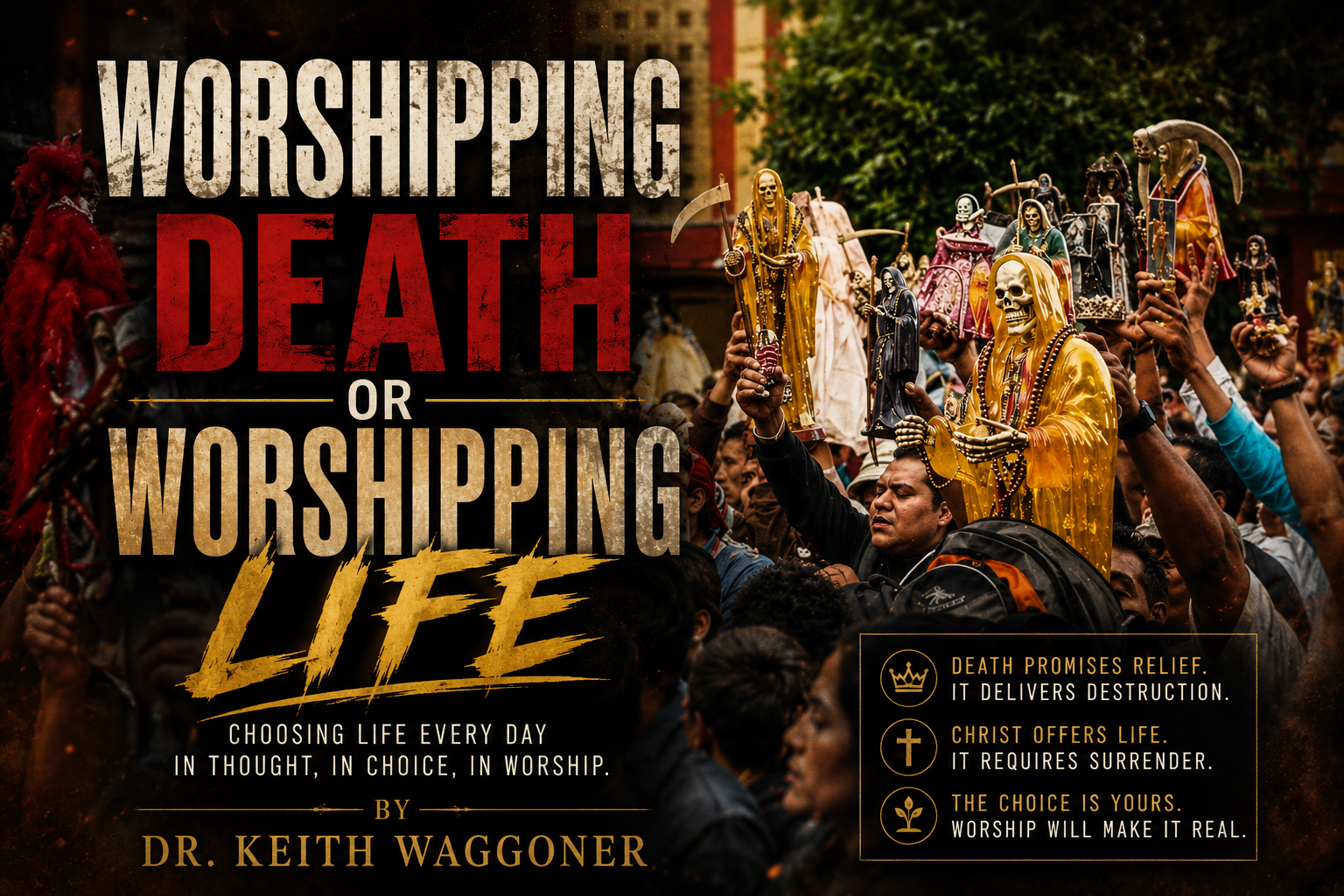
Worshipping Death or Worshipping Life
“It Scared Me to Life”
Several years ago, a client sat across from me and told me about the night he tried to commit suicide.
As he described those dark moments, there was very little emotion in his voice. He wasn’t looking for sympathy. He wasn’t trying to shock me. He was simply telling the truth.
Then he said something I’ll never forget.
“It scared me to life.”
I asked him what he meant.
He explained that coming so close to death made him realize something he had never understood before.
He didn’t actually want to die.
He wanted the pain to stop.
He wanted the shame to stop.
He wanted the loneliness to stop.
He wanted the disappointment to stop.
He wanted the constant pressure to stop.
Death had become his imagined solution because he could no longer imagine another one.
Surviving shattered that illusion.
For the first time, he saw life differently. Every sunrise felt different. Every conversation mattered more. Every breath seemed like a gift he almost threw away.
“It scared me to life.”
I’ve thought about those words for years.
Not simply because of what they revealed about him.
Because they exposed something about me.
My Own Agreement With Death
I have never attempted suicide.
But as I reflected on his story, I realized I had been living with my own agreement with death.
Not consciously.
Not because I wanted to die.
But because I had developed a pattern that slowly honored death instead of life.
I knew how to enter the arena.
I knew how to fight.
I knew how to sacrifice.
I knew how to endure.
I thrived in urgency.
If someone needed protecting, I showed up.
If there was a crisis, I moved toward it.
If there was a battle to fight, I fought.
But I eventually noticed a disturbing pattern.
I would show up.
I would fight.
If I didn’t get killed in the arena…
I’d go home and slowly kill myself in some other way.
I’d sacrifice sleep.
Ignore my health.
Carry burdens God never asked me to carry.
Work beyond wisdom.
Live on adrenaline.
Push my body until it protested.
Looking back now, I believe there was an agreement running silently in the background of my life. It had been there since around 2010. I didn’t recognize it then, but it revealed itself through years of self-sabotage disguised as responsibility. It finally culminated in the seizure that forced me to stop. Looking back, I don’t see that day merely as a medical event. I see it as God’s mercy. He would not allow me to continue worshipping death through the slow destruction of the life He had entrusted to me.
That experience forced me to ask a question I had never seriously considered.
Was I actually worshipping life… or had I unknowingly begun worshipping death?
The Core Temptation of Walking in Death
Most people imagine death as a single event that occurs at the end of life. Scripture frequently presents death as something more than a final moment. Death can also become a direction, a governing influence, and a way of walking through the world. Long before the heart stops beating, a person can begin practicing death through repeated choices that diminish the life God has entrusted to him.
This is the core temptation of walking in death: the temptation to squander life.
Jesus described the devil as “a murderer from the beginning” and “the father of lies” (John 8:44). The connection between lying and murder is significant. The enemy often destroys life by first persuading us to believe something false about it. He tells us that our lives do not matter, that our bodies are disposable, that our future is already ruined, that pleasure will satisfy us, that constant urgency proves our value, or that we can continue abusing ourselves without consequence.
The enemy does not always tempt a person to commit one dramatic act of destruction. More commonly, he tempts us to participate in our own gradual diminishment. Death disguises itself as relief, reward, entitlement, ambition, escape, comfort, or control. It says, “You deserve another drink.” It says, “You can rest when the work is finished.” It says, “This food is the only thing that makes you feel better.” It says, “You have already gone too far to change.” It says, “No one will know.” It says, “You are only valuable when you are producing, suffering, rescuing, or fighting.”
The temptation toward death rarely feels like a temptation toward death. It usually feels like an immediate answer to discomfort.
That is what makes it so dangerous.
Squandering the Life God Entrusted to Us
Jesus tells the story of a master who entrusted talents to three servants in Matthew 25. One servant received five talents, another received two, and another received one. The servants who received five and two invested what they had been given and produced a return. The servant who received one buried it in the ground.
The one-talent servant did not lose the talent through some dramatic scandal. He did not waste it in a night of reckless living. He simply refused to develop what had been entrusted to him. He buried it. When the master returned, he did not praise the servant for keeping the talent safe. He called him wicked and slothful because fear had persuaded him to squander possibility.
The parable applies to more than money. God has entrusted each of us with life itself. Our time, bodies, minds, opportunities, relationships, influence, abilities, experiences, and spiritual gifts do not ultimately belong to us. They are entrusted resources. We are stewards, not owners.
The five-talent man multiplied what he received. The one-talent man preserved his pulse but buried his purpose.
This raises a difficult question. Is it possible to remain physically alive while burying the life God gave us?
I believe it is.
A person can squander life through reckless excess, but he can also squander it through fear, passivity, resentment, isolation, and refusal. He can bury his courage because he is afraid to fail. He can bury his love because he is afraid to be hurt. He can bury his calling because obedience might require sacrifice. He can bury his body beneath years of neglect. He can bury his marriage beneath work. He can bury his imagination beneath cynicism. He can bury his faith beneath disappointment.
Walking in death does not always look like obvious rebellion. Sometimes it looks like refusing to become the person God created you to become.
The question is not merely whether we avoided a spectacular collapse. The question is what we did with the life the Master placed into our hands.
What It Looks Like to Slowly Die
Sometimes death comes violently. More often, a person participates in death gradually, one apparently manageable choice at a time.
It looks like the man who drinks every evening because he believes alcohol is the only way to quiet his mind. At first, he calls it relaxation. Eventually, his body, marriage, judgment, finances, and spiritual sensitivity begin paying the price. What started as a drink becomes an agreement. What became an agreement eventually becomes a master.
It looks like the person who uses drugs to escape emotional pain but slowly loses the ability to experience joy without chemical assistance. It looks like the man who eats far beyond nourishment because food has become comfort, anesthesia, celebration, and companionship. He may joke about his habits while his body quietly deteriorates beneath the weight of his choices.
It looks like chronic stress treated as a symbol of importance. A man remains perpetually activated, overcommitted, angry, and exhausted. He believes slowing down would mean losing his edge. His nervous system never receives permission to stand down. His blood pressure rises, his sleep deteriorates, his relationships weaken, and his body eventually begins forcing the rest he continually refused.
It looks like the successful businessman who builds an impressive company while his children grow up without meaningful access to him. He says he is sacrificing for his family, but his family experiences the sacrifice as abandonment. He provides a lifestyle while starving the people he loves of his presence.
It looks like the husband who feeds pornography while wondering why intimacy with his wife feels empty. It looks like resentment rehearsed so often that bitterness becomes personality. It looks like anger that is never surrendered, grief that is never processed, shame that is never confessed, and pride that would rather die privately than ask for help publicly.
It looks like hours spent scrolling through other people’s lives while neglecting the life directly in front of us. It looks like refusing to exercise, refusing to sleep, refusing to receive treatment, ignoring warning signs, and treating the body as though it were merely a disposable machine carrying the mind from one achievement to another.
It can also look like endless urgency.
I understand that temptation personally. I thrive in urgency. I know how to enter the arena, accept the mission, confront danger, and respond when something important is at stake. Urgency can sharpen my focus and call forth tremendous strength. But when urgency becomes the only place where I feel alive, I may begin unconsciously producing the conditions that keep me there.
A man who only feels valuable during a crisis may continually create crises. He procrastinates until everything becomes an emergency. He overloads his schedule. He takes unnecessary risks. He surrounds himself with unstable people. He neglects ordinary maintenance because rescue feels more meaningful than prevention.
He is not only fighting fires.
He may be setting some of them.
Death is not always an obvious act of self-destruction. Sometimes it is an entire lifestyle built around the slow expenditure of everything God intended us to steward.
The False Promises of Death
Every temptation contains a promise. Death promises relief without healing, pleasure without responsibility, freedom without truth, and peace without reconciliation.
The overindulgent man is not merely choosing alcohol, drugs, food, sex, or entertainment. He is reaching for a promise. He believes the substance or behavior will give him something he cannot find elsewhere. Perhaps he wants peace. Perhaps he wants numbness. Perhaps he wants reward, connection, control, confidence, sleep, excitement, or escape.
The appetite is real, but the proposed answer is false.
James explains that each person is tempted when he is “lured and enticed by his own desire.” Then desire, when it has conceived, gives birth to sin, and sin, when fully grown, brings forth death (James 1:14-15). The progression is clear. Desire is not immediately death. But desire accepted without discernment can conceive a pattern. The pattern matures, gains authority, and eventually produces death.
The person rarely intends to arrive there.
He simply keeps following the next desire.
This is why walking in life requires more than avoiding obviously evil behavior. It requires learning to examine the promises attached to our appetites. What am I expecting this drink, meal, purchase, sexual experience, accomplishment, conflict, or adrenaline surge to give me? What need am I trying to meet? What pain am I trying not to feel? What responsibility am I postponing?
The problem is not always the desire itself. The problem is what we have appointed as its master and solution.
The Pathway of Life Is Not the Pathway of Ease
Choosing life does not mean choosing the easiest road.
This is where many people become confused. They assume that if a decision is painful, demanding, inconvenient, or costly, it must be moving them toward death. But some forms of suffering destroy us, while other forms of suffering develop us. Some sacrifices diminish life, while others multiply it.
The pathway of death often offers immediate comfort with delayed consequences. The pathway of life often requires immediate discomfort for a greater future.
The drink may offer relief tonight while slowly destroying the body, the marriage, and the mind. The difficult conversation may create discomfort tonight while preserving the relationship. Overeating may provide comfort for twenty minutes while weakening health over time. Training the body may be uncomfortable for an hour while building strength, energy, and longevity. Avoiding the work may temporarily reduce anxiety while increasing fear and failure. Doing the work may require sacrifice now while creating competence, confidence, and freedom.
Walking in life is not about avoiding suffering.
It is about learning which suffering is worthy.
Learning to Suffer Well
Suffering is unavoidable. Every meaningful life will include disappointment, grief, discipline, rejection, sacrifice, failure, uncertainty, aging, and loss. The question is not whether we will suffer. The question is what our suffering will produce.
Some people suffer because they refuse to change.
Others suffer because they are changing.
Some suffer from the consequences of indulgence.
Others suffer through the discipline required to become free from indulgence.
Some suffer because they remain trapped in resentment.
Others suffer through forgiveness, humility, and reconciliation.
Some suffer because they bury their talents.
Others suffer through the risk required to develop them.
The Christian life does not promise escape from suffering. Jesus said, “In the world you will have tribulation.” He then added, “But take heart; I have overcome the world” (John 16:33). Scripture does not teach us to pursue pain for its own sake, nor does it teach us that all suffering is automatically virtuous. It teaches us to suffer faithfully, purposefully, and with our eyes fixed upon Christ.
Peter writes that it is better to suffer for doing good, if that should be God’s will, than for doing evil (1 Peter 3:17). That distinction is essential. There is suffering produced by foolishness, addiction, pride, avoidance, and sin. There is also suffering produced by obedience, growth, courage, responsibility, and love.
Learning to suffer well means refusing pointless self-destruction while accepting the costs of becoming who God has called us to become.
Passion Is What We Are Willing to Suffer For
The word passion is often used to describe excitement, enthusiasm, or strong emotion. But at its root, passion is connected to suffering. The Passion of Christ refers to His suffering and sacrifice. Passion is not simply what we enjoy. It is what we love enough to suffer for.
A man may say he is passionate about his marriage, but passion is proven when loving his wife requires patience, humility, forgiveness, restraint, courage, and sacrifice.
A father may say he is passionate about his children, but passion is proven when he gives them his time, attention, protection, instruction, presence, and discipline.
A person may claim passion for health, but passion is demonstrated through the willingness to train, prepare food, sleep properly, resist destructive appetites, endure discomfort, and continue when motivation fades.
A leader may claim passion for his mission, but genuine passion includes the willingness to study, fail, correct, persevere, receive criticism, and remain faithful when the work becomes difficult.
We do not discover our deepest passions merely by asking what excites us.
We discover them by asking:
What is worthy of my suffering?
What is worthy of sacrifice?
What is worthy of discipline?
What is worthy of remaining faithful when the initial emotion disappears?
Death teaches us to suffer for things that are killing us. A man will suffer hangovers for alcohol, financial loss for gambling, shame for pornography, disease for indulgence, loneliness for pride, and exhaustion for approval. He may endure enormous pain to remain loyal to the very habits destroying him.
Life calls us to suffer for something better.
The Three D’s of Mastery
In the Eight Core Categories of Life, growth and mastery do not happen automatically. Every category requires the Three D’s:
Discovery, Decision, and Discipline.
Discovery is the awakening of awareness. It is the moment when we see what is true. We recognize where we are, what we have been avoiding, what is no longer working, and what must change. Discovery can be painful because awareness removes our excuses. Once we see the truth, we can no longer claim complete ignorance.
A man discovers that his drinking is no longer harmless. He discovers that his marriage is weaker than he has admitted. He discovers that his body is paying the price for years of neglect. He discovers that his business has stalled because he refuses to develop new skills. He discovers that his spiritual life has become shallow, repetitive, and undisciplined.
Discovery is the beginning, but awareness alone changes nothing.
The second D is Decision.
Decision is the moment when awareness becomes commitment. The word decision carries the idea of cutting away alternatives. A true decision is not merely a preference or an intention. It is a declaration that the old way will no longer govern the future.
The man decides to become sober.
He decides to repair his marriage.
He decides to train his body.
He decides to confront his fear.
He decides to develop his gift.
He decides to return to God.
Decision gives direction to life, but direction must still become action.
The third D is Discipline.
Discipline is the willingness to remain committed to something worthwhile after the emotion of discovery and the excitement of decision have faded. Discipline is where most transformation either succeeds or dies.
Discovery may happen in a moment.
Decision may happen in a day.
Discipline must happen repeatedly.
Discipline gets up tomorrow.
Discipline makes the call.
Discipline keeps the promise.
Discipline trains when motivation is gone.
Discipline returns after failure.
Discipline does not require perfection, but it does require continuation.
This is where mastery is created.
Mastery Requires Meaningful Resistance
Nothing valuable develops without resistance.
Muscles grow through resistance. Skill develops through repetition. Wisdom develops through experience, correction, and reflection. Relationships deepen through truth, repair, patience, and shared adversity. Faith matures through testing. Character is formed when values are chosen under pressure.
James writes, “The testing of your faith produces steadfastness” (James 1:3). Paul teaches that suffering produces endurance, endurance produces character, and character produces hope (Romans 5:3-4).
This does not mean suffering itself is always good. Abuse, addiction, trauma, disease, and evil should never be romanticized. But when suffering comes, or when meaningful growth requires discomfort, God can use it to form strength, endurance, wisdom, and maturity.
The man walking in death asks, “How can I escape discomfort immediately?”
The man walking in life asks, “What can this difficulty develop in me?”
The first question seeks relief.
The second seeks formation.
There are times when we should leave suffering. We should seek safety, treatment, intervention, and protection. There are also times when leaving too early prevents growth. Wisdom is learning the difference between destructive suffering and developmental suffering.
The Eight Core Categories Require Sacrifice
Every Core Category of Life demands a form of meaningful sacrifice.
Health and fitness require the sacrifice of excess, convenience, and immediate gratification.
Emotional mastery requires the sacrifice of defensiveness, blame, resentment, and the need to always be right.
Marriage and relationships require the sacrifice of selfishness, secrecy, pride, and emotional laziness.
Family requires time, presence, patience, leadership, and the willingness to place another person’s development above personal convenience.
Business and finances require delayed gratification, learning, risk, planning, responsibility, and disciplined execution.
Mission and purpose require courage, consistency, and the willingness to continue when recognition is absent.
Personal growth requires the death of old identities, excuses, habits, and stories.
Faith requires surrender. It requires placing our will beneath the will of God and trusting Him when obedience is costly.
Life in every category requires us to give something up.
The issue is not whether we sacrifice.
The issue is what we sacrifice and what the sacrifice produces.
Walking in death sacrifices health for indulgence, family for achievement, peace for control, character for pleasure, and calling for comfort.
Walking in life sacrifices temporary comfort for health, pride for relationship, indulgence for freedom, fear for calling, and selfishness for love.
Both paths involve suffering.
Only one produces life.
Do Not Confuse Comfort With Life
One of the enemy’s most effective deceptions is convincing us that comfort is the same thing as life.
Comfort can be a gift. Rest, pleasure, celebration, safety, and enjoyment are all part of God’s goodness. But comfort becomes dangerous when it is treated as the highest good.
A life organized entirely around avoiding discomfort becomes increasingly small.
The person avoids difficult conversations, so the relationship deteriorates.
He avoids exercise, so the body weakens.
He avoids responsibility, so confidence disappears.
He avoids risk, so the calling remains buried.
He avoids grief, so sorrow becomes chronic.
He avoids confession, so shame grows in darkness.
He avoids discipline, so appetite becomes master.
Comfort without purpose eventually becomes decay.
The abundant life of John 10:10 is not a life without hardship. It is a life filled with Christ, truth, courage, love, order, fruitfulness, and meaning. It includes the strength to endure what must be endured and the wisdom to reject suffering that serves no holy purpose.
Carrying the Right Cross
Jesus said, “If anyone would come after me, let him deny himself and take up his cross daily and follow me” (Luke 9:23).
The cross is not every unpleasant circumstance. It is not an excuse to remain in abuse, neglect health, tolerate addiction, or destroy ourselves through religious performance. The cross is the cost of obedience. It is what must be surrendered so that we can follow Christ faithfully.
Some people carry crosses God never assigned.
They carry other people’s irresponsibility.
They carry false guilt.
They carry the need to rescue everyone.
They carry impossible expectations.
They carry a lifestyle of exhaustion and call it service.
At the same time, others refuse the cross God has assigned. They refuse to tell the truth, develop discipline, forgive, accept responsibility, remain faithful, or endure the slow work of transformation.
Walking in life requires both discernment and courage.
Lay down the suffering that comes from death.
Accept the suffering that produces life.
Choose What Is Worth the Cost
Every life will cost something.
Indulgence has a cost.
Discipline has a cost.
Addiction has a cost.
Freedom has a cost.
Bitterness has a cost.
Forgiveness has a cost.
Passivity has a cost.
Purpose has a cost.
You do not choose whether you will pay.
You choose what you are willing to purchase with your suffering.
The pathway of life is not always easy, but it is worthwhile. It asks us to discover what is true, decide what must change, and discipline ourselves to continue. It teaches us to suffer without worshipping suffering and to sacrifice without destroying the life God gave us.
Passion means loving something worthy of the cost.
Mastery means remaining faithful long enough for the cost to produce transformation.
Walking in life means choosing the pain of growth over the pain of decay.
It means refusing to die for what is destroying us and becoming willing to suffer for what God has called us to love.
Can You Diagnose Your Direction?
A person can begin diagnosing whether he is walking toward life or death, but self-diagnosis requires honesty. We are remarkably skilled at defending the habits that are destroying us. We rename addiction as relief, workaholism as responsibility, fear as wisdom, control as leadership, bitterness as discernment, and self-neglect as sacrifice.
The first diagnostic question is simple:
If I continue making these same choices for the next ten years, where will they lead me?
Will they lead toward greater health or preventable disease? Toward intimacy or isolation? Toward financial stability or bondage? Toward spiritual maturity or increasing numbness? Toward a stronger marriage or a carefully managed divorce? Toward courage or a smaller life? Toward Christ or deeper self-absorption?
Direction matters more than intention.
A person may intend to become healthy, but his habits are still walking toward disease. He may intend to remain married, but his daily behavior is walking toward disconnection. He may intend to serve God, but his private compromises are steadily weakening his ability to do so.
A second diagnostic question is:
What part of my life am I currently burying?
Am I burying a gift because I am afraid? Am I burying my health beneath indulgence? Am I burying my marriage beneath work? Am I burying my faith beneath resentment? Am I burying my future beneath immediate pleasure? Am I burying my voice because speaking truth may cost me something?
A third question is:
What behavior do I repeatedly defend even though I know it is diminishing me?
Defensiveness frequently identifies the location of the altar.
A fourth question is:
Where do I feel most alive, and why?
If I can only feel alive when I am drinking, using drugs, gambling, fighting, rescuing, receiving sexual attention, overworking, taking risks, or confronting emergencies, then I may have trained my nervous system to require an arena. Ordinary life begins to feel intolerably quiet.
A final question is:
What does my life produce?
Paul writes that the mind set on the flesh is death, while the mind set on the Spirit is life and peace (Romans 8:6). The fruit reveals the root. Are my patterns producing love, joy, peace, patience, faithfulness, self-control, courage, service, health, responsibility, and meaningful connection? Or are they producing chaos, secrecy, exhaustion, compulsion, isolation, dishonesty, resentment, and decay?
These questions are not designed to produce condemnation. They are designed to reveal direction while there is still time to change it.
The Enemy Will Try to Bring You Back
Choosing life does not mean the battle is finished.
When Jesus resisted Satan in the wilderness, Luke tells us that the devil departed from Him “until an opportune time” (Luke 4:13). The enemy left, but he intended to return when another opportunity presented itself.
Old patterns also wait for opportunities.
They return when we are tired, hungry, lonely, angry, bored, successful, grieving, rejected, overwhelmed, or overconfident. They return when accountability weakens and when we begin believing we no longer need the disciplines that helped us become free.
When a person begins walking in life, he should expect resistance. This does not mean every inconvenience is demonic. It means both temptation and habit will attempt to restore the old order.
The old agreement says, “You need urgency to matter.”
The new life says, “My identity is established in Christ.”
The old agreement says, “Destroy yourself to prove your devotion.”
The new life says, “Offer yourself as a living sacrifice.”
The old agreement says, “Pleasure will save you.”
The new life says, “God provides pleasure within truth, order, gratitude, and self-control.”
The old agreement says, “You can manage this alone.”
The new life says, “Confess your sins to one another and pray for one another.”
The old agreement says, “You have already failed, so keep going.”
The new life says, “Get up, repent, and return.”
The enemy will often attempt to convert a lapse into an identity. One failure becomes, “This is who you are.” One drink becomes a binge. One missed workout becomes a month of neglect. One angry exchange becomes permission to abandon the relationship. One late night becomes a renewed lifestyle of exhaustion.
This is where vigilance matters.
“Be sober-minded; be watchful,” Peter writes. “Your adversary the devil prowls around like a roaring lion, seeking someone to devour” (1 Peter 5:8).
We are not called to live frightened of the devil. We are called to remain awake.
Preparing for the Fight Before It Begins
A soldier does not wait until the battle begins to learn how to use his weapon. Preparation must happen before temptation reaches full strength.
First, we must identify the conditions under which we are most vulnerable. What happens before we begin walking back toward death? Is it exhaustion, rejection, conflict, boredom, travel, success, loneliness, or lack of structure? What time of day do old patterns return? What emotions make indulgence feel necessary? What relationships weaken our judgment?
Patterns become easier to resist when they are no longer mysterious.
Second, we must establish life-giving practices before we feel desperate. Sleep, nourishment, exercise, prayer, Scripture, worship, meaningful work, medical care, brotherhood, honest conversation, recreation, and time with family are not luxuries added after the important work is finished. They are part of the important work.
A man preparing to walk in life needs people who are permitted to question him. Isolation allows the agreement with death to continue without challenge. Trusted friends, pastors, counselors, physicians, coaches, and family members can often see what we have normalized.
We should decide in advance whom we will contact when the old agreement returns. We should know where we will go, what environment we will leave, what substance we will remove, what prayer we will pray, and what truthful statement we will speak.
Preparation also means removing unnecessary access to the things that repeatedly defeat us. Jesus used severe language when He spoke about cutting off what causes us to stumble. He was teaching that we must stop negotiating with what is destroying us.
A man serious about life does not keep his death instruments polished and nearby.
He changes the environment.
He interrupts the pattern.
He tells the truth.
He asks for help.
He stops romanticizing the very thing that almost destroyed him.
Mop the Floor While the Spill Is Small
I use a simple phrase to describe this process:
Mop the floor.
When something spills, you clean it before someone slips. You do not stare at the puddle, explain why it appeared, condemn yourself for spilling it, or wait until it spreads throughout the house. You address it.
When I catch myself worshipping death through an old thought, word, or behavior, I mop the floor.
I confess the lie.
I renounce the agreement.
I correct the behavior.
I tell someone the truth.
I choose an immediate action that moves me toward life.
Perhaps I go to sleep. Perhaps I turn off the phone. Perhaps I make the appointment. Perhaps I apologize. Perhaps I throw away the alcohol. Perhaps I take a walk, eat something nourishing, pray with someone, or leave an environment where temptation is increasing.
Small corrections prevent catastrophic collapse.
Life is often not lost through one enormous decision. It leaks away through thousands of unattended compromises.
Learning to mop the floor means refusing to let a moment become a pattern, a pattern become an agreement, and an agreement become an identity.
Walking in Newness of Life
The Christian answer is greater than behavior modification. We are not simply attempting to become more disciplined versions of the same dying people.
Paul writes that through baptism we were buried with Christ into death so that, just as Christ was raised from the dead, “we too might walk in newness of life” (Romans 6:4).
Walking in newness of life means the resurrection becomes the pattern of our existence. We no longer treat sin, shame, addiction, fear, or death as our rightful masters. We consider ourselves dead to sin and alive to God in Christ Jesus.
This newness must become visible in our choices.
We eat as people who are alive to God.
We work as people who are alive to God.
We rest as people who are alive to God.
We speak, love, create, lead, forgive, train, worship, and confront difficulty as people who have been raised into a new order of existence.
This does not mean Christians never suffer. Jesus did not promise a life without pain. Newness of life means suffering no longer has the authority to define the meaning of our lives. We may walk through the valley of the shadow of death, but we do not build a home there.
John 10:10 creates the great dividing line: “The thief comes only to steal and kill and destroy. I came that they may have life and have it abundantly.”
Abundant life is not indulgence. It is not getting everything we want. It is life properly ordered beneath the lordship of Christ. It is a life that can receive pleasure without becoming enslaved to it, endure suffering without worshipping it, enter the arena without needing to die there, and leave the arena without losing its reason to exist.
Worship Life
To worship life is not to worship biological existence as an idol. It is to worship the God who created life, entered human life, surrendered His life, conquered death, and rose into indestructible life.
Jesus did not say merely that He gives life.
He said, “I am the resurrection and the life” (John 11:25).
Therefore, worshipping life means orienting ourselves toward Christ. It means treating the body as a temple rather than an expendable object. It means cultivating our gifts rather than burying them. It means receiving relationships as sacred responsibilities. It means confronting addictions, excesses, and habits that slowly kill us. It means building, creating, healing, reconciling, serving, protecting, and multiplying what the Master entrusted to us.
It also means learning that ordinary life is worthy of gratitude.
I do not have to be in the arena every moment to have a reason to live. I can worship while I mop the floor. I can worship by resting, laughing, eating with my family, walking outside, enjoying beauty, developing my gifts, caring for my health, and completing the ordinary responsibilities of the day.
The arena may reveal courage, but ordinary life reveals stewardship.
Every morning presents the same choice Moses placed before Israel: “I have set before you life and death, blessing and curse. Therefore choose life” (Deuteronomy 30:19).
Choose life in what you consume.
Choose life in what you think.
Choose life in how you speak.
Choose life in how you treat your body.
Choose life in what you do with your talents.
Choose life in your marriage, family, business, ministry, and private decisions.
The enemy may attempt to call you back to your old agreement, but you do not have to obey.
The covenant with death can be annulled.
The agreement with the grave does not have to stand.
In Christ, you can walk in newness of life.
You can stop rehearsing your destruction.
You can stop squandering what God entrusted to you.
You can become a man who does not merely survive the arena, but knows what he is fighting to live for when he returns home.
—————————————————-
Suggested Reading
If this article challenged the way you think about life, suffering, stewardship, spiritual warfare, and human flourishing, the following books will help you continue the journey.
The Holy Bible
The foundation of every principle discussed in this article. Particular emphasis should be given to Genesis 1–3, Deuteronomy 30, Isaiah 28, Psalm 90, the Gospel of John, Romans, Ephesians, James, 1 Peter, and Revelation.
Dominion
Fr. Chad Ripperger
One of the most comprehensive biblical treatments of spiritual warfare, authority, temptation, and the ordinary ways demonic influence seeks to disorder the human person.
The Screwtape Letters
C.S. Lewis
A profound fictional exploration of temptation and the subtle strategies evil uses to slowly lead ordinary people away from God through seemingly insignificant compromises.
Man’s Search for Meaning
Viktor E. Frankl
Frankl demonstrates that suffering without meaning destroys people, while suffering attached to purpose can become transformative. This work provides one of the most important psychological frameworks for understanding resilience.
The Denial of Death
Ernest Becker
A Pulitzer Prize-winning exploration of humanity’s awareness of mortality and the psychological strategies people use to cope with death anxiety.
Beyond Order: 12 More Rules for Life
Jordan B. Peterson
Especially helpful for understanding sacrifice, responsibility, voluntary suffering, order, chaos, and the psychological necessity of carrying meaningful burdens.
Maps of Meaning
Jordan B. Peterson
Peterson’s most comprehensive work examining mythology, religion, psychology, sacrifice, and how humans create meaning within suffering.
Mere Christianity
C.S. Lewis
Lewis explains Christian discipleship with remarkable clarity, particularly the transformation of the whole person under the Lordship of Christ.
The Great Divorce
C.S. Lewis
A profound reflection on heaven, hell, choice, and how human beings slowly become the kind of people capable of embracing either life or destruction.
Wild at Heart
John Eldredge
A helpful exploration of masculine purpose, adventure, courage, and spiritual formation from a Christian perspective.
The End of Mental Illness
Dr. Daniel Amen
An important reminder that our brains are physical organs requiring stewardship. Spiritual growth and biological health are partners, not enemies.
Atomic Habits
James Clear
One of the best modern books on how small daily choices become lifelong patterns, reinforcing the article’s emphasis that life and death are practiced one decision at a time.
The Seven Habits of Highly Effective People
Stephen R. Covey
A classic work on intentional living, stewardship, and living according to principles rather than impulses.
References
Primary Biblical References
Genesis 1–3
Psalm 90:12
Proverbs 4:23
Isaiah 28:15-18
Deuteronomy 30:15-20
Matthew 25:14-30
Luke 4:1-13
Luke 9:23
John 8:44
John 10:10
John 11:25
Romans 6:1-14
Romans 8:5-13
Romans 12:1-2
2 Corinthians 5:17
Galatians 5:16-26
Ephesians 6:10-18
Philippians 4:8
Colossians 3:1-17
James 1:12-15
James 4:7
1 Peter 3:17
1 Peter 5:8-9
Theological Sources
Augustine of Hippo. Confessions.
Thomas Aquinas. Summa Theologica (selected writings on virtue, vice, and ordered love).
Fr. Chad Ripperger. Dominion.
Fr. Chad Ripperger. Deliverance Prayers for Use by the Laity.
C.S. Lewis. The Screwtape Letters.
C.S. Lewis. Mere Christianity.
C.S. Lewis. The Great Divorce.
John Eldredge. Wild at Heart.
The BibleProject. Teaching series on Genesis, Idolatry, Spiritual Beings, Holiness, The Tree of Life, and New Creation.
Psychology and Human Flourishing
Viktor E. Frankl. Man’s Search for Meaning.
Ernest Becker. The Denial of Death.
Jordan B. Peterson. Maps of Meaning.
Jordan B. Peterson. Beyond Order.
Jordan B. Peterson. 12 Rules for Life.
Dr. Daniel Amen. The End of Mental Illness.
Martin Seligman. Flourish.
James Clear. Atomic Habits.
Stephen R. Covey. The Seven Habits of Highly Effective People.
Positive Intelligence® by Shirzad Chamine (particularly concepts relating to self-sabotage and mental patterns).
Topics for Further Study
Spiritual warfare and Christian anthropology
Biblical stewardship
The theology of worship
The doctrine of sanctification
Meaning-centered psychotherapy
Terror Management Theory
Post-traumatic growth
The psychology of self-sabotage
Trauma, attachment, and identity formation
Neuroplasticity and habit formation
The physiology of chronic stress
The biblical theology of resurrection
The theology of vocation
Virtue ethics
Masculine formation and biblical leadership
About the Author
Dr. Keith M. Waggoner is a psychologist, executive coach, entrepreneur, martial artist, and founder of Strategic Edge Coaching and Undisputed Mastery. For more than twenty-five years he has helped business leaders, entrepreneurs, athletes, military personnel, and families develop mastery across the Eight Core Categories of Life through the integration of biblical truth, psychology, leadership development, and practical life application.