
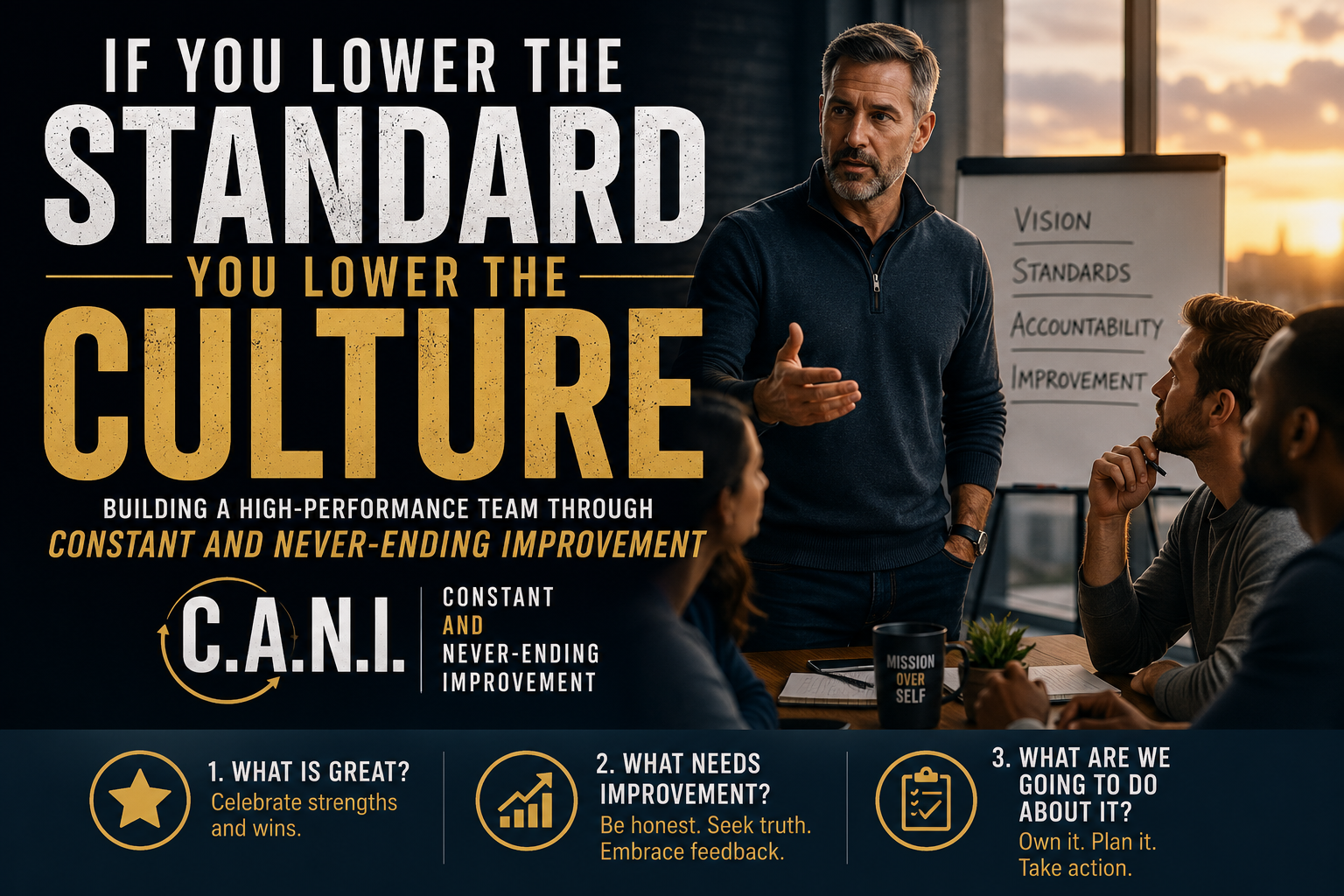
If You Lower the Standard, You Lower the Culture
Why Great Leaders Build a Culture of Constant and Never-Ending Improvement
By Dr. Keith M. Waggoner
There is a silent force that shapes every organization, every marriage, every family, every athletic team, every church, and every military unit.
It is culture.
Culture is not what hangs on the walls of your office. It is not your mission statement, your company handbook, or your annual retreat. Culture is the invisible collection of beliefs, behaviors, expectations, conversations, and standards that determine what people actually do when no one is watching.
Culture answers questions that no policy manual can.
What gets rewarded?
What gets ignored?
What gets tolerated?
What gets corrected?
And perhaps the most important question of all:
What standard are we willing to defend?
One of the greatest leadership mistakes I see is not poor strategy, weak marketing, or inadequate resources. It is leaders quietly lowering the standard in order to accommodate mediocrity.
Instead of developing people to reach the standard, they gradually reduce the standard to match the people.
At first, this feels compassionate.
Eventually, it becomes destructive.
Because every time we weaken the standard to accommodate incompetence, we weaken the culture.
Great cultures are not built by lowering expectations. They are built by raising people.
Culture Always Drifts Downhill
One principle has proven itself repeatedly throughout my career of coaching executives, entrepreneurs, NFL personnel, military leaders, physicians, pastors, and married couples.
Everything in life naturally drifts toward disorder unless intentional leadership intervenes.
A marriage does not accidentally become more intimate.
A business does not accidentally become more profitable.
A leader does not accidentally become wiser.
An athlete does not accidentally become stronger.
Excellence is never the default setting.
Entropy is.
Without intentional correction, organizations slowly normalize what they once considered unacceptable. The meeting starts five minutes late. Then ten. Deadlines become suggestions. Accountability becomes optional. Difficult conversations are postponed. Excuses become common. Before long, mediocrity becomes the culture, not because anyone intended it, but because no one protected the standard.
Culture rarely collapses overnight.
It erodes one compromise at a time.
The Heart of a CANI Culture
One of the foundational principles I teach every organization is what I call CANI.
Constant And Never-Ending Improvement.
This philosophy is not about perfectionism. It is about stewardship.
Healthy organizations are never satisfied with staying the same because they understand that growth is the natural expectation of healthy systems.
The goal is not to constantly criticize people.
The goal is to constantly improve systems, communication, leadership, execution, and ourselves.
Improvement requires honesty.
Improvement requires humility.
Improvement requires courage.
Most importantly, improvement requires action.
Every leadership meeting, every quarterly review, every coaching session, and every family discussion can be transformed by asking three simple questions.
- What is great?
Every healthy culture celebrates progress.
Recognition reinforces behavior.
People need to know that their efforts matter.
Too many leaders assume appreciation is understood. It rarely is.
Gratitude creates momentum because people naturally repeat what gets recognized.
Celebrating wins is not naïve optimism. It is strategic leadership.
- What needs improvement?
This is where courage begins.
Many organizations claim they value honesty, but punish it the moment someone speaks uncomfortable truth.
As a result, people learn to protect themselves instead of protecting the mission.
Problems become hidden.
Mistakes become political.
Innovation disappears.
A healthy culture never asks people to pretend everything is fine.
It creates an environment where reality can be discussed without fear of humiliation.
Honest feedback is not negativity.
It is responsibility.
We cannot improve what we refuse to acknowledge.
- What are we going to do about it?
This is where leadership separates itself from complaining.
Anyone can identify problems.
Children identify problems.
Customers identify problems.
Critics identify problems.
Leaders identify solutions.
Every discussion should conclude with ownership.
Who is responsible?
What is the first step?
When will it happen?
How will success be measured?
The conversation should never end with awareness.
It should end with action.
Never Criticize Without Becoming Part of the Solution
One expectation I establish with nearly every leadership team I coach is remarkably simple.
Never criticize something unless you are willing to help improve it.
This principle changes everything.
People stop gossiping.
Departments stop blaming one another.
Meetings become productive.
Ownership replaces victimhood.
I often tell leadership teams,
Never leave the site after identifying a problem without at least beginning the solution.
You may not finish it today.
You may not solve it completely.
But begin.
Schedule the meeting.
Assign the responsibility.
Create the first draft.
Take the first step.
Forward movement creates hope.
Endless discussion creates frustration.
Organizations become unhealthy when they become experts at discussing problems instead of implementing solutions.
The Leadership Mandate
Over the years I have summarized effective leadership into one simple mandate.
Always see things as they are.
Never make them worse than they are.
Always seek to make them better than they are.
Exceptional leaders live in reality.
They refuse denial.
They refuse catastrophizing.
They refuse excuses.
Reality becomes their starting point, not their destination.
Hope is not pretending problems do not exist.
Hope is believing that disciplined action can improve them.
The Question That Changes Every Room
There is one question I ask nearly every executive team, coaching client, leadership staff, and business owner.
It usually creates silence.
Then honesty.
Then transformation.
I ask,
If someone came into your position tomorrow and consistently outperformed you, what are the top five things they would probably do differently?
Almost everyone already knows the answer.
The issue has never been awareness.
The issue is courage.
This question immediately reveals the maturity of a culture.
Defensive people protect their ego.
Healthy leaders become curious.
The purpose of the question is not guilt.
It is growth.
Imagine every husband asking it.
Every CEO.
Every sales manager.
Every pastor.
Every parent.
Every coach.
Continuous improvement begins when we become more committed to excellence than to protecting our image.
Mission Mindset Versus Self Mindset
One of the clearest distinctions I observe across organizations is whether people operate from a mission mindset or a self mindset.
Mission-focused people ask,
“What serves the mission?”
“What helps the customer?”
“What strengthens the team?”
“What honors God?”
Self-focused people ask,
“How do I look?”
“Whose fault is this?”
“Will this make me uncomfortable?”
“What do I get out of this?”
Over-focus on self slowly destroys culture.
People begin protecting their reputation instead of improving their performance.
Departments compete instead of collaborating.
Feedback becomes personal instead of productive.
The mission becomes secondary to individual comfort.
Whether I am coaching NFL personnel, military leaders, executive teams, entrepreneurs, or married couples, this pattern never changes.
Healthy cultures are built by people whose greatest concern is advancing the mission—not defending themselves.
Leaders Raise People, Not Lower Standards
One of the greatest misconceptions in leadership is believing that grace requires lowering expectations.
It does not.
Great leaders extend grace to people while maintaining high standards.
They coach.
They mentor.
They train.
They encourage.
They forgive mistakes.
But they never redefine excellence simply because excellence requires effort.
People generally rise to the expectations of leaders who genuinely believe in them.
The highest expression of leadership is helping people become capable of achieving what they once believed impossible.
That is not pressure.
That is belief.
Final Thoughts
Culture is never built in one dramatic moment.
It is built in thousands of conversations.
Thousands of decisions.
Thousands of corrections.
Thousands of moments where leaders choose truth over comfort and improvement over excuses.
If you want a stronger company, strengthen the conversations.
If you want a stronger marriage, strengthen the conversations.
If you want a stronger family, strengthen the conversations.
Ask the three CANI questions.
Celebrate what is working.
Tell the truth about what is not.
Commit to the next step.
Then repeat the process tomorrow.
The organizations that thrive for decades are rarely the most talented.
They are the most committed to constant and never-ending improvement.
Because the moment we lower the standard to accommodate incompetence, we do not simply weaken performance.
We weaken the culture.
And culture will always determine the future.
Continue the Conversation
If you are a business owner, executive, physician, entrepreneur, pastor, or organizational leader who wants to build a high-performance culture without sacrificing your values, this is precisely what we do through Business Results Coaching (B.R.C.).
For more than three decades I have coached leaders across multiple industries, including Fortune-level executives, entrepreneurs, physicians, pastors, professional athletes, NFL personnel, military leaders, martial arts organizations, and executive teams. My approach combines organizational psychology, leadership development, behavioral science, strategic planning, performance coaching, and faith-based principles into practical systems that create measurable results.
Culture is never changed by inspiration alone. It changes through intentional leadership, accountability, and disciplined execution.
If you’re ready to build a healthier culture, stronger leaders, and better results, I’d be honored to help.
Visit KeithMWaggoner.com to learn more about Business Results Coaching and schedule a discovery conversation.
Suggested Reading
- Patrick Lencioni, The Advantage
- Patrick Lencioni, The Five Dysfunctions of a Team
- James Clear, Atomic Habits
- John C. Maxwell, Developing the Leader Within You 2.0
- John Kotter, Leading Change
- Jim Collins, Good to Great
- Simon Sinek, Leaders Eat Last
- W. Edwards Deming, Out of the Crisis
- Peter Drucker, The Effective Executive
- Jocko Willink and Leif Babin, Extreme Ownership
Suggested Videos & Talks
- Simon Sinek – “How Great Leaders Inspire Action” (TED Talk)
- Patrick Lencioni – Organizational Health presentations
- Jocko Willink – Extreme Ownership leadership lectures
- Admiral William McRaven – “Make Your Bed” commencement address
- Carol Dweck – Growth Mindset presentations
- James Clear – Habit formation interviews and lectures
References
Collins, J. (2001). Good to Great.
Deming, W. E. (1986). Out of the Crisis.
Drucker, P. F. (2006). The Effective Executive.
Dweck, C. S. (2006). Mindset: The New Psychology of Success.
Edmondson, A. (2019). The Fearless Organization.
Kotter, J. P. (1996). Leading Change.
Lencioni, P. (2002). The Five Dysfunctions of a Team.
Lencioni, P. (2012). The Advantage.
Sinek, S. (2014). Leaders Eat Last.
Willink, J., & Babin, L. (2015). Extreme Ownership.