
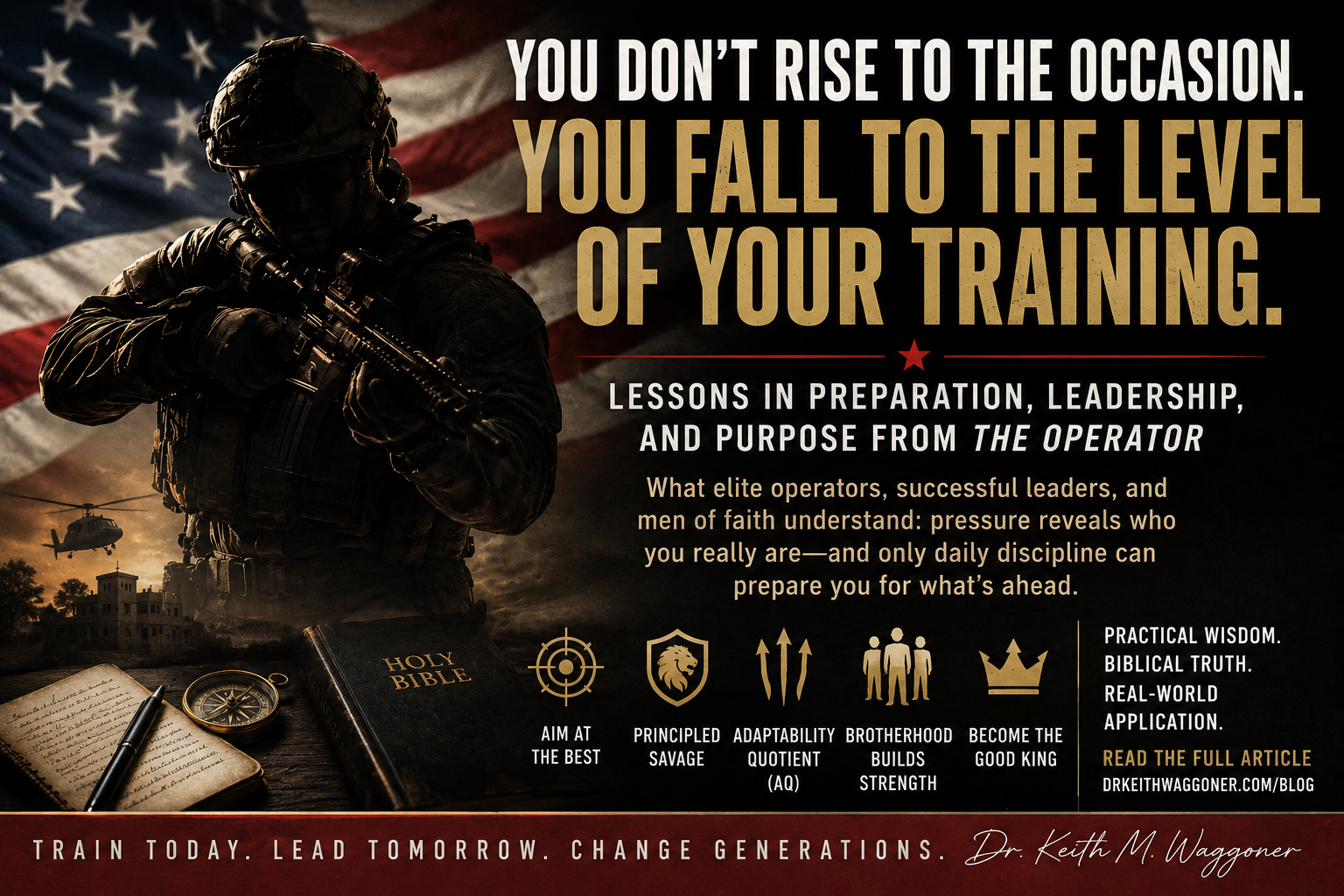
You Don’t Rise to the Occasion. You Fall to the Level of Your Training.
Why Elite Performers Prepare Differently
By Dr. Keith M. Waggoner
Imagine the deafening thump of helicopter blades cutting through the darkness over Abbottabad, Pakistan. Inside, some of the most highly trained military operators in history sat quietly, each absorbed in his own thoughts. They weren’t exchanging motivational speeches. They weren’t psyching themselves up or trying to manufacture courage. They were simply preparing to execute the mission they had rehearsed countless times.
One of those men was Robert O’Neill, whose memoir The Operator recounts his journey from an ordinary young man in Montana to a member of the elite Naval Special Warfare Development Group, commonly known as SEAL Team Six. Although the book is remembered primarily because of O’Neill’s participation in the raid that killed Osama bin Laden, that is not what impressed me most. What stayed with me was a lesson that extends far beyond military operations.
Elite performers don’t become extraordinary when the pressure arrives.
They were becoming extraordinary long before anyone was watching.
That principle applies just as powerfully to your marriage as it does to a battlefield. It applies to your business, your parenting, your ministry, your finances, and your walk with Christ. Every significant moment in your life will reveal the man your daily habits have been quietly building.
For years I’ve told my coaching clients something that initially sounds discouraging but is actually incredibly liberating:
You do not rise to the occasion. You fall to the level of your training.
Most people spend their lives hoping they’ll make the right decision when life becomes difficult. Wise men prepare so thoroughly that making the right decision becomes the most natural response available.
Pressure Never Lies
One of the reasons I enjoy studying elite performers is because they expose a universal truth. Pressure is one of life’s most honest teachers.
When life is easy, almost everyone appears patient, generous, courageous, and faithful. Character is inexpensive when nothing is at stake. But introduce conflict into a marriage, financial uncertainty into a business, betrayal into a friendship, temptation into a private moment, or tragedy into a family, and something remarkable happens.
The mask comes off.
Pressure has no interest in embarrassing you. It simply reveals what was already living inside you.
Jesus taught exactly this principle when He said, “For out of the abundance of the heart the mouth speaks” (Matthew 12:34). Whatever consistently emerges under pressure has likely been developing beneath the surface for years. Anger, bitterness, fear, selfishness, peace, humility, courage, faith, and self-control all reveal themselves eventually.
This is why I tell clients to stop viewing stress merely as an enemy. Stress is often an X-ray. It reveals fractures that can no longer remain hidden. If you have the humility to learn from what pressure exposes, it becomes one of God’s greatest tools for transformation.
Many people ask me why they keep reacting the same way despite their desire to change. The answer is almost always the same. They are trying to change behavior without changing formation.
Behavior is the fruit.
Formation is the root.
Until the roots change, the fruit eventually returns.
Confidence Is Not Positive Thinking
One of the most destructive ideas in modern self-help is that confidence comes primarily from believing in yourself. We are encouraged to visualize success, repeat affirmations, and simply “own the room.”
There is some value in positive expectation, but genuine confidence has always come from somewhere much deeper.
Confidence grows out of competence.
A Navy SEAL isn’t confident because someone convinced him he was special. He is confident because he has repeatedly solved difficult problems under increasingly demanding conditions. Thousands of hours of disciplined training have removed uncertainty. Experience has earned trust.
The same principle governs every area of life.
A surgeon gains confidence by performing surgeries.
A pilot gains confidence by flying aircraft.
A martial artist gains confidence by practicing techniques until they become instinctive.
A husband gains confidence by consistently choosing patience over pride, sacrifice over selfishness, and honesty over convenience.
One of the themes we teach at Undisputed Mastery Dominion is that a dangerous man is first a competent man. Competence produces confidence because reality confirms what training has prepared.
That is why I often say that shooting doesn’t lie.
You either hit the target or you didn’t.
The paper doesn’t care how motivated you feel.
Reality doesn’t negotiate with wishful thinking.
Eventually, life scores every shot.
Aim Before You Fire
One of the central frameworks I teach is what I call Aim at the Best.
The biblical word “sin” literally carries the idea of missing the mark. Righteousness, therefore, is not simply avoiding bad behavior. It is continually aiming your life toward God’s highest good and adjusting whenever your aim drifts.
Every day you are aiming at something.
Perhaps you’re aiming at comfort.
Maybe approval.
Financial security.
Status.
Pleasure.
Or perhaps you’re aiming at Christ Himself.
Whatever consistently occupies your aim eventually shapes your destiny.
Marksmen understand something that most people forget. Missing by a fraction of an inch at the muzzle becomes several feet at the target. Tiny errors in direction eventually become massive errors in destination.
The same is true spiritually.
Small compromises accumulate.
Small disciplines accumulate.
Tiny adjustments toward truth compound over years until they become extraordinary lives.
That is why preparation matters so much. You don’t wait until the target appears to learn how to aim.
Calm Is a Leadership Skill
One characteristic consistently shared by elite military operators, championship athletes, successful entrepreneurs, and mature spiritual leaders is emotional regulation.
Notice I didn’t say emotional suppression.
Healthy leaders feel fear.
They feel grief.
They experience uncertainty.
But they refuse to allow emotion to become the commander.
Every family eventually mirrors the emotional maturity of its leadership.
If Dad panics, everyone feels it.
If the business owner becomes reactive, the organization begins operating from fear.
If the pastor loses conviction, the congregation senses instability.
Scripture repeatedly commands believers to be sober-minded, steadfast, watchful, and self-controlled. Those are not merely spiritual virtues. They are leadership competencies.
The calmest man in the room is often the safest man in the room.
Not because he lacks emotion.
Because he has trained his emotions to serve wisdom rather than replace it.
One of the greatest gifts you can give your family is not perfection.
It is your steady presence.
The Principled Savage
One of the great paradoxes of masculinity is that the strongest men are often the gentlest.
That statement sounds contradictory until you understand the difference between harmlessness and goodness.
A harmless man is not necessarily a good man. He may simply be incapable of doing harm. He lacks the strength, courage, or competence to protect what matters. There is nothing particularly virtuous about weakness. Weakness cannot choose restraint because it has no real power to restrain.
A good man is different.
A good man possesses strength, yet governs it.
He has the ability to fight, but chooses peace whenever peace is righteous. He can confront evil, yet refuses to become evil himself. He has developed what I call the Principled Savage. The beast has not been eliminated; it has been disciplined. Its appetites have been brought under the authority of principle, truth, and ultimately Christ.
When I train men in martial arts, I am not simply teaching them how to strike, shoot, or defend themselves. I am teaching them responsibility. Every increase in competence demands an equal increase in character.
Power without principle becomes tyranny.
Principle without power becomes helpless idealism.
Biblical masculinity requires both.
Jesus Himself embodied this paradox perfectly. He could calm a storm with His voice, drive merchants from the temple with a whip, silence religious leaders with truth, and willingly submit Himself to the cross without retaliating against those who mocked Him. His strength was never in question. His restraint was voluntary.
That is the model.
Not passive.
Not aggressive.
Dangerous, disciplined, and directed toward righteousness.
Adaptability Under Pressure
One of the concepts I teach executives, entrepreneurs, athletes, and military leaders is the importance of Adaptability Quotient, or AQ.
Most people are familiar with IQ and EQ. Intelligence matters. Emotional intelligence matters.
But under pressure, adaptability often matters even more.
Life rarely unfolds according to our plans. Businesses encounter recessions. Marriages face conflict. Children make painful decisions. Health changes. Markets fluctuate. Ministries experience disappointment. Leaders are forced to make decisions with incomplete information.
The question is not whether adversity will come.
The question is whether you can adapt without abandoning your principles.
That distinction is critical.
Some people become rigid under pressure. They cling to methods that are no longer effective because changing feels like failure.
Others become so flexible that they abandon every conviction they once held. They adapt their values instead of adapting their strategies.
Neither response produces wise leadership.
High AQ means adjusting your methods while remaining anchored to timeless principles. A ship constantly changes its heading to compensate for wind and current, but it never loses sight of its destination.
The same should be true of us.
The mission remains constant.
The methods may evolve.
That is one of the defining characteristics of elite performers. They improvise without compromising.
Brotherhood Is a Force Multiplier
One lesson woven throughout The Operator is that no mission succeeds because of one extraordinary individual.
Hollywood loves the lone hero.
Reality does not.
Elite teams function because trust has replaced ego.
Each man knows his role. Each man accepts responsibility. Each man believes that the success of the mission matters more than personal recognition.
That principle echoes throughout Scripture.
When David faced Goliath, Israel still needed an army.
When Nehemiah rebuilt Jerusalem’s walls, every family carried stones.
Jesus could have accomplished His earthly ministry alone, yet He intentionally invested in twelve men and sent them out together.
The Apostle Paul spent his ministry raising leaders rather than collecting admirers.
God has always chosen to accomplish extraordinary things through committed communities.
Yet many men today remain isolated.
They have acquaintances but no brothers.
Followers but no accountability.
Networking contacts but no covenant relationships.
Isolation slowly weakens discernment. It amplifies fear. It magnifies temptation because there is no one close enough to challenge our thinking.
That is one of the reasons we created UM Dominion.
The goal has never been to host another men’s conference.
The goal is to build bands of brothers who sharpen one another long after the event is over.
Iron sharpens iron because friction is uncomfortable.
Growth rarely happens without it.
Christ Never Reacted. He Responded.
Perhaps the greatest leadership lesson of all is found in Jesus Himself.
Study His life carefully.
He was never hurried.
Never manipulated by public opinion.
Never surprised by betrayal.
Never controlled by fear.
He responded with intentionality because He lived in continual submission to the Father.
Before major decisions He prayed.
Before public ministry He spent forty days in the wilderness.
Before the cross He wrestled in Gethsemane until His will was fully surrendered.
His composure during His greatest trial was not accidental.
It was the fruit of years of perfect obedience.
If Jesus, the Son of God, consistently prepared Himself through prayer, solitude, Scripture, and submission, how much more should we?
Preparation is not a sign of weakness.
Preparation is an act of humility.
It acknowledges that tomorrow’s challenges require today’s discipline.
The Man You Are Becoming
One of the most important questions I ask coaching clients is not, “Who are you today?”
It is, “Who are your daily habits quietly creating?”
Every routine is casting a vote for the man you are becoming.
Every workout.
Every prayer.
Every meal.
Every conversation with your spouse.
Every decision to forgive.
Every compromise hidden from public view.
Every hour wasted.
Every chapter read.
Every act of generosity.
None of these moments seems particularly significant by itself.
Together, they become your life.
This is why I encourage leaders to stop chasing dramatic transformation and start mastering ordinary faithfulness.
Great men are rarely built in dramatic moments.
They are built in ordinary mornings.
Your Next Mission
Whether your next battlefield is a boardroom, a hospital waiting room, a difficult marriage conversation, raising teenagers, leading a church, or simply overcoming your own weaknesses, the principle remains the same.
Don’t wait for the crisis to prepare you.
Prepare because the crisis will eventually come.
Train your body.
Sharpen your mind.
Deepen your faith.
Strengthen your marriage.
Develop your leadership.
Build authentic brotherhood.
Practice telling the truth when it costs you something.
Learn to remain calm when emotions demand otherwise.
Aim at what is eternally true rather than temporarily comfortable.
When that day arrives—and it will—you won’t suddenly discover courage that was never there.
You will reveal the man your disciplines have been shaping all along.
That realization should not discourage you.
It should fill you with hope.
Because every disciplined choice you make today is preparing you for opportunities you cannot yet see. Every prayer, every act of obedience, every difficult conversation handled with integrity, every workout completed when no one is watching, every page of Scripture studied, every temptation resisted, and every promise kept is becoming part of the foundation upon which tomorrow’s victories will stand.
The defining moments of your life are rarely won in the defining moments themselves.
They are won long before the battle begins.
Further Reading
If this topic resonates with you, I recommend spending time with these outstanding resources:
- The Operator by Robert O’Neill
- Extreme Ownership by Jocko Willink and Leif Babin
- The Mission, the Men, and Me by Pete Blaber
- Spiritual Disciplines for the Christian Life by Donald Whitney
- Wild at Heart by John Eldredge
- The Bible Project (leadership, holiness, spiritual beings, and biblical theology)
Scriptures to Study
- Matthew 12:34
- Proverbs 24:10
- James 1:2-4
- Galatians 6:7-9
- 1 Corinthians 16:13-14
- Ephesians 6:10-18
- 2 Timothy 2:1-7
- Hebrews 12:1-3
About Dr. Keith M. Waggoner
For more than three decades, I’ve had the privilege of coaching executives, entrepreneurs, professional athletes, military personnel, first responders, and families to become stronger leaders in every area of life. Through Business Results Coaching and Undisputed Mastery Dominion, my mission is to help men develop the competence, character, conviction, and faith necessary to lead their businesses, marriages, families, and communities with courage and integrity.
If you’re ready to stop merely hoping you’ll become the man you were created to be and start intentionally training to become him, I’d be honored to walk that journey with you. The battle for your future begins long before the crisis arrives, and the best time to prepare is today.