
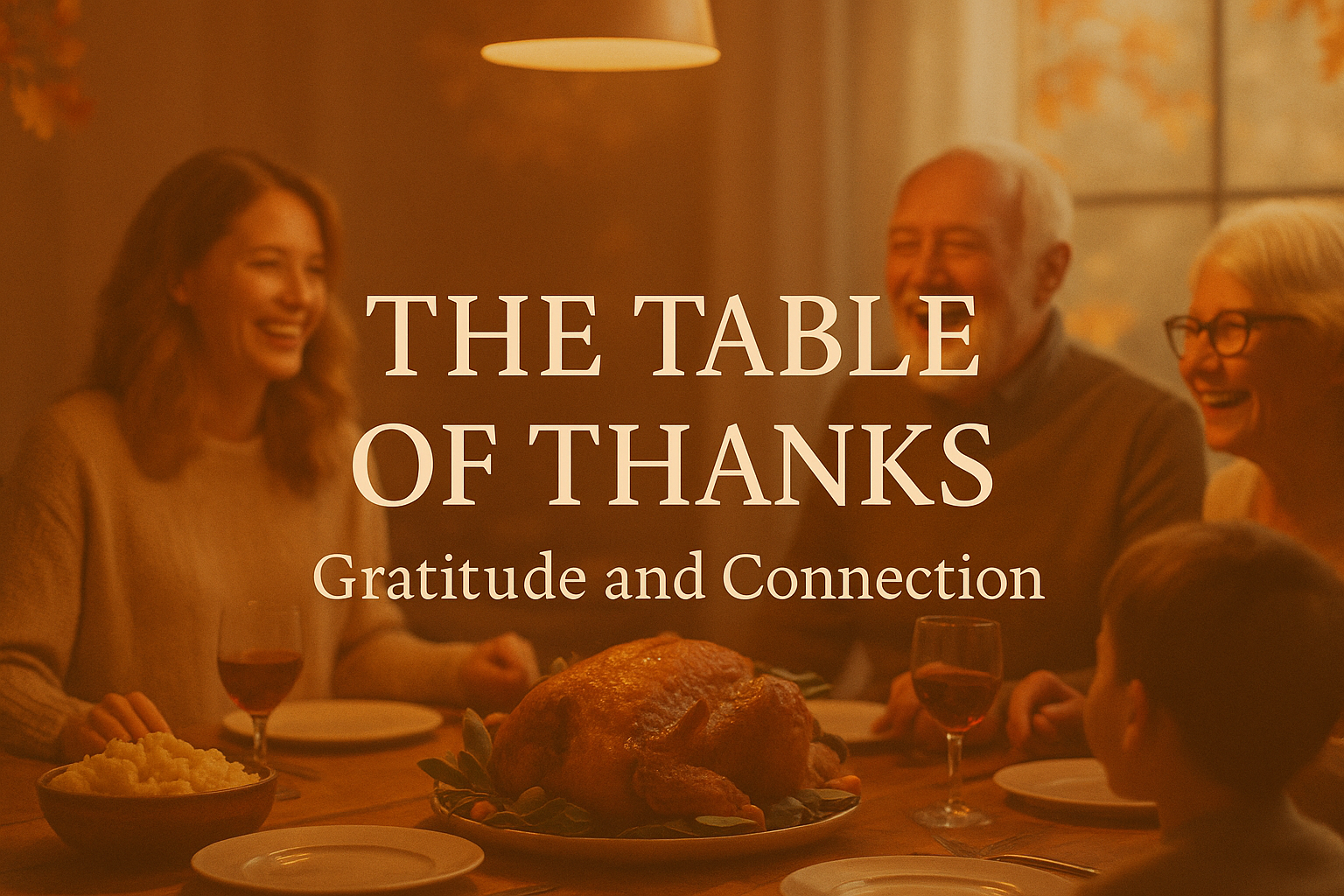
A Season to Remember What Matters
Every November, before the noise of December takes over, America pauses. Kitchens fill with the smell of roasted turkey, families travel across states, and for a moment the nation gathers around tables to share a meal that means more than food. Thanksgiving reminds us that our lives are bound together by stories, by sacrifice, and by gratitude.
For many, it is their favorite holiday because it is not about gifts or grandeur. It is about gathering. It is about being human again.
Yet beneath the surface of this holiday lies something much deeper and more necessary than we often realize. Thanksgiving is not only a national tradition; it is a spiritual practice, a psychological reset, and a social prescription for healing the soul of a disconnected age.
The History of Gratitude in America
The first recorded Thanksgiving celebration in America dates back to 1621 when the English settlers and the Wampanoag people shared a three-day feast to give thanks for survival and harvest. What began as a humble act of gratitude became a national holiday through President Abraham Lincoln’s 1863 proclamation calling the nation to “a day of Thanksgiving and Praise to our beneficent Father who dwelleth in the Heavens.”
Lincoln’s words were not written during prosperity. They were written during the Civil War. He called a divided nation to look upward and inward, to acknowledge that gratitude is not a reaction to perfection but a rebellion against despair.
That call still stands. Every November we are invited to resist the cynicism of our time and return to the table.
The Science of Gratitude
Modern science confirms what ancient faith and wisdom have always known: gratitude changes the human being.
A study from the Greater Good Science Center at the University of California, Berkeley, found that regular gratitude practice increases long-term happiness by over 25 percent (Emmons & McCullough, 2003). Harvard Medical School reported that people who keep a gratitude journal sleep better, exercise more, and have stronger immune systems (Harvard Health Publishing, 2019). UCLA Health found that gratitude lowers stress hormones and improves heart health.
Neuroscientists have now mapped what happens when a person feels thankful. The brain releases dopamine, serotonin, and oxytocin, the chemicals tied to pleasure, trust, and connection. Gratitude literally rewires the brain for optimism and resilience.
“When you express gratitude, your brain’s reward center lights up like fireworks,”
says Dr. Glenn Fox, a neuroscientist at USC.
“It primes you to notice good, to connect with others, and to create more meaning in life.”
What this means is that Thanksgiving is not just a holiday; it is a neurological reset. It shifts us from fear to faith, from scarcity to sufficiency, from self-protection to open-handed living.
The Table as Sacred Ground
Something holy happens when people sit at a table together. Anthropologists have long noted that shared meals are the oldest form of human bonding. Eating together communicates trust, belonging, and safety. Families who eat dinner together at least four times a week have higher academic scores, lower rates of addiction, and stronger emotional health in children (Fiese & Schwartz, Journal of Family Psychology, 2008).
Yet, according to a 2023 survey by the Food Marketing Institute, nearly half of American families rarely eat together anymore. Screens have replaced conversations. Fast food replaces slow presence. People eat alone, scrolling through highlight reels of lives they are not living.
The human heart was not designed to dine in isolation. The table was never meant to be a convenience. It was meant to be communion.
A Personal Moment of Gratitude
I remember one Thanksgiving after my father passed away. The air in the house felt different. The table seemed too quiet. My mother still cooked his favorite dish, but his chair stood empty. I watched my family trying to hold joy and grief in the same moment. It was not easy. But when my daughter reached for my hand and said, “I’m thankful for Papa,” the silence broke. Gratitude filled what absence had taken.
That day reminded me that gratitude is not the denial of pain. It is the redemption of it. We give thanks not because everything is perfect but because everything is still a gift.
When the Chair Is Empty
For many, Thanksgiving brings a different kind of silence. The chair that used to be filled by a father, a mother, or a grandparent now sits empty. The laughter that used to echo across the room has faded. Loss visits like a ghost.
Grief has a way of showing up at the dinner table. Sometimes it wears the face of death. Other times it looks like divorce, distance, or disconnection. There are families who used to gather but now cannot. There are people who have no invitation. There are veterans sitting alone in apartments, widows with memories louder than the room, and sons estranged from fathers they still wish would call.
If this is you, hear this truth: gratitude is not denial. It is defiance.
It is the decision to still see beauty even when something precious is gone.
It is the courage to say, “Thank you for what was,” even as you ache for what is missing.
Gratitude does not erase grief. It transforms it.
The Crisis of Disconnection
In the last decade, social scientists have warned of an epidemic of loneliness. Former U.S. Surgeon General Dr. Vivek Murthy calls it a public health crisis. Disconnection increases risk of early death as much as smoking fifteen cigarettes a day. It is correlated with heart disease, stroke, dementia, and depression (Murthy, Together: The Healing Power of Human Connection in a Sometimes Lonely World, 2020).
We have more virtual friends but fewer real ones. We have more convenience but less communion. We have learned how to scroll endlessly but forgotten how to sit still with one another.
Connection theory, developed by Dr. Edward Deci and Dr. Richard Ryan in their Self-Determination Theory, shows that the need for relatedness, real mutual connection, is one of the three essential needs for human motivation and well-being. Without it, people lose purpose, joy, and vitality.
Thanksgiving, then, is not just a feast. It is an antidote. A table set against the loneliness of a distracted world.
Stories from the Table
A few years ago I coached a man named David. He was a successful professional athlete and business owner, but his family life was in ruins. He hadn’t shared a meal with his wife and teenage son in months. Every evening they ate separately, faces lit by their phones. When I asked him to describe his home, he said, “It feels like a hotel lobby. We pass each other but never connect.”
I challenged him to host a small Thanksgiving dinner that year. Nothing fancy. No big speeches. Just a meal together with no phones and one rule: everyone had to share one thing they were grateful for that wasn’t about work or possessions.
David said: “I couldn’t believe what a difference this made… just one meal a week together… it’s amazing Dr. Keith.” Something shifted for their family. Silence turned into laughter. The home came back to life. They talked more, spent more time together than ever… one night grew to two… Now they only and always eat meals together at a kitchen table that was never used before.
That is the power of expressed gratitude.
It heals, it opens, it bonds, it binds hearts together.
Gratitude has a strange power to open what pride keeps closed.
The table, when reclaimed, becomes the ground of reconciliation.
Gratitude in Scripture
The Bible teaches that gratitude is not seasonal. It is central to a life of faith.
“Give thanks in all circumstances; for this is the will of God in Christ Jesus for you.”
(1 Thessalonians 5:18)
This command is not given as a test but as a key. Gratitude re-centers the heart. It pulls our attention from what is lost to what is lasting. In Psalm 100, David writes, “Enter his gates with thanksgiving and his courts with praise; give thanks to him and bless his name.” Gratitude, then, is the doorway to presence. It is the way we enter peace.
Practical Ways to Live Thanksgiving All Year
Gratitude does not grow accidentally. It grows through practice. Here are steps to help you reclaim it this year.
1. Begin the day with a gratitude list.
Before you check your phone, write down three things you are thankful for. Research from Emmons and McCullough found that this simple act improves optimism and overall health within weeks.
2. Speak your gratitude aloud.
Telling someone you appreciate them activates both emotional and relational circuits in your brain. It strengthens the bond and deepens your own sense of value.
3. Eat with others.
Once a week, share a meal with family, friends, or neighbors. The act of eating together increases oxytocin and dopamine, the chemicals of trust and joy.
4. Reclaim the dinner table.
Make it a screen-free zone. The University of Oxford found that shared meals correlate with greater happiness and stronger community ties (Dunbar, 2017).
5. Remember the ones who are gone.
Light a candle, share a story, or make their favorite dish. Gratitude bridges time. It keeps love alive.
6. Give thanks for what you give.
When you serve others, through a charity meal, church outreach, or helping a neighbor, you experience what psychologists call “helper’s high,” a surge of serotonin and endorphins that lift mood and expand empathy.
7. Seek connection if you are alone.
Attend a community dinner. Volunteer. Message a friend. Join a local men’s or women’s group. Do not wait for someone else to invite you. The act of reaching out is healing in itself.
The Deeper Invitation
Thanksgiving is more than a holiday. It is an annual reminder that gratitude and connection are the twin pillars of a meaningful life. Gratitude anchors you in the present. Connection reminds you that you belong.
“When it comes to life, the critical thing is whether you take things for granted or take them with gratitude.”
— G. K. Chesterton
If you find yourself struggling to build these rhythms, you are not alone. Many people do not know how to rebuild relationships after loss or how to experience genuine connection in a digital world. That is what my coaching is designed to help you do.
I have spent decades helping men, women, and families reclaim the most essential skill of all, the art of gratitude and connection. When people restore this, they find their joy again. They find each other again.
If you are ready to grow in this area, I invite you to reach out. Schedule a conversation. Let’s rebuild what matters most before another year passes by.
A Thanksgiving Worth Living
This Thanksgiving, as you sit at your table, whether it is full or quiet, remember that gratitude is not something you feel once a year. It is a way of living that shapes who you become. It transforms survival into meaning. It turns ordinary meals into sacred moments.
Put away the phone. Pour the drink. Look someone in the eyes.
Say the words that make life richer: “I’m thankful for you.”
That single sentence might change the trajectory of your home, your health, and your heart.
Because gratitude is not the end of Thanksgiving.
It is the beginning of everything else.
References
-
Emmons, R. A., & McCullough, M. E. (2003). “Counting Blessings Versus Burdens: An Experimental Investigation of Gratitude and Subjective Well-Being.” Journal of Personality and Social Psychology, 84(2), 377–389.
-
Harvard Health Publishing. (2019). Giving Thanks Can Make You Happier. Harvard Medical School.
-
Fiese, B. H., & Schwartz, M. (2008). “Reclaiming the Family Table.” Journal of Family Psychology, 22(1), 22–30.
-
Murthy, V. H. (2020). Together: The Healing Power of Human Connection in a Sometimes Lonely World. Harper Wave.
-
Dunbar, R. I. M. (2017). “Breaking Bread: The Functions of Social Eating.” Adaptive Human Behavior and Physiology, 3(3), 198–211.
-
Fox, G. R., Kaplan, J., Damasio, H., & Damasio, A. (2015). “Neural Correlates of Gratitude.” Frontiers in Psychology, 6, 1491.
-
UCLA Health. (2023). The Health Benefits of Gratitude. UCLA Newsroom.
-
Deci, E. L., & Ryan, R. M. (1985). Self-Determination Theory. University of Rochester Press.
-
The Holy Bible, English Standard Version (1 Thessalonians 5:18, Psalm 100).
By Dr. Keith M. Waggoner
Strategic Edge Coaching & Undisputed Mastery
Helping men and families live life alive through gratitude, purpose, and connection.